TL;DR
- A conversational marketing platform talks with website visitors in real time, works out who is ready to buy, and books those people a meeting with sales before they leave the page.
- Drift built the category and is now being retired. The platforms that took over sell AI agents, often called AI SDRs, but the job is unchanged: answer, qualify, book.
- Pick by your stack and your budget: Qualified on Salesforce, HubSpot's chat on HubSpot, Warmly to see which company is visiting, Breakout or Docket for an inbound AI SDR, Darwin when the job is booking meetings from website chat, Intercom when support shares the messenger.
- Prices run from free tools and pay-per-booking plans to annual contracts and quotes. Six of the seven platforms still on sale publish at least a starting price; Qualified is the exception.
How we researched this
- 7 products reviewed. Each one says how and when, under its heading.
- 114 sources. Each with the date it was read. See the list.
- Facts last checked .
Written by Ari Goldstein, Founder & CEO, Darwin. We make Darwin, one of the products reviewed here; our editorial policy says how we handle that.
A conversational marketing platform is software that chats with the people on your website as they browse, works out which of them are ready to buy, and books those buyers a meeting with your sales team before they leave. Instead of a form and a follow-up email a day later, the visitor gets an answer and a time on the calendar in the same conversation.
Which platform fits depends mostly on your CRM and on how much setup you can take on. Enterprise teams on Salesforce usually start with Qualified. If HubSpot is your CRM, try its own chat and customer agent before buying anything. Warmly suits teams that want to know which company is on the site, and Breakout and Docket sell an inbound AI SDR with a published starting price. Intercom fits when the same messenger also handles support. If the job is booking sales meetings from your website chat, Darwin is the best fit, because it answers from your own site, offers times inside the conversation, tests its own opening lines on live traffic and charges per booked meeting instead of per seat. Drift, the company that built the category, is being retired, so it only matters if you are moving off it.
A disclosure before the details: we make Darwin, so we are not neutral. It sits fifth in the list because it does one part of the job, answering and booking meetings, and leaves out what the four platforms above it are bought for, such as identifying the visiting company or deep Salesforce routing. For that one job, done without a demo or a contract, we think it is the best option, and the section on where it fits explains why and when to pick something else. Every price and capability on this page comes from the vendor's own pages, with the date we last checked it.
What is a conversational marketing platform?
The idea is older than the AI agents now attached to it. Qualified's own explainer puts it simply: if you can tell when a qualified buyer has arrived on your site, greet them with a conversation instead of a form that ends in “we'll get back to you”. Drift turned that idea into a software category in the late 2010s. Drift's co-founder and CEO David Cancel and its VP of Marketing Dave Gerhardt wrote Conversational Marketing, published by Wiley in 2019; Wiley's author note says Gerhardt helped create the category.SourcesQualifiedWiley
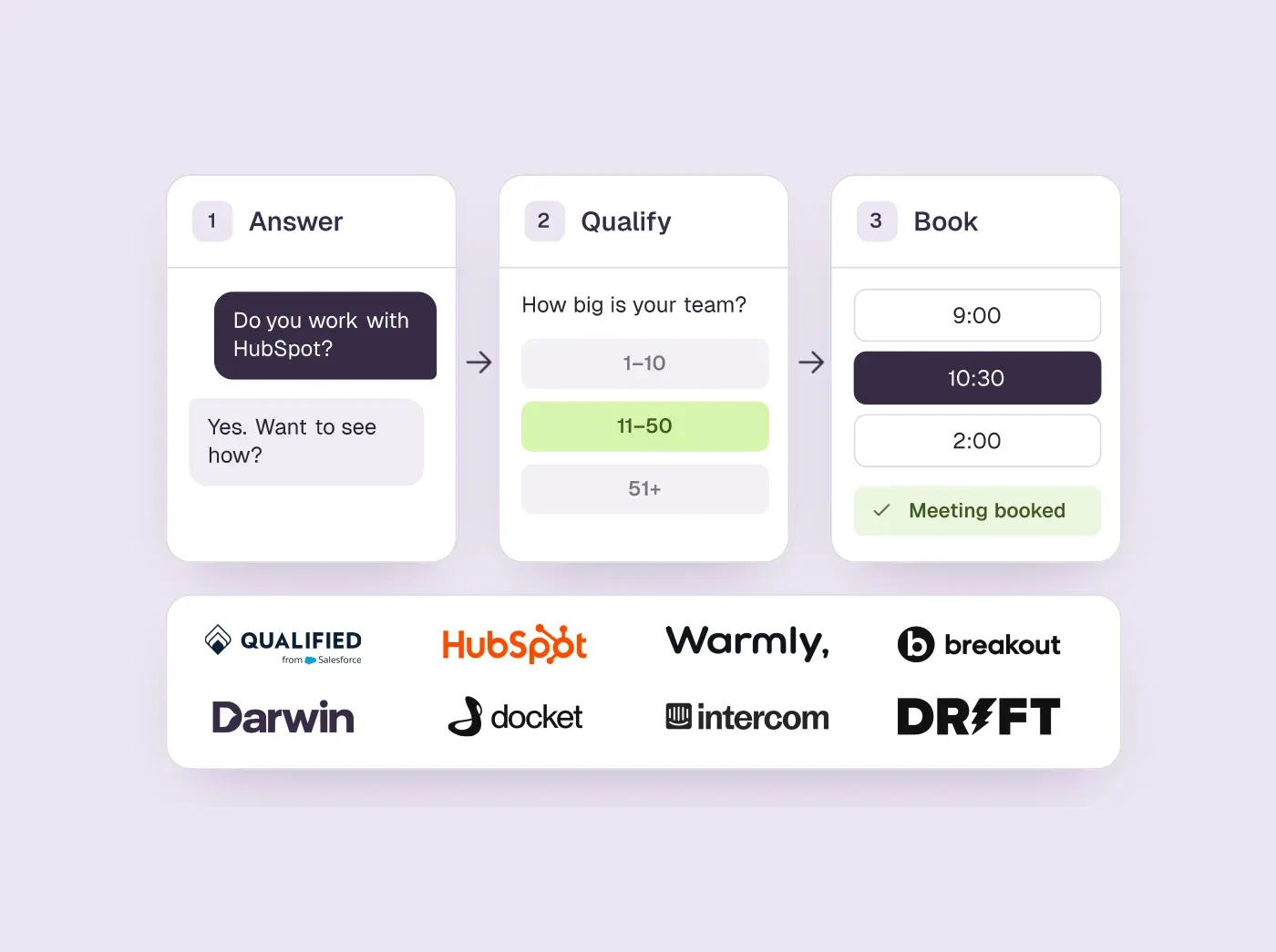
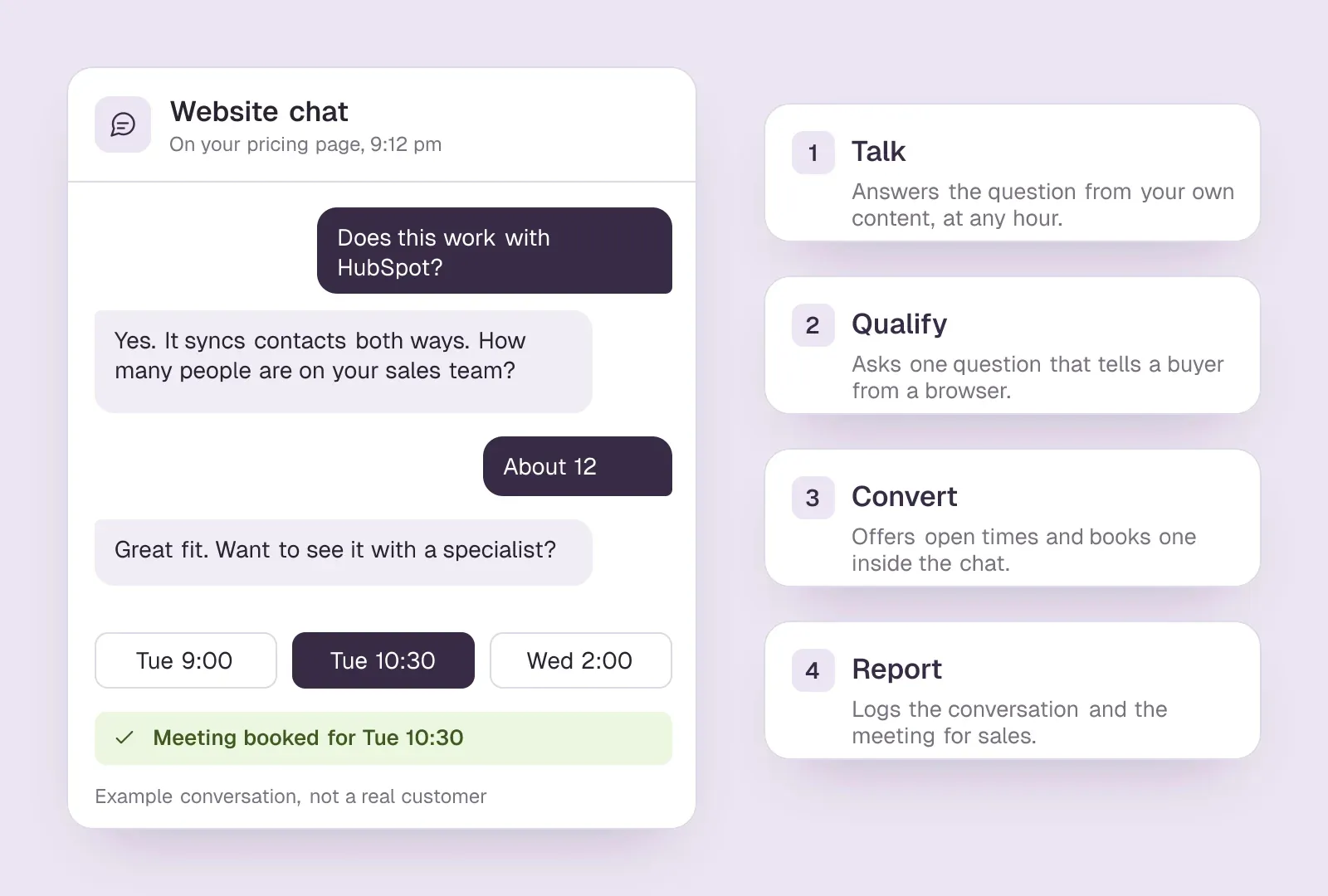
Whatever the vendor calls it, a conversational marketing platform does four jobs:
- Talk. It answers a visitor's questions in the chat window, from your content, at any hour.
- Qualify. It works out whether this visitor is a buyer worth a salesperson's time, from what they say, the page they are on, and sometimes the company they work for.
- Convert. It puts the qualified visitor on the right rep's calendar inside the chat, or hands them to a person who is online.
- Report. It records which conversations became meetings and pipeline, usually in your CRM.
That last pair is what separates it from neighbouring tools. A support chatbot is judged on tickets it resolves, and plain live chat needs a person on the other end. Our chatbot vs live chat guide covers that difference. You will also see “conversational marketing” used for messaging campaigns by SMS, WhatsApp or in-app messages to consumers. That is a different job with different tools, and this guide sticks to B2B website conversations that end in a sales meeting.
What is conversational marketing? A definition and an example
Conversational marketing is the practice of replacing a form and a slow follow-up with a real-time conversation that answers a buyer's question and, once they are ready, books them a meeting with sales. That is the conversational marketing definition this guide works from. The word that matters is real-time: the answer arrives while the buyer is still on the page and still interested.
The difference is easiest to see when you follow one buyer through both kinds of website, step by step.
The same buyer, with a form and with a conversation
| Moment | Form-first website | Conversational website |
|---|---|---|
| A buyer has a question on your pricing page at 9 pm | Finds a contact form, types the question and waits for a reply | Asks the chat and gets an answer from your own content straight away |
| Working out whether they are a fit | A rep reads the form the next working day and emails back with questions | The chat asks one or two qualifying questions in the same conversation |
| Booking the meeting | A few emails back and forth to agree a time | The chat offers open times and books one before the buyer leaves |
| What sales sees | A form entry with a name and an email address | The whole conversation, the buyer's answers and a meeting on the calendar |
A conversational marketing bot is the part that holds that conversation. In the Drift years it followed a script someone wrote, branch by branch. Today most are AI agents that compose answers from your website and documents, which is why the content you give the agent matters as much as the platform you choose. The example below shows the four jobs in one short chat.
How the category changed: from Drift's playbooks to AI SDR agents
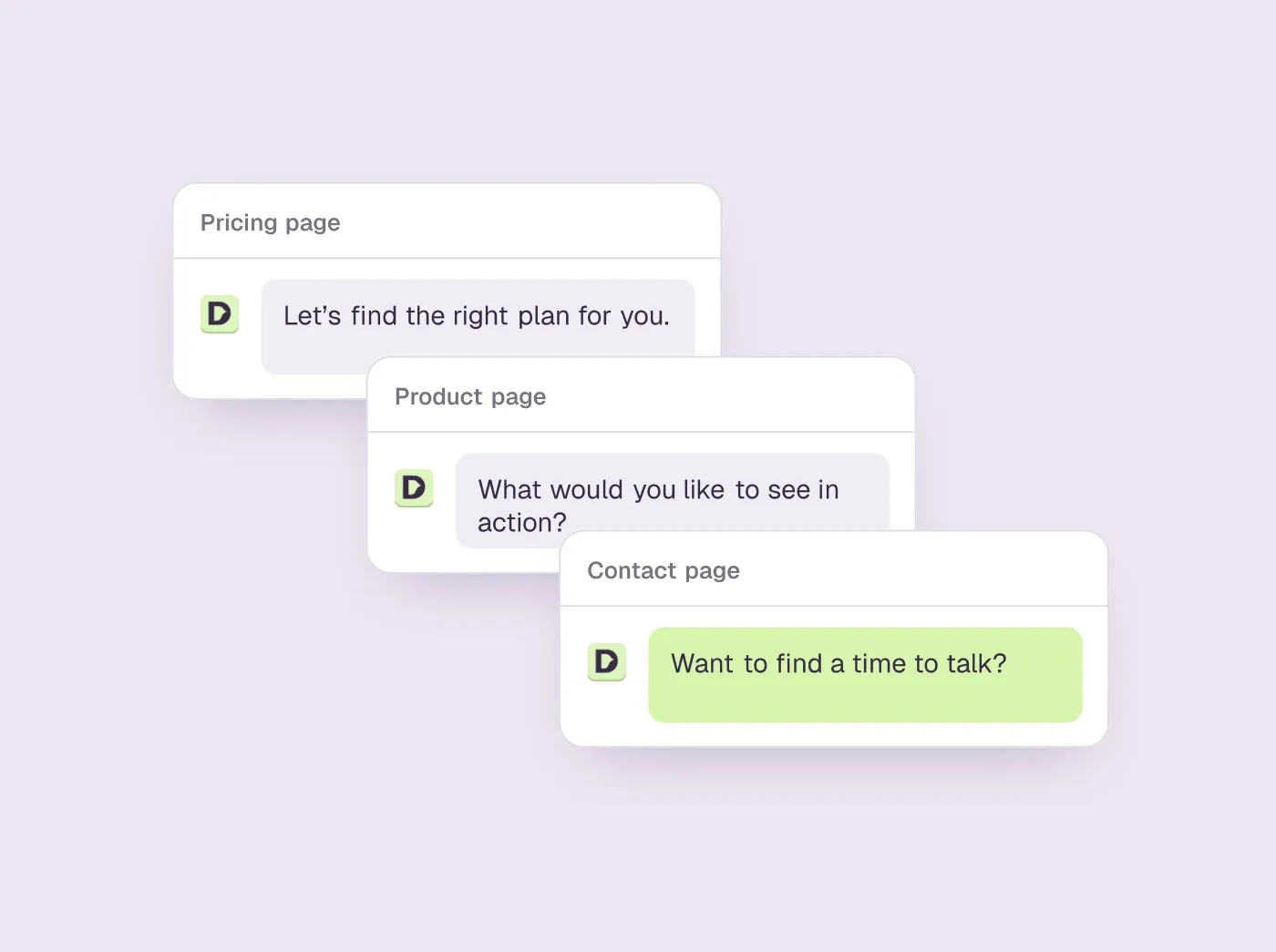
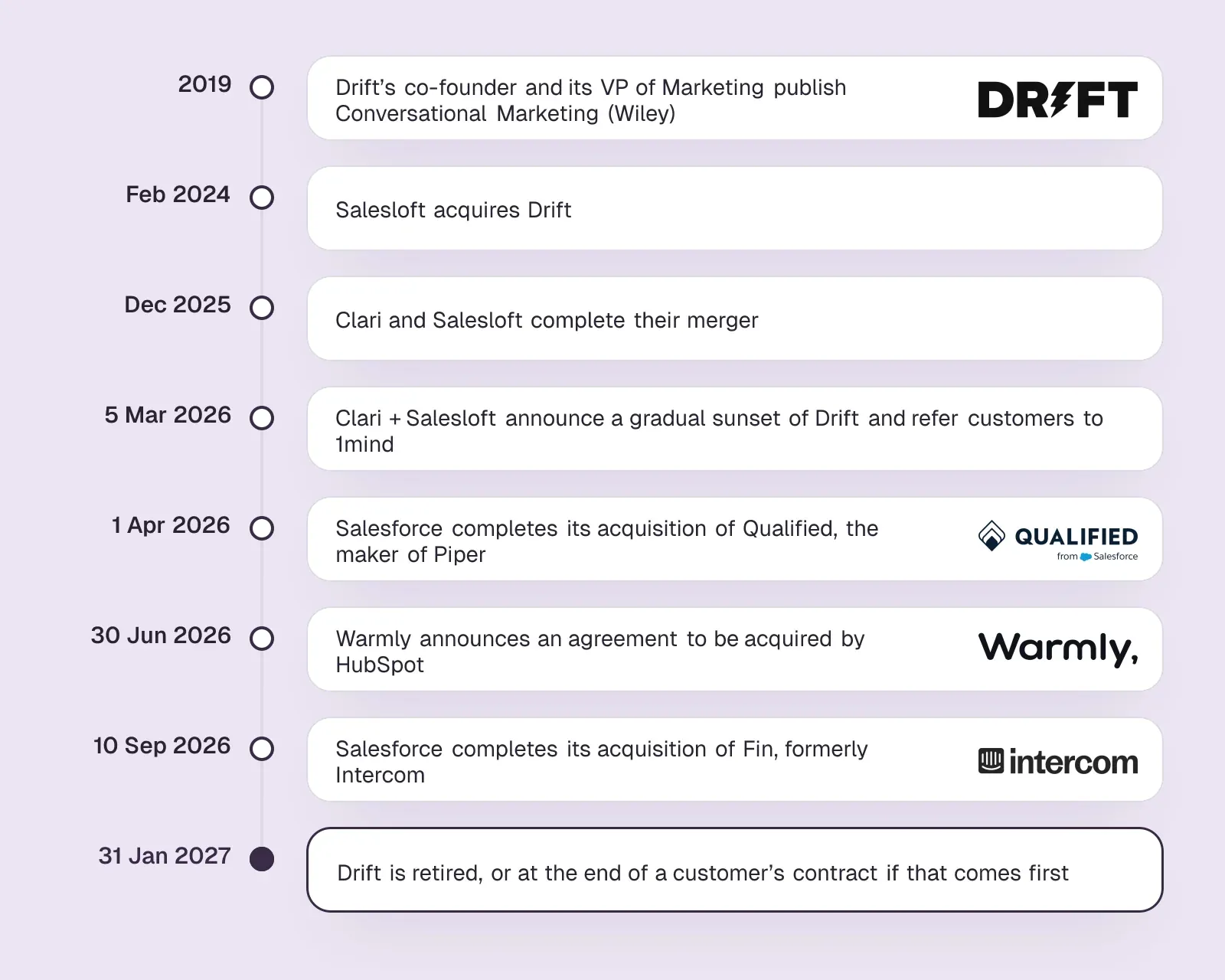
For most of its life, conversational marketing meant Drift. Teams wrote playbooks, the scripted bots that greeted visitors on chosen pages, asked qualifying questions and routed the good ones to a rep, and Drift's Book a Meeting skill put that rep's calendar into the chat. Salesloft bought Drift in early 2024. Two years later the new owner changed course. On 5 March 2026, Clari + Salesloft announced a gradual sunset of Drift and said it would refer existing Drift customers to 1mind as the successor. Salesloft's Drift Sunset FAQ, last updated on 22 September 2026, says Drift will be retired on 31 January 2027, or at the end of a customer's contract if that comes first. So anyone researching the Drift conversational marketing platform today is looking at a product with an end date, and drift.com itself now forwards to Salesloft's page about the move to 1mind.SourcesSalesloft +3PYMNTS1mind
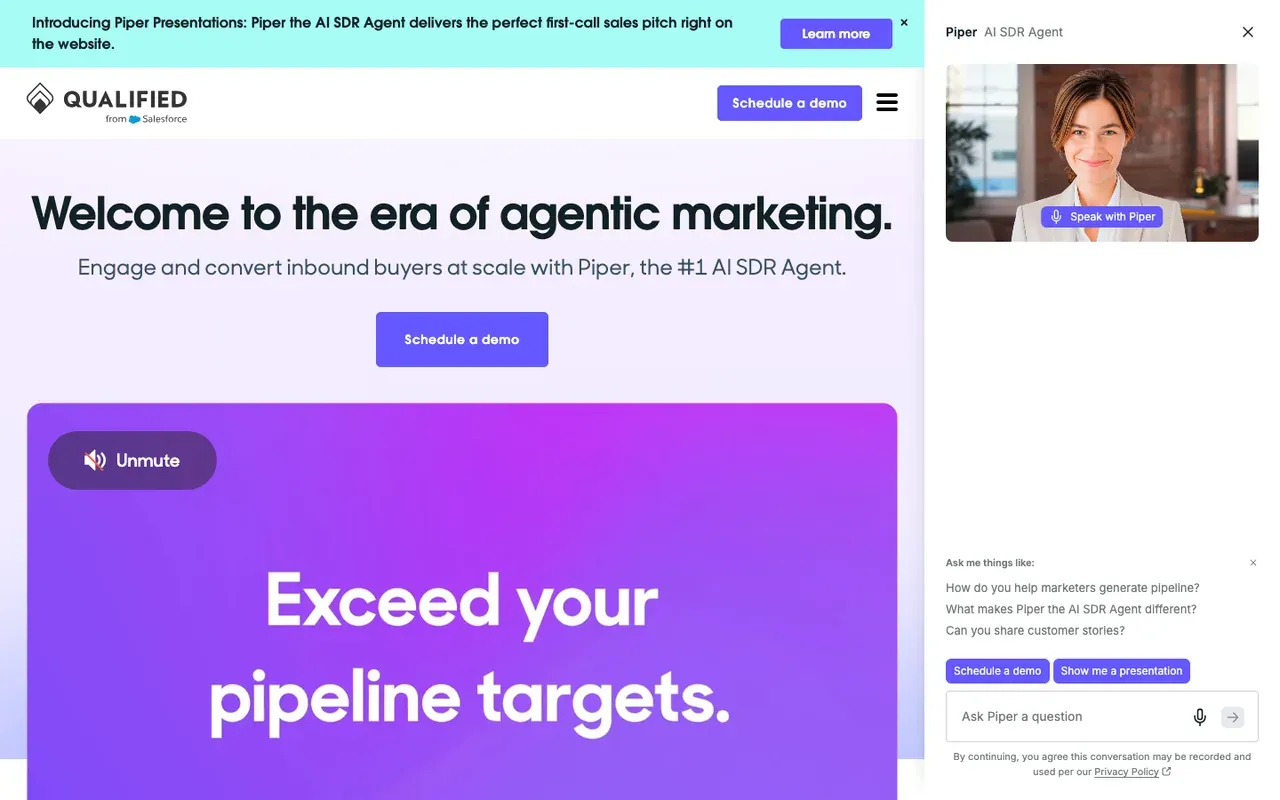
You can watch the category's old name being retired on the vendors' own sites. Salesloft's conversational marketing page now sends visitors to a Chat Agents page that says the company has moved from Drift to 1mind. Qualified still keeps its conversational marketing explainer online, but its homepage now welcomes visitors to “the era of agentic marketing” and sells Piper as an AI SDR agent. Breakout calls itself an inbound AI SDR, Docket an inbound demand platform, and Warmly leads with identifying the companies on your site.SourcesSalesloft +1Qualified +1BreakoutDocketWarmly
Three things actually changed under the new names:
- Answers come from a model, not a script. A playbook said exactly what someone wrote. An AI agent composes its own reply from the content you give it, and some platforms read your website to get that content.
- Fewer, bigger owners. Salesforce completed its acquisition of Qualified, the maker of Piper, on 1 April 2026. Salesforce has since bought Fin, the company behind Intercom, and Warmly has agreed to be acquired by HubSpot.SourcesSalesforce +2Warmly
- More ways to pay. Drift was sold by quote. The platforms now on sale charge per seat, per outcome, per annual contract, per tier or per booked meeting, and most of them print a starting price.
What did not change is the goal. A conversational marketing platform is still worth paying for only if it turns website visitors into sales conversations, so judge every one of them on meetings booked, not on chats started.
What to look for in a conversational marketing platform
Most conversational marketing software looks alike in a demo, so decide which of these matter to you before you book one. Nearly every difference between the platforms below comes down to them.
- Where its answers come from. Some platforms read your website, others answer only from documents, FAQs and sample conversations your team uploads. Ask who keeps that content up to date.
- Whether it books inside the chat. The best ones show a calendar in the conversation. Others send a meetings link or collect details for a rep to follow up.
- Whether it knows the visitor. Account identification tells you which company is browsing before anyone types. It is valuable for account-based selling and usually the most expensive part.
- How it fits your CRM. Some are built on Salesforce, one is joining HubSpot, and others connect to either.
- How it gets better after launch. Ask what changes without your team doing the work: some describe learning from your feedback, some let you A/B test messages you write, and one tests its own opening lines.
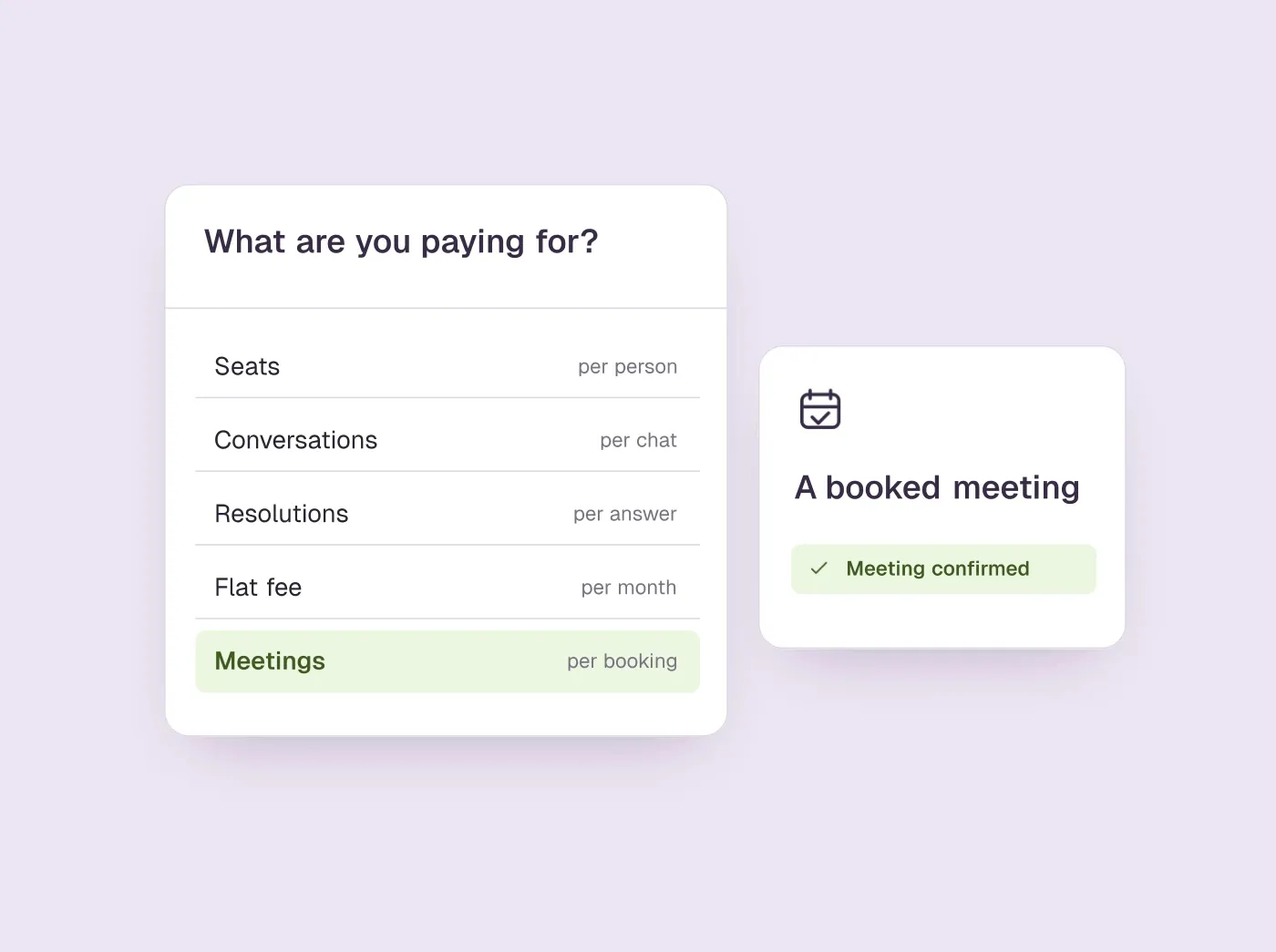
- How the bill grows. Seats, outcomes, conversations, visitor volume or booked meetings. The model matters more than the starting price a year in; our chatbot pricing guide explains each one.
Conversational marketing platforms at a glance
Platforms run in the order of the sections below, from the enterprise standard to Drift, which is being retired. Hover over a cell to see the full finding and the date we checked it.
| Tool | Starting price | Free plan or trial | Native booking | Learns from your site | How it charges | Improves on its own |
|---|---|---|---|---|---|---|
 Qualified Qualified | Quote only; its chat gives no range | Not documented | Yes | Uploaded content | Quote-based | Feedback-based |
 HubSpot HubSpot | $0/mo | Free tools | Meetings link | URL import | Seats + credits | Not documented |
 Warmly Warmly | $10,000/yr | Not documented | Yes | Docs & FAQs | Annual contracts | Auto-learn |
 Breakout Breakout | $500/mo | 30 day trial (Signals) | Yes | Knowledge base | Tiered monthly | Not documented |
 Darwin Darwin | $0/mo | 5 free bookings | In chat: Calendly, Google, RevenueHero | Yes | Plan fee + bookings | Yes |
 Docket Docket | $3,000/mo | No | Yes | Knowledge Lake | Annual, by visitor volume | Active learning |
 Intercom Intercom | $39/seat/mo | 14 day trial | Via integration | Content import | Seats + Fin outcomes | Not documented |
 Drift Drift | Not documented | Not documented | Yes | Content Library | Quote-based | Manual A/B tests |
Values come from shared product facts, checked Oct 2, 2026 to Oct 5, 2026. Sources
How we picked and checked these platforms
A platform made this list if it does the conversational marketing job for B2B websites today, answering, qualifying and booking, or if buyers will meet it in an evaluation anyway, as with HubSpot and Intercom. Drift is included because many readers are replacing it. Outbound-only AI SDRs that write cold email are in our AI SDR tools guide instead.
- Pages read. Each vendor's pricing, product and help pages, in September 2026 and again on 5 October 2026. Every price and capability is a dated fact; hover over a table cell for its source.
- Chats asked. On 1 and 2 October 2026 we typed the same buyer questions, starting with what it costs and whether it can book a meeting, into the chat on Qualified's, Warmly's, HubSpot's, Intercom's and our own website, without giving contact details. The next section shows what happened.
- Not done. We did not run a paid trial of every platform, and vendors' own results claims are left out. Not documented in a cell says only that we could not confirm the feature on the vendor's public pages.
- Our interest. We make the fifth platform on the list. Its facts are checked on the same schedule as everyone else's, and its section says what it does not do.
The Best for and Not for lines, pros and cons come from one review per product that we keep up to date in every guide. What each section says around them was written for this page.
What each platform's own website chat did when we asked
| Platform | Asked what it costs | Asked whether it books meetings |
|---|---|---|
| Qualified (Piper) | Said pricing is customized and would not give a starting price or a range; asked for an email. | Yes, but said Qualified requires Salesforce CRM. |
| Warmly | Listed its tiers with their annual prices. | Yes, including HubSpot meeting links; asked for a work email before a call. |
| HubSpot (HubBot) | Asked for a work email instead of answering. | Yes, through a Book a meeting bot action and a meetings link; offered a button to book. |
| Intercom (Fin) | First try: asked for a business email. Second try: gave seat prices and Fin for Sales fees. | Yes, using HubSpot scheduling pages. |
| Darwin | Gave the paid plans and their booking allowances, but left out the Origin plan, which has no monthly fee. | Yes; it opened a booking form asking for a work email. |
Every platform said yes to booking, so that question does not separate them. The price question does. Qualified's and HubSpot's chats asked for an email instead of naming a price, and Intercom's did the same on our first try; Warmly's gave real numbers straight away. On a second try Intercom's Fin did list its prices, which is worth knowing if you plan to let an AI agent talk about price on your own site. Our own chat left out our cheapest plan, a reminder to check what your agent says about price before visitors do. Try the same test on any platform you shortlist: ask its chat the questions your buyers ask and see whether you leave with an answer.
Qualified: the enterprise standard on Salesforce
Enterprise revenue teams that run on Salesforce and want an AI SDR with a services team behind it.
Small teams without Salesforce, or anyone who wants a price before a sales call.
- Native booking
- Yes
- Learns from your site
- Uploaded content
- How it charges
- Quote-based
Qualified is where most large B2B teams start, and it has the deepest version of the job. Piper, its AI SDR agent, greets visitors, qualifies them against your rules and books the meeting on the rep who owns the account, using Salesforce to decide who that is. It also works by email, voice and video, and it can recognize target accounts from your intent and CRM data before they type.SourcesQualified +2
The price is the catch. Qualified prints three plans with no prices on them. Qualified's own website chat would not share a starting price or a typical range. Qualified has also been part of Salesforce since April 2026, which suits Salesforce companies and matters less to everyone else. Our Qualified alternatives guide goes through the options if that fit is wrong for you.SourcesQualifiedSalesforce
SourcesQualified
Qualified pros
- Deep Salesforce integration and account-level personalization
- Piper books meetings and follows up by email, on video, voice and text
- Mature enterprise support and implementation
- Part of Salesforce since April 2026, so it sits natively in that stack
Qualified cons
- No published pricing and no trial
- Built for Salesforce shops; smaller teams pay for depth they will not use
- Implementation is a project, not an afternoon
What Qualified users say
Users like
The other big upside is the AI SDR working around the clock.
Qualified's Piper AI SDR qualifies and books visitors around the clock, so SDRs no longer need to staff the chat.
engage high-intent website visitors in real time and connect them with the right sales reps
Qualified engages website visitors in real time, routes them to the right rep and books meetings on the spot.
Users complain about
The AI sometimes has issues … and it sends people down the wrong path.
Qualified's AI agent needs ongoing training and content upkeep; some say it sends visitors down the wrong path.
Its a premium product that is premium priced.
Qualified is premium-priced; several reviewers call it expensive, though most of them add that it pays off.
Reviewers' words, our summaries · reviews read Oct 6, 2026
Qualified is the safe pick for an enterprise team that runs on Salesforce and sells to named accounts. Budget for an annual contract and a proper implementation.
How we reviewed Qualified: Read its pricing, product and help pages on 11 September 2026 and again on 5 October 2026; asked Piper, the chat on Qualified's own website, for a price on 2 October 2026. No trial.
Reviewed Oct 5, 2026
HubSpot: conversational marketing inside the CRM
Companies already on HubSpot CRM who want chat without another vendor.
Companies on another CRM, or teams that want chat to improve without hand-editing flows.
- Native booking
- Meetings link
- Learns from your site
- URL import
- How it charges
- Seats + credits
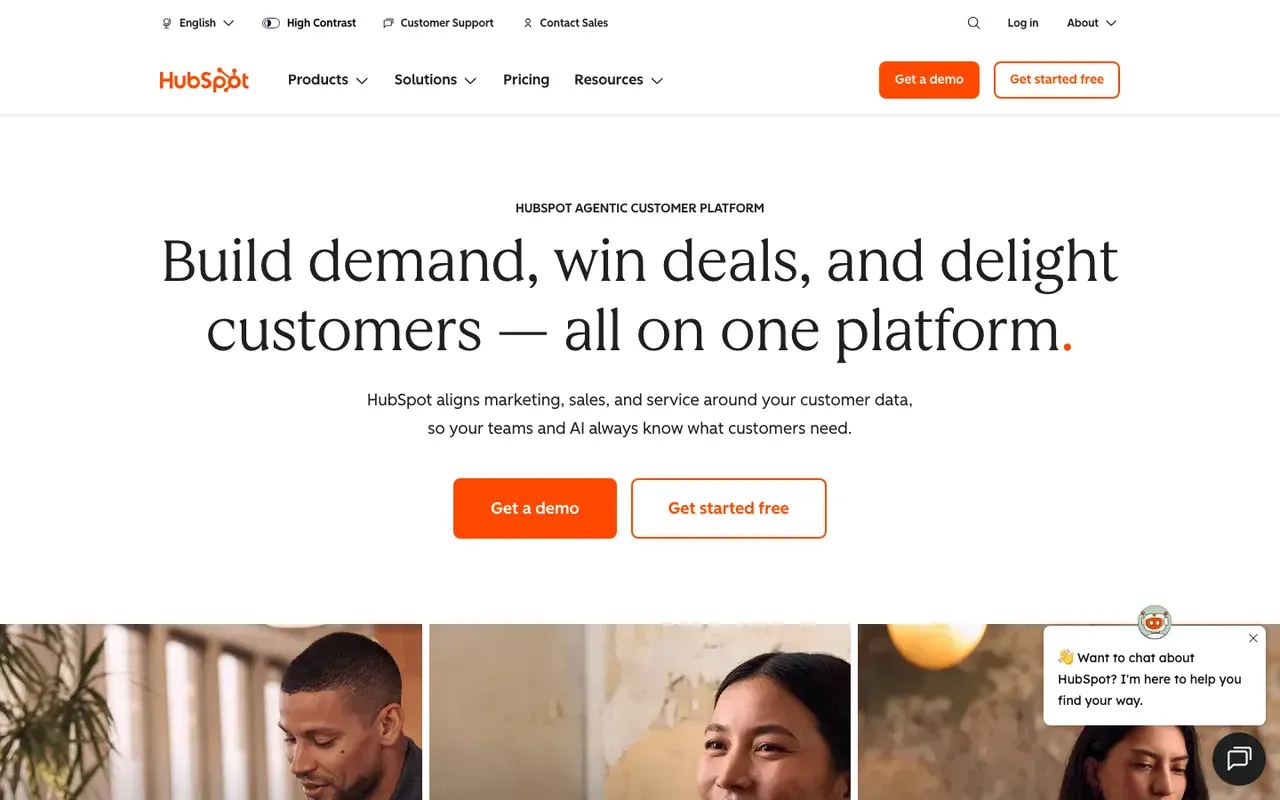
If your CRM is HubSpot, you may own a conversational marketing platform already. HubSpot's free tools include live chat and a limited chatbot with HubSpot branding. Chatflows greet visitors on the pages you choose, and the Breeze customer agent answers in its own words from your website pages and HubSpot content.SourcesHubSpot +1
Booking is the weaker part. Chatbots share a HubSpot meetings link; the customer agent can route qualified leads to a meeting link. The AI agent also costs more than the free tools suggest: it needs a Professional or Enterprise hub, Sales Hub Professional lists $100/seat/mo plus a one-time onboarding fee of $1,500, and the agent spends HubSpot Credits on every conversation it resolves.SourcesHubSpot +3
HubSpot pros
- Free live chat and bots, native to the CRM
- Meetings links and routing already in the platform
- The customer agent learns from public website URLs
HubSpot cons
- The AI agent costs credits on top of seats and needs Professional or higher
- Bots are flow builders; you write the openings by hand
- Sales chat is a feature here, not the product
What HubSpot users say
Users like
Its easy to use and onboard new colleagues
Most reviewers find HubSpot Service Hub easy to learn and use day to day.
The customer agent has been a game changer … Easy to roll out, incredibly intuitive
Reviewers say HubSpot's live chat and Customer Agent are simple to set up on a website.
Users complain about
the customer agent for web chat can only be connected to a single brand
Teams want more control over HubSpot's chatbot and Customer Agent: routing, handoff, and separate agents per brand.
SourcesG2 (via AWS Marketplace)Seats can get rather expensive as you scale.
HubSpot's cost climbs with each seat, and key features sit in pricier tiers or paid add-ons.
Reviewers' words, our summaries · reviews read Oct 6, 2026
HubSpot is the first thing a HubSpot customer should switch on, because the data is already there. Expect a meetings link rather than a calendar inside the chat, and a bigger bill once you want the AI agent.
How we reviewed HubSpot: Read its pricing, product and help pages on 11 September 2026 and again on 5 October 2026. Did not set up a HubSpot account for this review.
Reviewed Oct 5, 2026
Warmly: start from who is on the site
B2B teams that want to know which companies are on the site, then chat with them.
Teams whose main problem is the conversation itself, or budgets under five figures a year.
- Native booking
- Yes
- Learns from your site
- Docs & FAQs
- How it charges
- Annual contracts
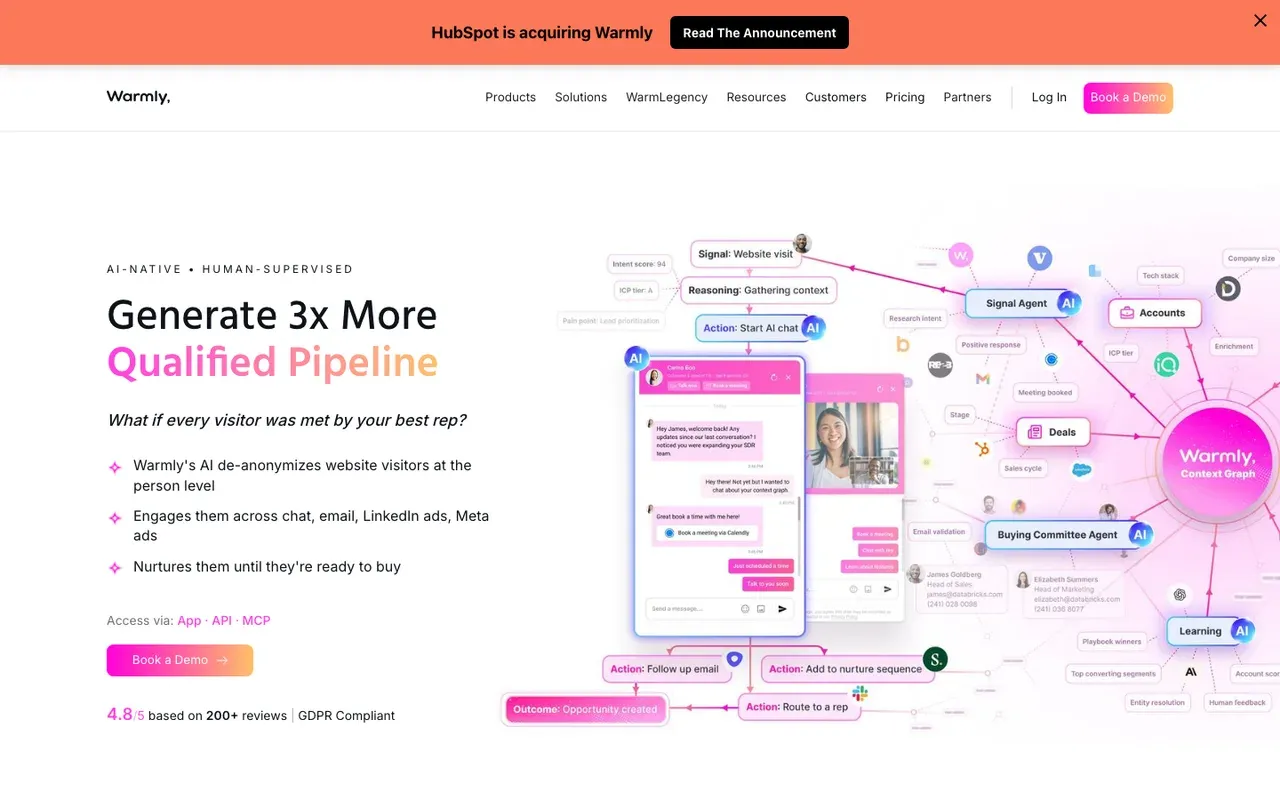
Warmly approaches the job from the visitor's company. It identifies the businesses on your site, then runs an AI chat that uses CRM records, earlier visits and intent signals to decide what to say. Warmly books meetings directly in the chat, through Google Calendar, Outlook or Chili Piper links.SourcesWarmly +1
The price is public, which is unusual at this end of the market. Identification starts at $10,000/yr, and the Inbound Chat plan with the AI agent is $20,000/yr, on annual or quarterly contracts. The agent answers from the documentation, FAQs and sample conversations you give it rather than reading your site on its own.SourcesWarmly +1
Warmly agreed in June 2026 to be acquired by HubSpot, and says contracts, pricing and the product stay as they are for now. If you run Salesforce, ask how the integration will be supported over the next few years.SourcesWarmly
Warmly pros
- Company-level visitor identification built in
- Books directly onto Google, Outlook or Chili Piper calendars
- The Autopilot tier adds automated outreach to identified accounts
Warmly cons
- Contracts start at five figures a year, with no free plan
- Whether it learns from your website on its own is not specified
- Agreed in June 2026 to be acquired by HubSpot, so ask about the roadmap if you run another CRM
What Warmly users say
Users like
Warmly's engagement tools, like AI-powered inbound chat, significantly improve visitor engagement.
Teams like Warmly's AI chat for engaging visitors in real time and turning site visits into demo requests.
SourcesG2The initial setup was very simple, and the CSMs were very helpful
Reviewers say Warmly is quick to set up, usually with an onboarding or success manager doing much of the work.
SourcesG2
Users complain about
100 users visited my websites then i will get data of only about 30-40 people
Warmly identifies only part of the traffic, and reviewers report wrong people, wrong accounts or unusable contacts.
SourcesG2there is no autosave, so you can possibly lose all your work
Some find Warmly's workflows and chatbot builder confusing or buggy, e.g. no autosave or settings that don't save.
SourcesG2
Reviewers' words, our summaries · reviews read Oct 6, 2026
Warmly is the strongest choice when knowing the account matters as much as the conversation. It is a contract purchase, so a small team should look further down the list.
How we reviewed Warmly: Read its pricing, product and help pages on 11 September 2026 and again on 5 October 2026. No trial.
Reviewed Oct 6, 2026
Breakout: an inbound AI SDR with posted prices
B2B revenue teams that want an inbound AI SDR covering forms and chat together.
Teams that want to start free, or that only need chat and not forms.
- Native booking
- Yes
- Learns from your site
- Knowledge base
- How it charges
- Tiered monthly
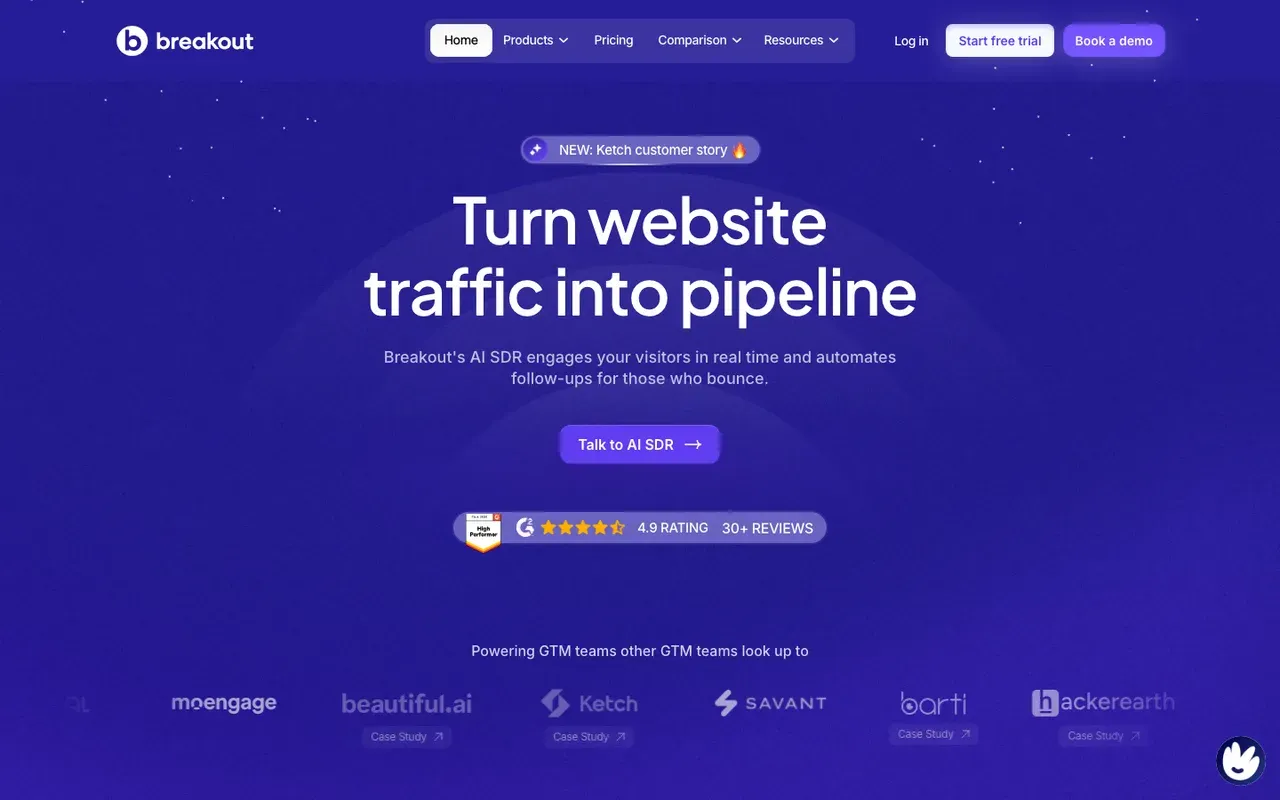
Breakout sells the Qualified idea, an inbound AI SDR, with its prices on the website. The agent identifies visitors, adjusts its nudges to their industry, size and region. Breakout books meetings in the chat and from its Smart Forms, with pre-filled one-click calendar booking.SourcesBreakout +1
Its tiers are monthly. Signals, the identification tier, starts at $500/mo, and you can try Signals free without a card first. The AI SDR itself is in Growth, from $2,000/mo. You point the agent at your knowledge base and give it instructions.SourcesBreakout +1
SourcesBreakout +1
Breakout pros
- One-click calendar booking from chat and smart forms
- A free 30-day trial without a card on the Signals plan
- Published monthly pricing
Breakout cons
- Growth, the tier with the AI SDR, starts at four figures a month
- Whether it learns from your website on its own is not specified
- Usage charges beyond the plan fee are not published
Breakout suits a mid-sized B2B team that wants an inbound AI SDR on chat and forms and would rather see the price before the first call.
How we reviewed Breakout: Read its pricing, product and help pages on 11 September 2026 and again on 5 October 2026. No trial.
Reviewed Oct 5, 2026
Darwin: the best fit for booking meetings from website chat
Teams that want website chat to book sales meetings, set up themselves and priced per meeting.
Teams that need a support inbox, outbound email, or company-level visitor identification.
- Improves on its own
- Yes
- Native booking
- In chat: Calendly, Google, RevenueHero
- Learns from your site
- Yes
- How it charges
- Plan fee + bookings
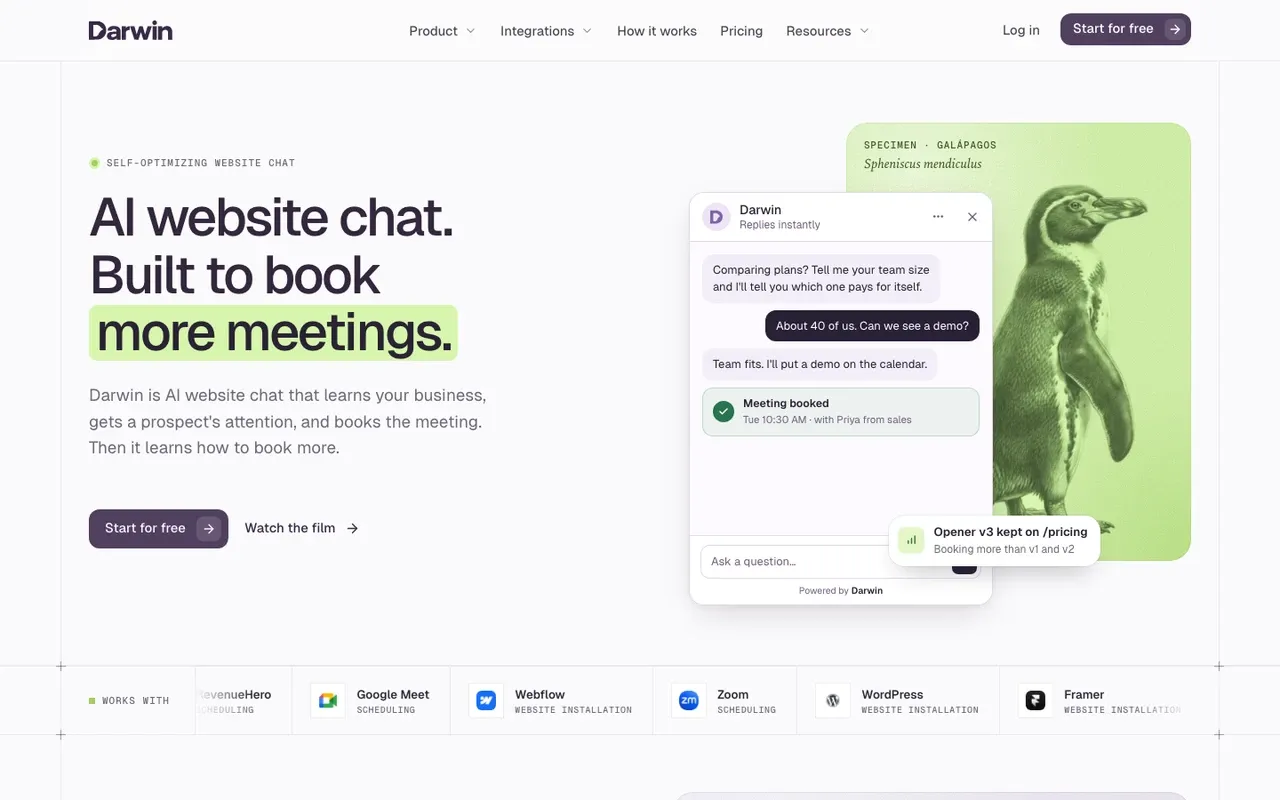
Darwin does the talk-and-book part of conversational marketing and leaves out the account identification and help desk that bigger platforms bundle. For that part, it is the platform we would pick. You give it your website address, and it reads your pages, drafts the assistant and writes the first opening line. When a visitor is ready, the chat itself shows open times from your Calendly, Google Calendar or RevenueHero setup, so nobody is sent to another page to book.SourcesDarwin +1
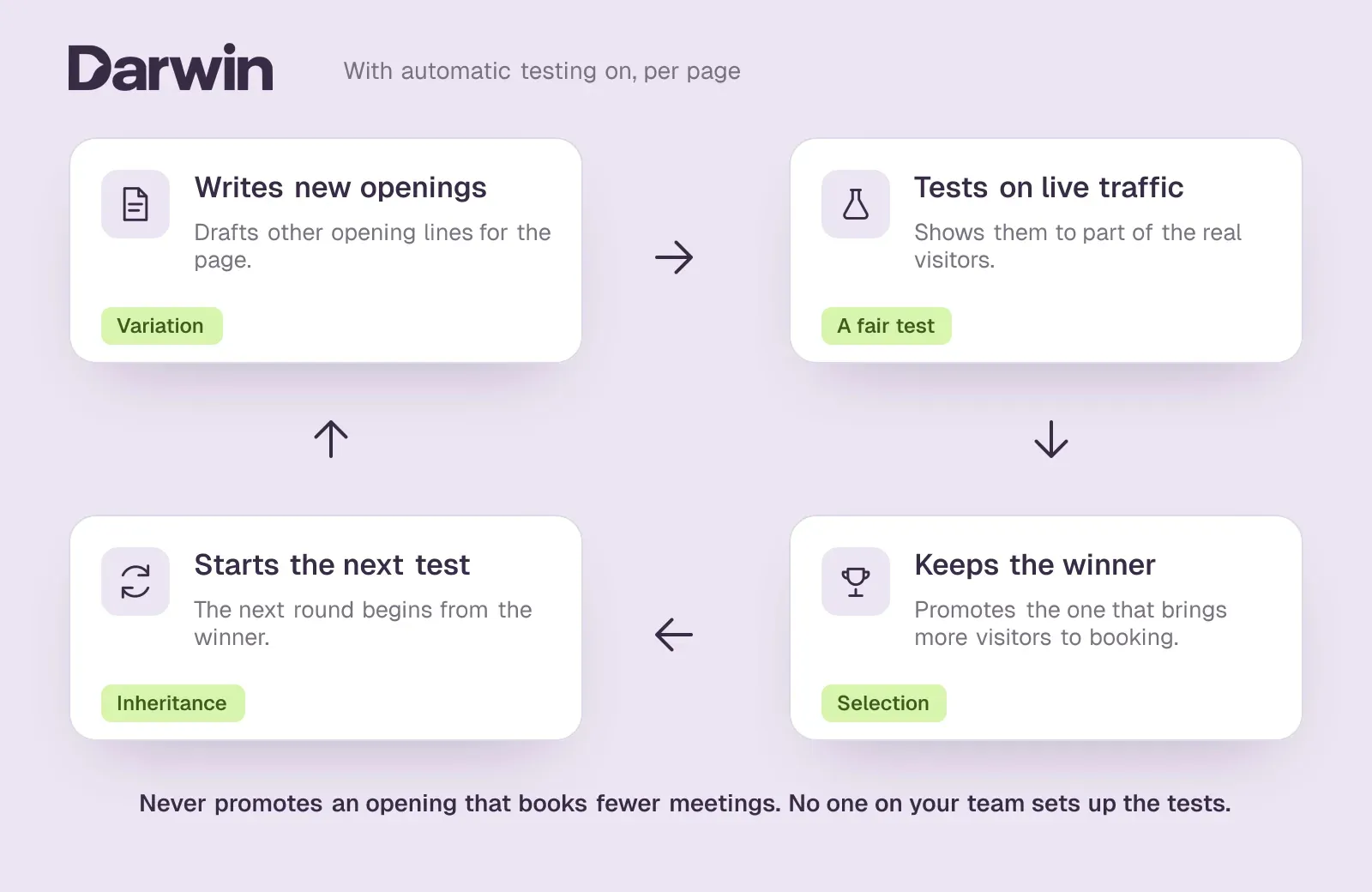
It also changes after launch without your team rewriting anything. With automatic testing on, it tries different opening lines on each page, promotes the ones that bring more visitors to the booking step (never one that books fewer meetings) and starts the next test from the winner. The others describe something different: Piper adjusts to your team's feedback, Warmly says its top tier auto-learns, Docket mentions active learning, and Intercom lets you A/B test messages you write.SourcesDarwinQualifiedWarmlyDocketIntercom
Pricing follows meetings. Origin costs $0/mo and includes 5 free bookings once; after that it charges $20/booking. Paid plans with a monthly booking allowance start at $99/mo. The how it works page shows setup, and every plan is on the pricing page.SourcesDarwin
SourcesDarwin
Darwin pros
- With automatic testing on, it tests its own openings and promotes the winners
- Drafts its setup from your website URL
- Offers a time inside the chat, through Calendly, Google Calendar or RevenueHero
- Priced per booked meeting, not per seat or per answer
Darwin cons
- Website chat only: no email sequences, no visitor identification
- Not a support inbox; there is no ticketing
- A young product with a shorter track record than the incumbents
Darwin is the best fit when the job is turning website visitors into booked sales meetings: it books inside the chat, improves its own openings and charges per meeting. If you need to know which company is visiting, or routing deep inside Salesforce, choose Qualified or Warmly instead.
How we reviewed Darwin: Our own product. Facts come from Darwin's public docs and pricing page, checked on the same schedule as every other tool; cons written by the team that builds it.
Reviewed Oct 5, 2026
Docket: an AI agent with a team that sets it up
Mid-market and enterprise B2B teams with heavy traffic and a deep sales content library.
Smaller sites, self-serve buyers, or anyone who wants to try before signing an annual contract.
- Native booking
- Yes
- Learns from your site
- Knowledge Lake
- How it charges
- Annual, by visitor volume
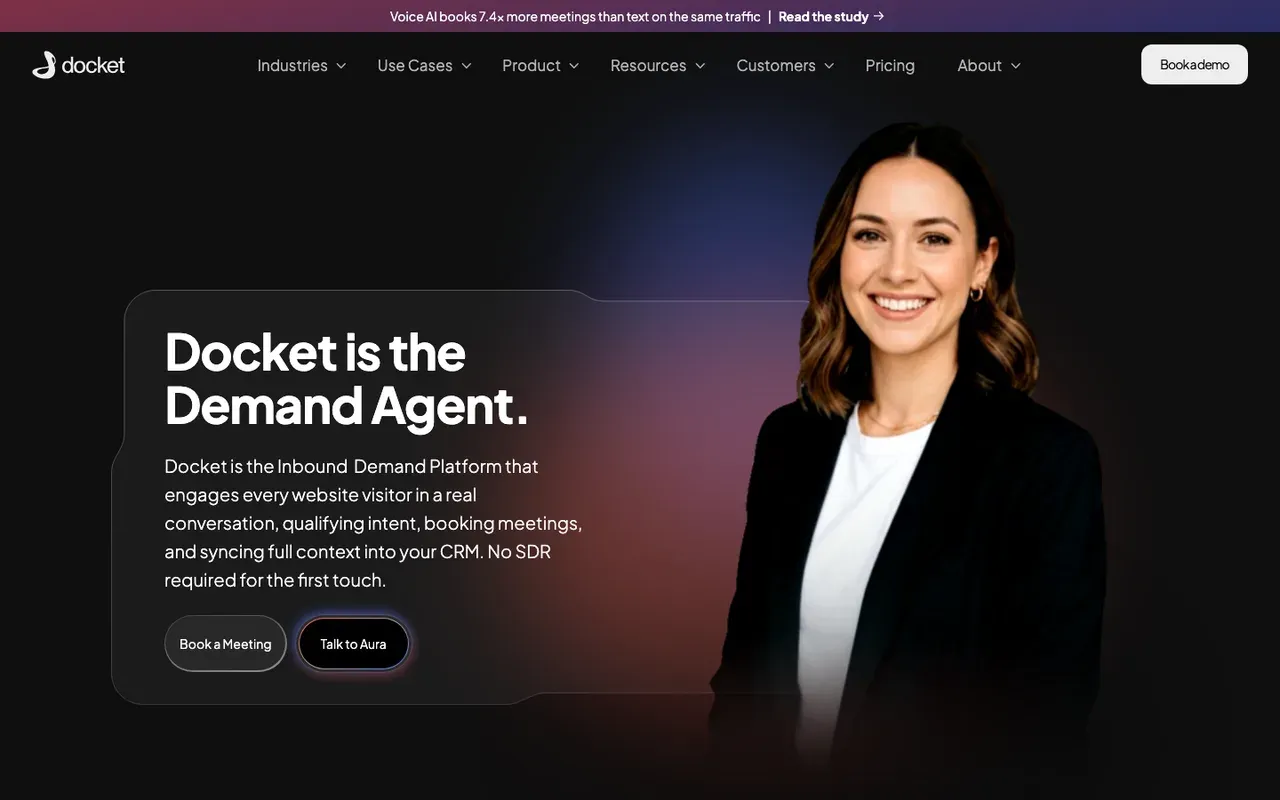
Docket suits companies with heavy traffic and a lot to explain. Its own team implements the agent, which answers from a knowledge store that pulls in CRM records, call recordings, documents and wikis, so it can field detailed product questions. Every plan includes meeting booking with calendar integration.SourcesDocket +1
Plans are annual and grow with monthly visitors rather than seats, with unlimited conversations; the entry plan starts at $3,000/mo. There is no free trial, so the first real test happens after you sign.SourcesDocket
SourcesDocket +1
Docket pros
- Unlimited conversations on every plan
- Knowledge from calls, CRM and documents, not only web pages
- Docket's team handles implementation
Docket cons
- Annual contracts from $3,000/mo, with no trial
- Not self-serve; implementation is done for you
- Whether it learns from your website on its own is not specified
What Docket users say
Users like
DocketAI can quickly answer and summarises details across a number of valuable internal resources
Docket gives sellers fast answers to product and technical questions from their company's own knowledge, often inside Slack.
SourcesG2It qualifies intent, routes leads, and even schedules meetings with our reps in real time.
Docket's newer website agent is said to answer complex product questions, qualify visitors and book meetings.
SourcesG2
Users complain about
The tool is only as good as the data you feed it
Docket's answers are sometimes inaccurate or outdated, so reps double-check or rephrase their questions.
SourcesG2for companies with multiple product lines (like us), you’ll want to invest time upfront
Docket's website agent takes upfront work for companies with many product lines or custom lead flows.
SourcesG2
Reviewers' words, our summaries · reviews read Oct 6, 2026
Docket is a good match for a busy B2B site that wants the agent built and tuned for it. It is more than a small company needs.
How we reviewed Docket: Read its pricing, product and help pages on 11 September 2026 and again on 5 October 2026. No trial.
Reviewed Oct 5, 2026
Intercom: when support and sales share a messenger
Support-led companies that want one messenger for service, with a sales assist on the side.
Sales teams that do not need a helpdesk and would rather not pay per seat and per answer.
- Native booking
- Via integration
- Learns from your site
- Content import
- How it charges
- Seats + Fin outcomes
Intercom comes at conversational marketing from customer service. It is a help desk with a shared inbox and help center, and Fin, its AI agent, now has a sales mode that qualifies leads and books meetings in the Messenger through calendar integrations.SourcesIntercom
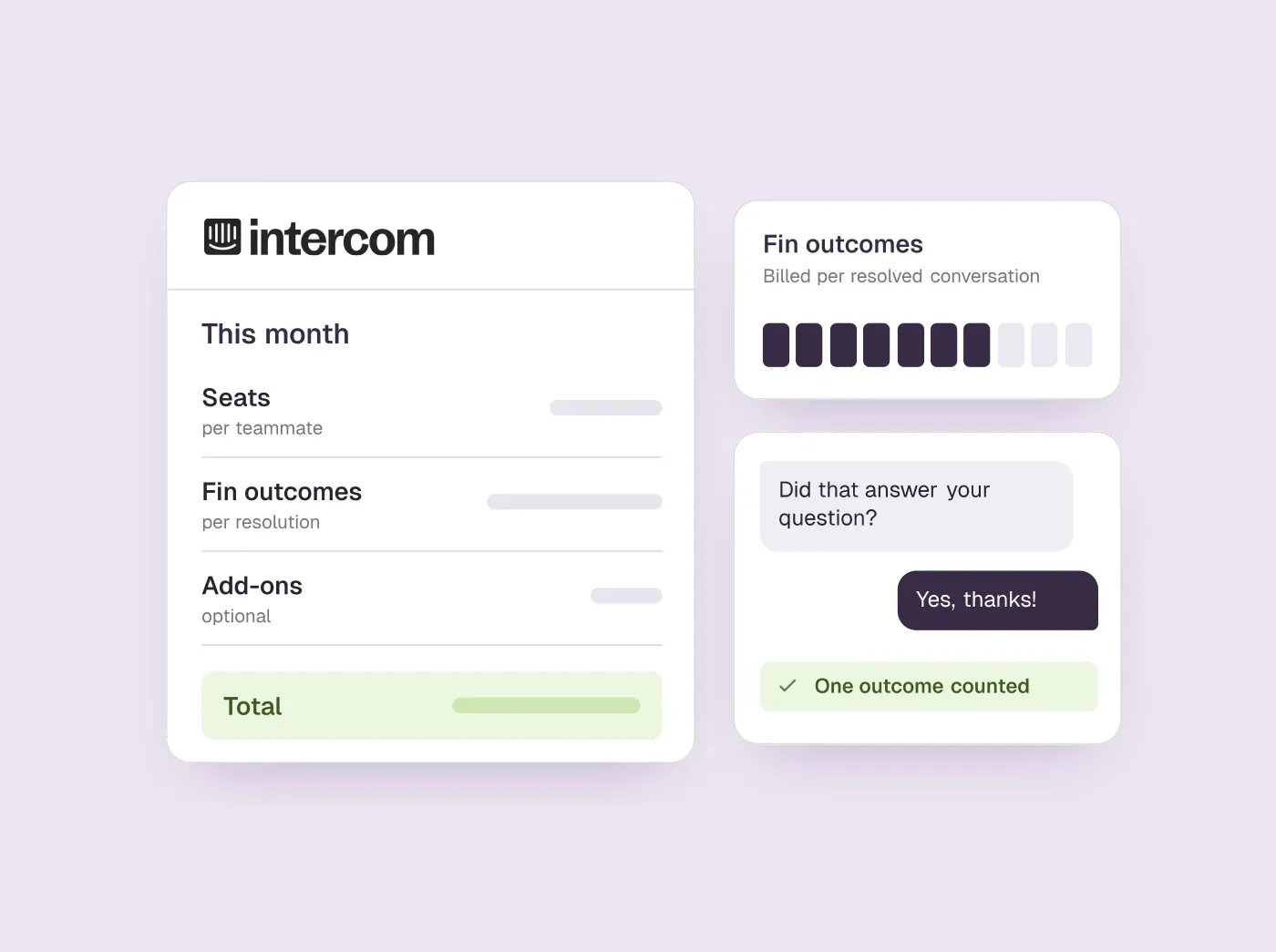
Seats start at $39/seat/mo, Fin for Sales costs $9.99/qualification, and other Fin outcomes are billed separately. There is a 14 day trial. The company behind Intercom renamed itself Fin in May 2026 and has been part of Salesforce since September.SourcesIntercom +3Salesforce +1
SourcesIntercom +2
Intercom pros
- A strong support inbox and help center
- Fin drafts a sales playbook from a prompt or your pricing page
- Messenger imports your logo and colors from your domain
Intercom cons
- Two-layer pricing, seats plus outcome fees, so the bill grows when the AI succeeds
- Sales chat is an add-on to a support product
- No free plan after the trial
What Intercom users say
Users like
It’s helpful for resolving common customer issues and makes it easier to handle routine questions.
Intercom's Fin answers routine questions well when it can draw on a solid help center or knowledge base.
SourcesTrustRadius +1G2Fin allows us to provide 24x7 quick help to our customers
Intercom's Fin cuts first response times and gives customers answers around the clock.
SourcesTrustRadius +1G2
Users complain about
I don't like how much it hallucinates and gives people incorrect answers.
Intercom's Fin still gives wrong or made-up answers on nuanced questions or when content is large or messy.
SourcesTrustRadius +1G2even when instructions clearly say to avoid that and escalate immediately
Customers can struggle to reach a person through Intercom's Fin; handoff to a human is slow or unreliable.
SourcesTrustRadius +1G2
Reviewers' words, our summaries · reviews read Oct 6, 2026
Intercom makes sense when the same people answer customers and prospects. If the chat is only there to create pipeline, you would be paying for a help desk you do not use.
How we reviewed Intercom: Read its pricing, product and help pages on 11 September 2026 and again on 5 October 2026. No trial.
Reviewed Oct 5, 2026
Drift: the platform that started it, now being retired
Teams already on Drift who need to plan their move before Clari + Salesloft retires it.
Anyone choosing a platform today: Drift is being wound down and its customers are referred to 1mind.
- Native booking
- Yes
- Learns from your site
- Content Library
- How it charges
- Quote-based
Drift deserves its place in any history of this category, but not on a new shortlist. Clari + Salesloft announced a gradual sunset of Drift in March 2026. Existing customers are being pointed to 1mind, an AI agent company that runs product demos by video and voice. 1mind publishes no prices. 1mind's own website chat told us pricing is annual and usually starts around $100,000.SourcesSalesloft +21mind
If you still run Drift, the clock is running. According to Salesloft, a customer's access to Drift ends on 31 January 2027 or at the end of its current contract, whichever comes first; contracts that run past that date are handled case by case by the account team. Plan the move now; our Drift alternatives guide covers the options and how to switch.SourcesSalesloft
SourcesSalesloft +4
Drift pros
- Defined the category, with playbooks that greet, qualify and route visitors
- Its Book a Meeting skill puts a rep's calendar into the conversation
- Reports on conversations, meetings and Salesforce-influenced pipeline
Drift cons
- Being retired; customers are referred to 1mind
- No published prices; plans were sold by quote
- Bots answer from content uploaded to its library rather than reading your site
Drift is for existing customers only. Use the time before the sunset to pick a replacement and run it alongside Drift on part of your traffic.
How much does a conversational marketing platform cost?
Anything from nothing to an enterprise contract. Conversational marketing platform software is sold in five ways, and how a platform charges tells you more than its starting price.
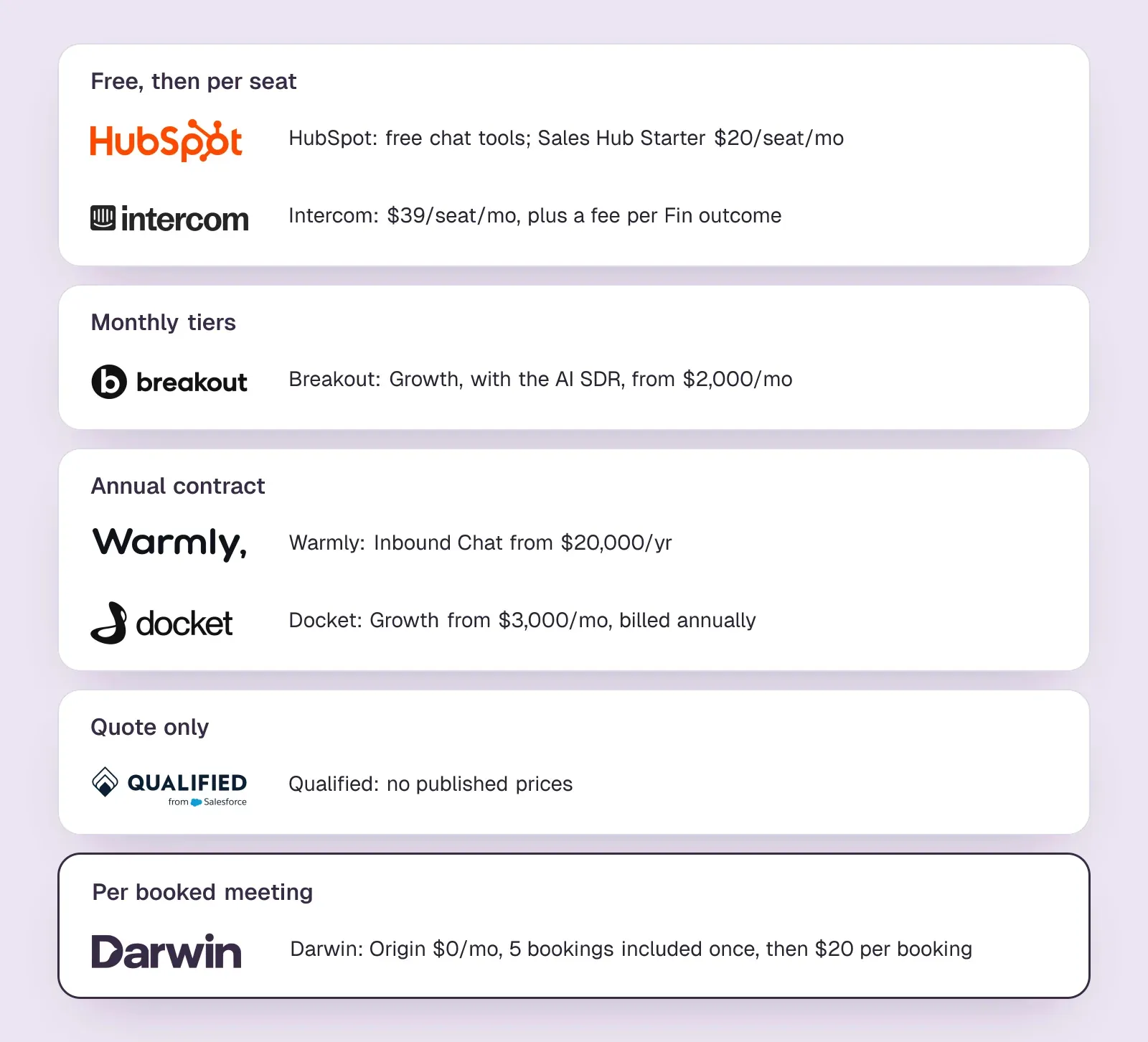
- Free, then per seat. HubSpot's chat tools are free, and the paid hubs add seats; Sales Hub Starter lists $20/seat/mo. Intercom starts at $39/seat/mo and adds a fee for each Fin outcome.SourcesHubSpotIntercom
- Monthly tiers. Breakout's AI SDR plan starts at $2,000/mo.SourcesBreakout +1
- Annual contracts with a published floor. Warmly's chat plan is $20,000/yr, and Docket's entry plan is $3,000/mo.SourcesWarmlyDocket
- Quote only. Qualified and 1mind price after a demo, as Drift did.
- Per booked meeting. Darwin's Origin plan charges $20/booking once the included bookings are used, with no monthly fee.SourcesDarwin
A seat price grows with your team, an outcome price with your traffic, and a contract with whatever you negotiated. Before you compare two numbers, work out what each one counts and what a busy month would cost. If a quoted platform is on your list, ask for the quote early, so you are not comparing a real number with a guess.
Starting prices do not tell you what a real month costs, so here is one worked example. Take a team with 3 sales reps that wants about 20 booked meetings a month from its website chat. The table uses each platform's published entry price for a plan that can do the job, and the sums are ours.
Example: 3 reps and 20 booked meetings a month
| Platform | Example monthly cost | How we got it |
|---|---|---|
| Darwin (Evolve) | $299 a month | Evolve is $299/mo. Adapt includes 5 bookings, Evolve 20 and Apex 60 per month. |
| Darwin (Origin) | $400 a month ($300 in the first month) | No monthly fee and 5 free bookings once, then $20/booking: 15 × $20 in month one, then 20 × $20. |
| Darwin (Adapt) | $324 a month | $99/mo including 5 bookings, plus 15 extra bookings × $15. |
| HubSpot Sales Hub Professional | $300 a month, plus onboarding and credits | 3 seats × $100/seat/mo, plus a $1,500 onboarding fee once; the customer agent also spends HubSpot Credits. |
| Intercom with Fin for Sales | $316.80 a month or more | 3 seats × $39/seat/mo, plus Fin for Sales at $9.99/qualification for at least 20 qualified leads. |
| Warmly Inbound Chat | about $1,667 a month | $20,000/yr spread over 12 months, on an annual or quarterly contract. |
| Breakout Growth | $2,000/mo and up | The tier that includes the AI SDR; usage beyond the plan is not published. |
| Docket Growth | $3,000/mo and up | Billed annually, so at least $36,000 a year. |
| Qualified | Quote only | Qualified's own website chat would not share a starting price or a typical range. |
Three things stand out. First, Darwin's Evolve plan and HubSpot's Professional seats land near the same monthly figure, but they buy different things: the HubSpot price buys CRM seats and adds onboarding and credits, while Evolve buys the 20 meetings themselves. Second, Intercom's bill rises with every lead Fin qualifies, so a good month costs more. Third, the contract platforms cost several times more because they include things a small team may not need, such as identifying the visiting company or an implementation team. Run the same sums with your own numbers before the first demo.
Where Darwin fits: a conversational marketing platform built to book meetings
If what you want from a conversational marketing platform is booked sales meetings from the visitors already on your website, Darwin is built for exactly that, and for that job we think it is the best option. You give it your website address and it reads your pages to draft its knowledge, your brand styling and its first opening lines. It answers visitors from that content, asks the questions that separate a buyer from a browser, and when someone is ready it shows open times inside the chat and books the meeting through Calendly, Google Calendar or RevenueHero.SourcesDarwin +1
Four things make it the strongest choice for that job:
- It books in the conversation. The visitor picks a time in the chat window rather than following a meetings link to another page, and the meeting lands on the calendar your team already uses.
- It improves its own chat. Of the 31 website chat and AI SDR tools we have checked, Darwin is the only one whose documentation describes testing its own chat openings on live traffic, keeping whichever brings more visitors to the booking step, and starting the next test from that winner, with no one setting the tests up.SourcesDarwin
- It charges for results. Origin has no monthly fee and includes 5 free bookings once, then charges $20/booking; paid plans with a monthly booking allowance start at $99/mo. The bill grows when the chat books more meetings, not when you add a rep or a visitor asks a question.SourcesDarwin
- It sets itself up from your site. There is no playbook to write before launch: you review the draft and add one snippet to your site.SourcesDarwin
The second point is the one the company is named after. Natural selection needs variation, a fair test and inheritance. Darwin writes new opening lines for a page (variation), shows them to a share of real visitors next to the current one (the fair test), keeps whichever brings more people to the booking step, and starts the next round from that winner (inheritance). It is the scientific method on autopilot: nobody on your team writes the variants, picks the winner or remembers to start the next test.SourcesDarwin
Choose something else when the job is different. If you need to know which company is browsing before anyone types, Warmly is built for that. If you sell to named accounts with routing inside Salesforce, Qualified is the stronger fit. If the same chat has to run a support inbox with tickets, pick Intercom. And if you want an AI that writes cold email, you need an outbound SDR instead; our AI SDR tools guide covers those.
Plans and booking allowances are on the pricing page, and Darwin's docs explain how the testing works. Side-by-side pages compare Darwin with Qualified, HubSpot, Warmly, Breakout, Docket, Intercom and Drift.
How to choose a conversational marketing platform
Start from your CRM and the one thing you most need the chat to do.
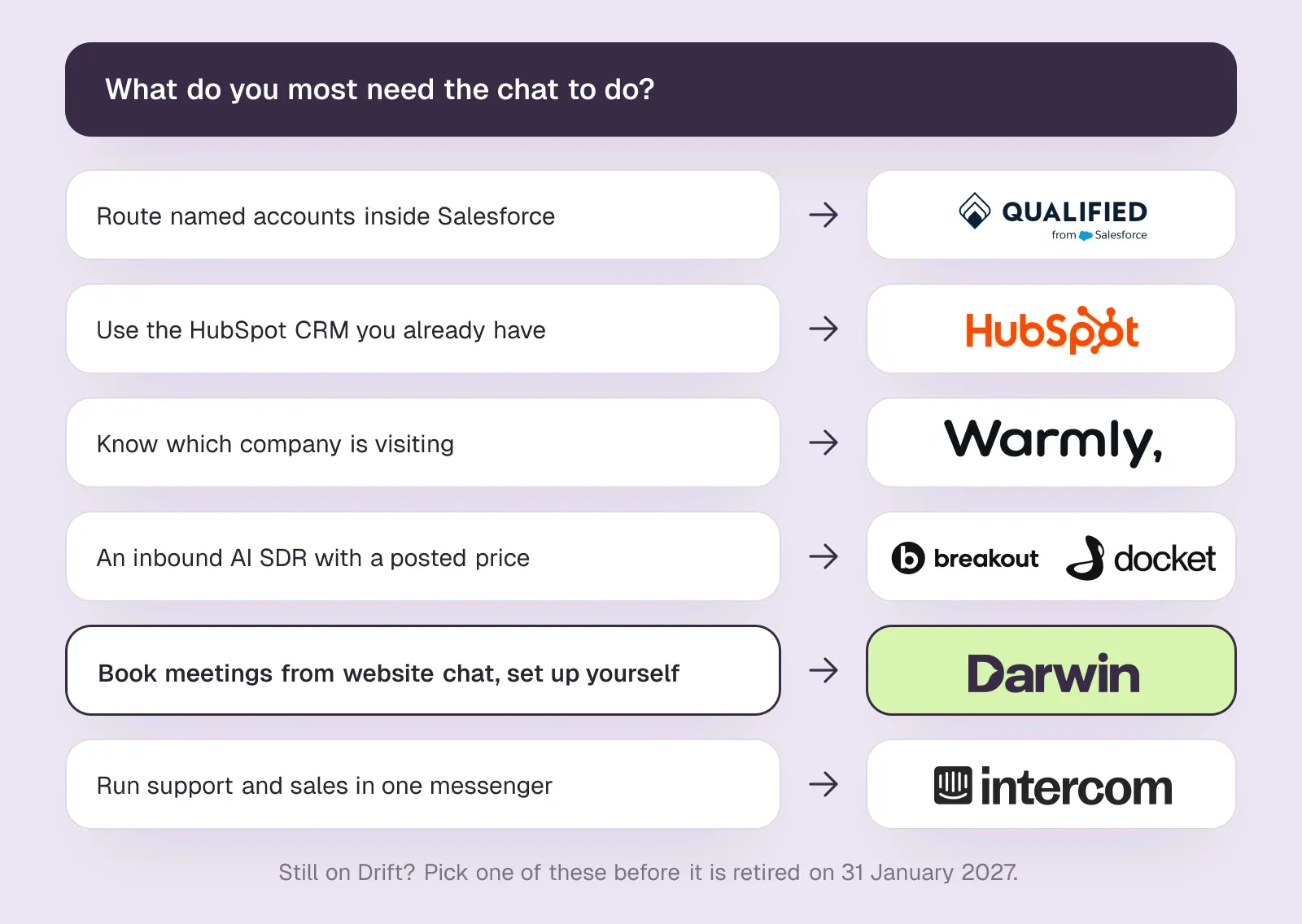
- Enterprise team on Salesforce, selling to named accounts, with someone to run the program: Qualified.
- Already on HubSpot CRM: switch on HubSpot's chat and customer agent first, and only buy something else if booking or answers fall short.
- Seeing which company is on the site matters most: Warmly.
- Want an inbound AI SDR with prices you can read before the first call: Breakout, or Docket if you also want the setup done for you.
- Want website chat that turns visitors into booked meetings, set up yourself and paid per booking: Darwin, the best fit for that job.
- Support and sales share one inbox: Intercom.
- Still on Drift: pick one of the above and plan the switch; do not renew for long.
Then test each finalist the way a buyer would. Open its chat on your own pricing page, ask a hard question, and see whether you end up with a straight answer and a meeting on the calendar. Our guide to turning website chat into booked meetings covers what to measure once it is live.
A conversational marketing strategy in six steps
A platform is half the work. The other half is a conversational marketing strategy: which pages get a conversation, what counts as a buyer, and how you will know it is working. Six steps cover it, whichever platform you choose.
- Choose the pages. Start where buyers already show intent: pricing, demo, product and comparison pages. A chat on every blog post adds noise before it adds meetings.
- Write down who is worth a meeting. Two or three qualifying questions, such as team size, use case and timing, are enough. Every extra question is another chance for the visitor to leave.
- Give the agent real answers. Buyers ask about pricing, integrations, security and contract terms. Then ask your own chat those questions. When we asked ours, it left out our cheapest plan.SourcesDarwin
- Put the calendar in the chat. Connect the scheduler your reps already use and decide who gets which meeting, so a ready buyer is never told that someone will be in touch.
- Test the opening line. The first message decides whether anyone replies. Test it by hand with A/B tests, or choose a platform that runs the tests itself.
- Measure meetings, not chats. Track booked meetings per page and read a sample of conversations every week. Fix the answers that sent buyers away.
You do not need a conversational marketing agency to run these steps. Platforms that need a project come with their own implementation team, as Docket does, and self-serve tools are set up by whoever owns the website. An agency earns its fee when you run many sites or languages and nobody in-house can own the chat.SourcesDocket
AI chat questions.
What is a conversational marketing platform?
It is software that holds real-time conversations with visitors on your website, works out which ones are likely buyers, and books them a meeting with sales or hands them to a person who is online. Most platforms now use an AI agent to answer from your content instead of a fixed script. Qualified, Warmly, Breakout, Docket, HubSpot and Intercom all do some version of this.
What is an example of conversational marketing?
A buyer on your pricing page asks the chat whether you integrate with HubSpot. The chat answers from your documentation, asks how big the sales team is, and offers three times for a call; the buyer picks one and leaves with a meeting booked. That one conversation replaces a contact form, a next-day email and a round of scheduling.
Is conversational marketing the same as a chatbot?
No. A chatbot is one part of it. Conversational marketing is the practice of replacing forms and slow follow-ups with a live conversation that leads to a sales meeting; the platform adds qualification, routing, booking and pipeline reporting around the bot. A support chatbot uses similar technology but is judged on resolved tickets, not meetings.
What happened to Drift?
On 5 March 2026, Clari + Salesloft announced a gradual sunset of Drift and said it would refer existing Drift customers to 1mind as the successor. Salesloft's Drift Sunset FAQ, last updated on 22 September 2026, says Drift will be retired on 31 January 2027, or at the end of a customer's contract if that comes first. Drift's own website, drift.com, now forwards to a Salesloft page about the move to 1mind. If you still use Drift, start evaluating a replacement now rather than waiting for the last month.
How much does a conversational marketing platform cost?
It depends on the model. HubSpot's chat is free to start and Intercom charges per seat plus Fin fees. Breakout's AI SDR plan starts at $2,000/mo, Warmly's chat plan at $20,000/yr, and Docket at $3,000/mo on an annual plan. Qualified prices by quote only. Per-booking plans skip the monthly fee and charge for each meeting the chat books.
Is conversational marketing still relevant now that there are AI SDRs?
Yes, it has mostly been renamed. Qualified now talks about agentic marketing and AI SDR agents, and Salesloft talks about chat agents, but the job is still a website conversation that ends in a sales meeting. What changed is that AI writes the answers instead of a playbook, so the quality of your content and the booking step matter more than the scripts did.
Do I need Salesforce for a conversational marketing platform?
Only for some. Qualified is built on Salesforce, and its own chat told us it requires Salesforce CRM for booking. HubSpot's tools assume HubSpot CRM. Warmly, Breakout and Docket connect to either, and tools that book through Calendly or Google Calendar work whatever CRM you use.
Is there a conversational marketing platform that improves on its own?
Of the 31 website chat and AI SDR tools we have checked, Darwin is the only one whose documentation describes testing its own chat openings on live traffic, keeping whichever brings more visitors to the booking step, and starting the next test from that winner, with no one setting the tests up. The others describe different kinds of improvement: Qualified says Piper adjusts to your team's feedback, Warmly says its Autopilot tier auto-learns, and Intercom and Drift let you A/B test messages your team writes.
Sources & references (114)
Supporting material for the product details in this article. Each source keeps its own access date.
- What is Conversational Marketing? Qualified · Accessed
- Conversational Marketing: How the World's Fastest Growing Companies Use Chatbots to Generate Leads 24/7/365 (and How You Can Too) Wiley · Accessed
- Drift – Chat Playbook Guide Part 2 Salesloft · Accessed
- Salesloft acquires Drift PYMNTS · Accessed
- Clari + Salesloft & 1mind Partner for AI Revenue Growth Salesloft · Accessed
- 1mind is the exclusive AI successor to Drift 1mind · Accessed
- Drift Sunset FAQ Salesloft · Accessed
- Salesloft chat agents (drift.com forwards here) Salesloft · Accessed
- Conversational Marketing (Salesloft platform page) Salesloft · Accessed
- Welcome to the era of agentic marketing Qualified · Accessed
- The Inbound AI SDR — Breakout Breakout · Accessed
- Docket — the Demand Agent Docket · Accessed
- Warmly Warmly · Accessed
- Salesforce Signs Definitive Agreement to Acquire Qualified (editor's note: completed April 1, 2026) Salesforce · Accessed
- Salesforce Completes Acquisition of Fin Salesforce · Accessed
- Salesforce Signs Definitive Agreement to Acquire Fin Salesforce · Accessed
- Warmly Is Joining HubSpot Warmly · Accessed
- Our test chat asking Qualified's Piper for a price Qualified · Accessed
- Our test chat with Warmly's website chat Warmly · Accessed
- Our test chat with HubSpot's HubBot HubSpot · Accessed
- Our test chats with Intercom's Fin Intercom · Accessed
- Our test chat with Darwin's website chat Darwin · Accessed
- The Playbook for Setting Up and Measuring Piper the AI SDR Qualified · Accessed
- Piper the AI SDR Agent Qualified · Accessed
- The Agentic Marketing Platform powering Piper the AI SDR Agent Qualified · Accessed
- Qualified reviews (G2 reviews syndicated on AWS Marketplace) G2 (via AWS Marketplace) · Accessed
- Piper the AI SDR by Qualified Reviews TrustRadius · Accessed
- Qualified pricing Qualified · Accessed
- HubSpot Sales Hub pricing HubSpot · Accessed
- Manage the customer agent's content sources HubSpot · Accessed
- Choose your rule-based chatbot actions HubSpot · Accessed
- Set up customer agent actions to qualify leads HubSpot · Accessed
- HubSpot Sales Hub pricing HubSpot · Accessed
- HubSpot Product and Services Catalog: HubSpot Credits Rate Sheet HubSpot · Accessed
- Service Hub Enterprise reviews (G2 reviews syndicated on AWS Marketplace) G2 (via AWS Marketplace) · Accessed
- HubSpot Service Hub Reviews Software Advice · Accessed
- Warmly AI Chatbot Warmly · Accessed
- Using Chili Piper Booking Links in Warmly Chat & AI Inbound Autopilot Agent Warmly · Accessed
- Warmly pricing Warmly · Accessed
- Warmly pricing Warmly · Accessed
- Warmly reviews G2 · Accessed
- Breakout vs Qualified Breakout · Accessed
- Inbound Agents — Breakout Breakout · Accessed
- Breakout pricing Breakout · Accessed
- Breakout blog: RB2B alternatives Breakout · Accessed
- Set up with Darwin Darwin · Accessed
- Connect your scheduling page Darwin · Accessed
- How Darwin improves your openings Darwin · Accessed
- Docket platform Docket · Accessed
- A/B test different message variations Intercom · Accessed
- Darwin plans and booking prices Darwin · Accessed
- Plans and included meetings Darwin · Accessed
- Docket pricing Docket · Accessed
- Docket reviews G2 · Accessed
- Docket integrations Docket · Accessed
- Book meetings with Calendly using Fin for Sales Intercom · Accessed
- Intercom standard pricing after Early Stage Intercom · Accessed
- Fin pricing Intercom · Accessed
- Intercom pricing FAQs Intercom · Accessed
- Today Intercom becomes Fin Intercom · Accessed
- Fin (Intercom) Reviews from Real Users TrustRadius · Accessed
- Fin Review Insights TrustRadius · Accessed
- Fin (Intercom) reviews G2 · Accessed
- Book meetings with HubSpot using Fin for Sales Intercom · Accessed
- How to train Fin for Sales Intercom · Accessed
- Intercom pricing Intercom · Accessed
- Clari + Salesloft and 1mind partner to advance AI-driven revenue orchestration Salesloft · Accessed
- Salesloft chat agents (drift.com forwards here) Salesloft · Accessed
- Our test chat with 1mind's website agent 1mind · Accessed
- Drift – Site Concierge – Overview Salesloft · Accessed
- Drift – Build a Bionic Chatbot Salesloft · Accessed
- Drift – What New Features Come with an Upgrade Salesloft · Accessed
- Salesloft pricing Salesloft · Accessed
- Install Darwin on your website Darwin · Accessed
- Create a rule-based chatbot HubSpot · Accessed
- Set guidelines for the customer agent HubSpot · Accessed
- AI in Warmly FAQ Warmly · Accessed
- Salesloft pricing (redirects to Talk to Sales) Salesloft · Accessed
- Our test chat with Qualified's Piper Qualified · Accessed
- Piper the AI SDR Agent Qualified · Accessed
- The Playbook for Setting Up and Measuring Piper the AI SDR Qualified · Accessed
- Qualified pricing Qualified · Accessed
- Choose your rule-based chatbot actions HubSpot · Accessed
- Set up customer agent actions to qualify leads HubSpot · Accessed
- HubSpot Sales Hub pricing HubSpot · Accessed
- Manage the customer agent's content sources HubSpot · Accessed
- Create a rule-based chatbot HubSpot · Accessed
- Set guidelines for the customer agent HubSpot · Accessed
- Warmly AI Chatbot Warmly · Accessed
- Using Chili Piper Booking Links in Warmly Chat & AI Inbound Autopilot Agent Warmly · Accessed
- Warmly pricing Warmly · Accessed
- Warmly is joining HubSpot Warmly · Accessed
- Breakout vs Qualified Breakout · Accessed
- Inbound Agents — Breakout Breakout · Accessed
- The Inbound AI SDR — Breakout Breakout · Accessed
- Breakout pricing Breakout · Accessed
- How Darwin improves your openings Darwin · Accessed
- Connect your scheduling page Darwin · Accessed
- Set up with Darwin Darwin · Accessed
- Darwin plans and booking prices Darwin · Accessed
- Plans and included meetings Darwin · Accessed
- Docket pricing Docket · Accessed
- Docket — the Demand Agent Docket · Accessed
- Docket integrations Docket · Accessed
- Docket platform Docket · Accessed
- Book meetings with Calendly using Fin for Sales Intercom · Accessed
- Book meetings with HubSpot using Fin for Sales Intercom · Accessed
- Intercom pricing Intercom · Accessed
- Intercom standard pricing after Early Stage Intercom · Accessed
- Intercom pricing FAQs Intercom · Accessed
- How to train Fin for Sales Intercom · Accessed
- Clari + Salesloft & 1mind Partner for AI Revenue Growth Salesloft · Accessed
- 1mind is the exclusive AI successor to Drift 1mind · Accessed
- Darwin pricing Darwin · Accessed