What to take away.
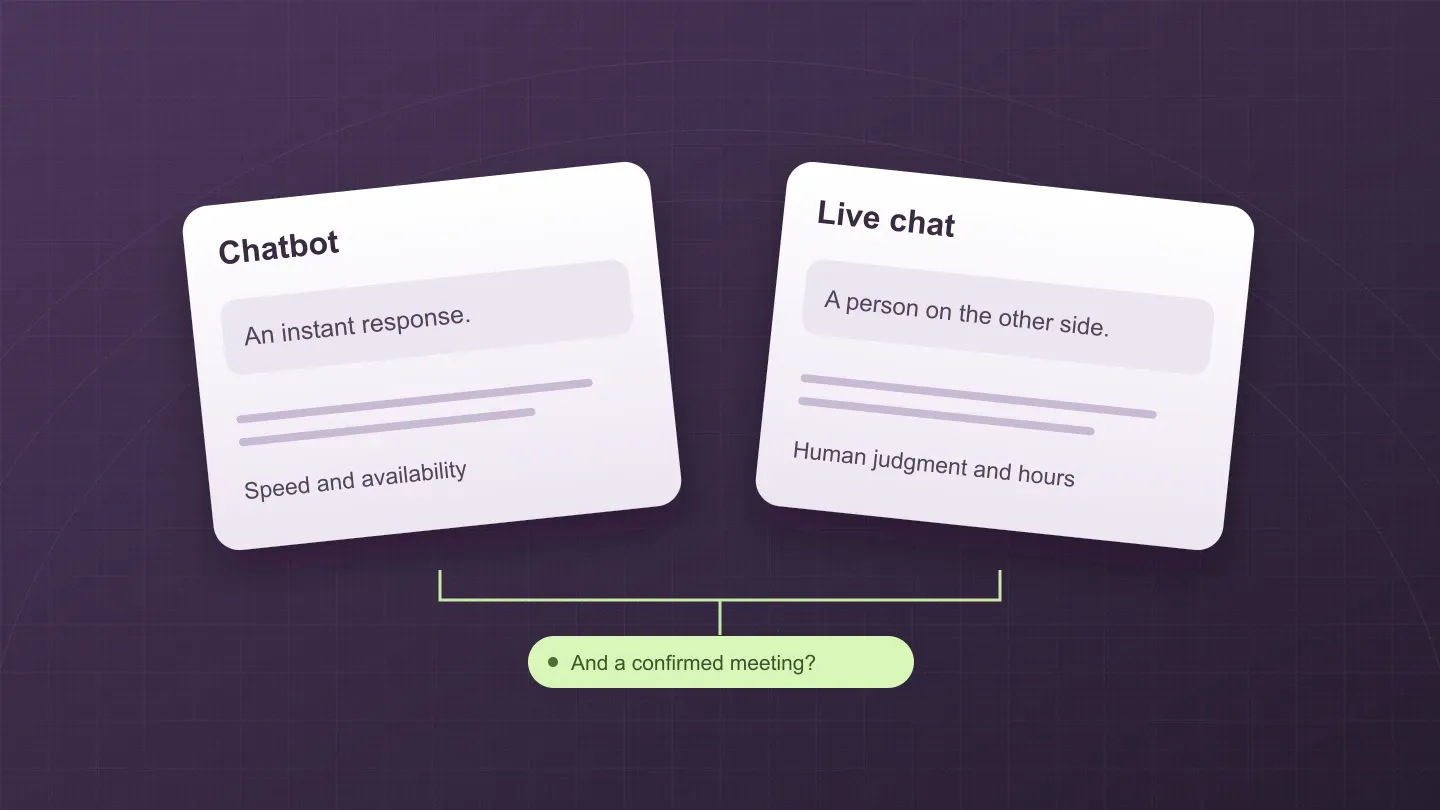
- Live chat wins on judgement and loses on hours. It is only as good as the person on shift, and after 6pm there usually is nobody.
- A scripted chatbot wins on speed and loses on answers. Most of them collect an email and promise someone will be in touch, which is a form with a face.
- For a sales team the deciding question is not bot or human. It is whether the meeting gets booked while the prospect is still on the page.
- AI chat that answers from your website and books into your calendar does both jobs. Darwin also keeps testing its own opening lines, so it books more over time without anyone touching it.
Most articles on this question end the same way: use both, route the easy stuff to the bot and the hard stuff to a person. That advice was written for support teams, and it is fine for them. If you run chat on a B2B website because you want more sales meetings, the comparison looks different, and the usual answer is the wrong one.
A disclosure first. We make Darwin, which is AI website chat that answers a prospect's questions from your site and books the meeting inside the conversation. So we have a view. We have still written this the way we would explain it to a friend choosing between a LiveChat seat and a chatbot plan, and the prices in it come from each vendor's own pages, with the date we checked.
If you only read one paragraph: live chat gives you a person's judgement for the hours a person is online, and you pay per seat for it. A chatbot gives you instant replies at any hour, and most of them cannot do more than collect an email. The thing a sales team actually needs, an accurate answer followed by a booked meeting, sits between the two. That third option exists now, and it starts free.
The short answer
| What you need | Live chat | Chatbot |
|---|---|---|
| Replies in seconds | Only while someone is on shift | Always |
| Answers a real product question | Yes, if the agent knows the product | Scripted bots no; AI bots yes, from what they were trained on |
| Handles the odd question | Yes, that is the point of a person | Falls back to 'leave your email' |
| Books the meeting in the chat | The agent pastes a calendar link | Usually a link too, sometimes nothing |
| Covers nights and weekends | No, or at a cost | Yes |
| Gets better over time | As the agent learns | Only when you rewrite it |
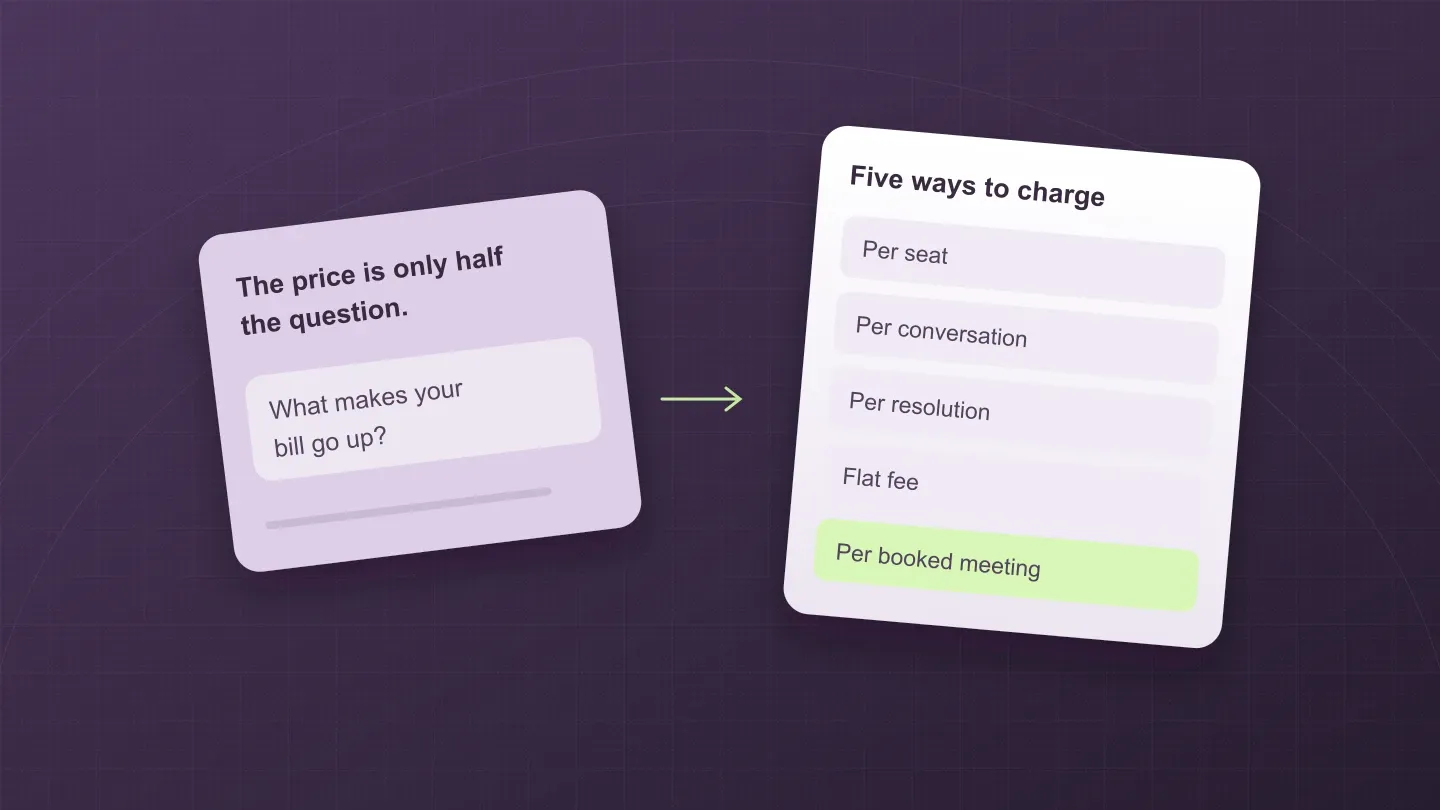
| What you pay for | Seats | Conversations, answers or a flat fee |
What live chat does well, and where it breaks
Live chat is a person behind a widget. When that person knows your product, it is the best experience a website can offer. They read the question properly, they notice the hesitation, they know that the enterprise plan is not the right fit for a five-person team, and they say so. Nobody has to write a script for that.
The trouble is everything around the person. Chat only works when someone is watching it, so the widget goes dark at night, at lunch, and during every meeting the rep is in. A prospect who types a question at 9pm gets an away message and a form. By the morning they have read three competitors' pricing pages.
Then there is the bill. Live chat is priced per seat, so coverage is a headcount decision. LiveChat's Starter plan is $25/agent/mo, and Intercom's Essential seat is $39/seat/mo. Two people covering a working day is two seats; covering evenings is more people, not more software. And the booking step is still manual. The agent decides the prospect is worth a call, pastes a scheduling link, and hopes they use it.
- Best at: nuanced questions, objections, anything where reading the room matters.
- Weakest at: hours, consistency between agents, and the moment after the conversation when the meeting has to get booked.
- Pay for: seats, plus a person's time on every conversation, including the ones that were never going to buy.
What a chatbot does well, and where it breaks
A chatbot is software behind the same widget, and the word covers two very different things. The older kind is a scripted flow: buttons, branches, and a message tree someone built in an afternoon. The newer kind is an AI assistant that reads your content and writes its own replies. They share one strength and split on everything else.
The shared strength is time. A bot answers in a second at 3am, and it never gets tired of the same question. For the questions that come up fifty times a week, that alone is worth having.
The scripted kind breaks the moment a visitor types something the tree did not anticipate, which is most of the time. The fallback is always the same: leave your email and someone will be in touch. That is a form with a face, and prospects know it. The AI kind answers real questions, but it is only as good as what it was trained on and how often that gets refreshed. A bot trained on last quarter's pricing page will confidently quote last quarter's prices.
The quieter problem is that chatbots do not improve. The greeting you wrote at setup is the greeting every visitor sees on every page until someone remembers to change it. LiveChat's own documentation describes greetings and campaigns the operator writes, and Intercom's A/B tests need the operator to write the variants and pause the loser. Nobody has time for that, so the opening line ages in place.
- Best at: instant replies, repeat questions, coverage at any hour, zero marginal cost per conversation.
- Weakest at: anything off-script, out-of-date answers, and the handoff when a prospect is ready to talk.
- Pay for: a flat fee, a per-conversation rate, or an add-on to a seat plan you already have.
The question underneath: what happens when the prospect is ready
Here is the test we would apply to any chat tool on a sales site. A prospect lands on your pricing page, asks two good questions, gets two good answers, and says: can I talk to someone? What happens in the next thirty seconds?
With live chat, it depends on the shift. With a scripted bot, it is an email field. With most AI chatbots, it is a calendar link that opens a new tab, and a fair share of prospects never come back from that tab. In every case the tool did the hard part, earning the conversation, and then dropped it at the finish.
The tool a sales team wants does three things in one conversation. It answers from your actual website, so the answer is right and current. It offers a time when the prospect is interested and confirms the slot without leaving the chat. And it pays attention to which openings get people talking on each page, so next month it books more than this month. That is a different category from either side of the chatbot vs live chat debate, and it is the one we built.

Darwin
B2B sites that want chat to answer accurately and book the meeting, without a person on shift or a testing to-do list.
Teams whose chat is mainly a support channel with tickets, queues and agents.
- Books in the chat
- Via integration
- Improves on its own
- Yes
- Starting price
- $0/mo
- Free plan or trial
- 5 free bookings
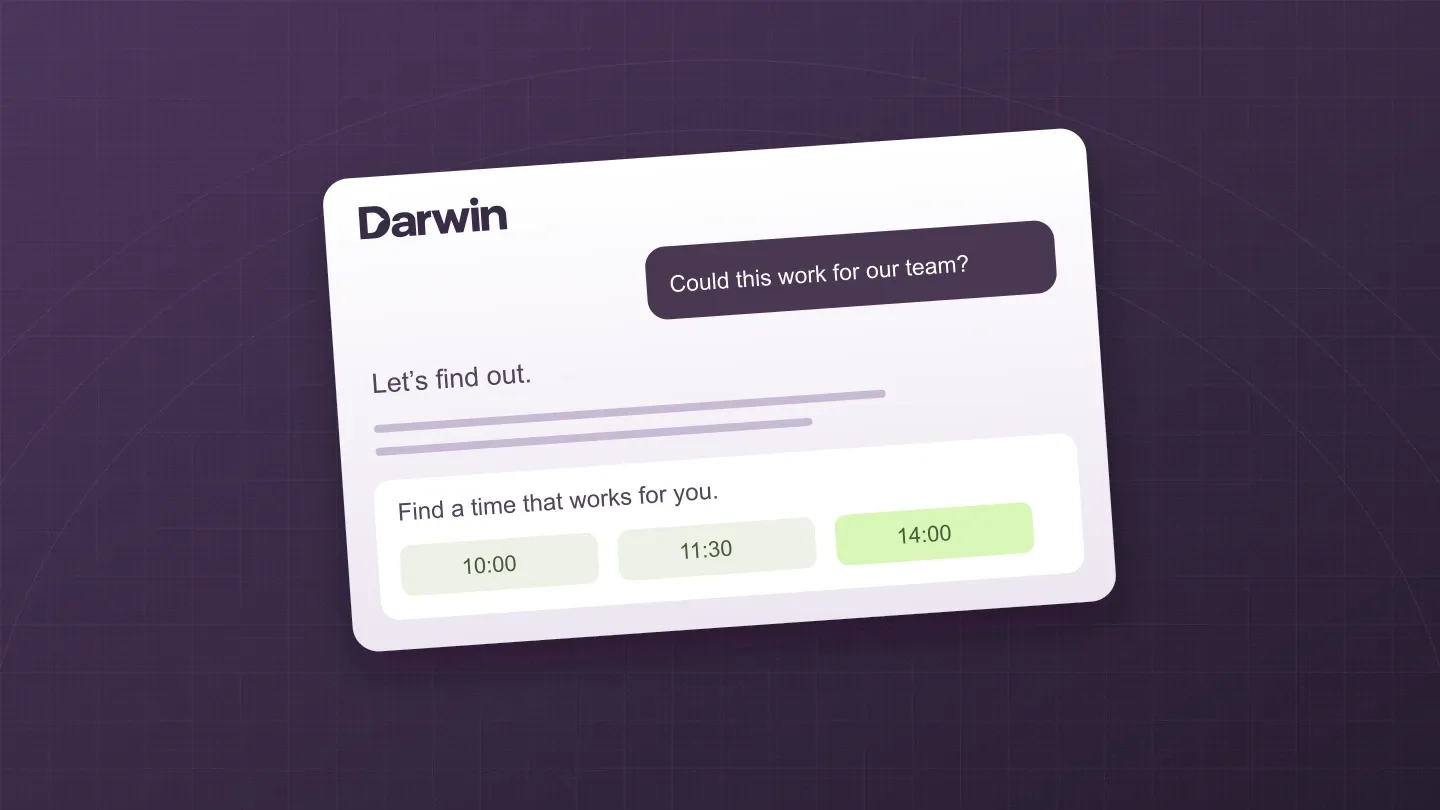
Give Darwin your URL and it reads your site, drafts the assistant and writes the first opening line for each page. A prospect gets an answer from your own content, and when they are interested, a time on your team's calendar through Calendly, RevenueHero or HubSpot Meetings, confirmed inside the chat.
Then it does the thing neither a chatbot nor a live agent does. Darwin tries different opening lines on each page, keeps the ones that lead to more meetings, drops the rest, and tests again. Nobody schedules the experiments or reads the reports. A few weeks in, more visitors are booking than before.
Origin costs $0/mo and includes 5 free bookings. After that you pay $20/booking, or move to a plan starting at $99/mo. There are no seats, because there is nobody on shift.
See the whole flow in how Darwin works, or run the numbers on the pricing page.
Where it stands out
- Answers from your website, so the answer matches the page the prospect is on
- Books the meeting inside the chat, on the scheduler you already use
- Gets better on its own: the only tool in this comparison that does
- Priced per booked meeting, not per seat or per conversation
Limitations
- Website chat only: no helpdesk, no ticketing, no email sequences
- Not built for support queues; a human handoff is not the point of it
- A young product with a shorter track record than the incumbents
Verdict. If the reason you are comparing chatbots and live chat is meetings, this is the option the comparison leaves out. Not the pick if what you actually need is a support inbox.
Facts checked Sep 11, 2026Darwin
Six chat tools, judged on what happens when a prospect is ready
Live chat products (LiveChat, Intercom, HubSpot, Freshchat, Tidio) alongside Darwin. Read the first and third columns together: booking in the chat is common, improving without anyone touching it is not. Hover a cell for the full finding and its check date.
| Tool | Books in the chat | Answers from your site | Improves on its own | Starting price | How it charges |
|---|---|---|---|---|---|
| Darwin | Via integration | Yes | Yes | $0/mo | Yes |
 LiveChat LiveChat | Link to scheduler | Agent-assist only | Manual tests | $25/agent/mo | Per agent |
 Intercom Intercom | Via integration | Content import | Not documented | $39/seat/mo | Yes |
 HubSpot HubSpot | Yes | URL import | Not documented | $0/mo | Seats + credits |
 Freshchat Freshchat | Via integration | URL import | Not documented | $0/mo | Seats + sessions |
 Tidio Tidio | Via integration | URL scraper | Not documented | $0/mo | Conversation-based |
Values come from shared product facts, checked Sep 11, 2026. Sources
How to decide
Live chat earns its seats when a human has to do the selling: long cycles, custom pricing, procurement questions, and enough daytime inbound to keep a trained person busy. If that is your site, budget for the people and accept that the widget sleeps when they do.
A chatbot is the right call when chat is really a support channel and the questions repeat. Order status, password resets, where a setting lives. A scripted flow handles that cheaply and an AI assistant handles it well. Just do not expect it to sell anything.
If your website's job is to produce sales meetings, which describes most B2B software companies, most agencies, and anyone with a Book a demo button, you want the third thing: AI chat that answers from your site, offers the meeting at the right moment, confirms it in the conversation, and gets better at all three without a project plan. A handoff to a person is a nice feature on top. It should not be the whole product.
And the classic advice, run both, only makes sense if you already have the agents. A bot in front of a live team is a real setup. A bot in front of nobody is just a bot.
What each option costs
Live chat is a seat business. LiveChat's Starter plan is $25/agent/mo, and the customer-facing AI agent is sold separately: The customer-facing AI Agent is a separate Text product from $19 per user per month. Intercom starts at $39/seat/mo for a seat, and Fin, its AI agent, adds usage on top: Fin pricing starts at $0.99 per outcome. Freshchat's paid plans begin at $23/agent/mo.
Free tiers exist and are worth knowing about. HubSpot's free tools include live chat and a basic chatbot with HubSpot branding, and the paid path is per seat from $20/seat/mo. Freshchat's Free plan covers up to ten agents. Both are generous for support and thin for selling: the booking step is a meetings link, and nothing in either improves the opening line for you.
Darwin is priced on the outcome. Origin has no monthly fee, the first five booked meetings are included, and after that Origin charges $20 per booked meeting after the introductory allowance. Paid plans start at $99/mo with a monthly allowance and a lower rate per extra meeting. If chat books nothing, it costs nothing. The pricing page has the calculator.
AI chat questions.
Is a chatbot better than live chat?
For support, usually the bot handles the repeat questions and a person handles the rest, and that split works. For sales, neither is quite right on its own. Live chat depends on someone being there, and a chatbot depends on someone having written the answer. The better question is which tool answers correctly and books the meeting while the prospect is still on the page.
What is the difference between live chat and a chatbot?
Live chat puts a person behind the widget; a chatbot puts software there. The person is better at judgement and worse at hours. The software is instant and always on, and its answers are only as good as its script or its training. Newer AI chat sits between the two: it reads your website and writes its own replies, so it can answer real questions without a person on shift.
Can a chatbot replace live chat?
It can replace the parts of live chat that were never a good use of a person: the same ten questions, the after-hours coverage, the first reply. It cannot replace a rep's judgement on a complicated deal, and it should not try. What it can do, if it books meetings, is get that rep into a calendar slot with a prospect who already had their questions answered.
Can a chatbot book meetings?
Some can. Darwin offers a time and confirms it inside the conversation through Calendly, RevenueHero or HubSpot Meetings. Intercom's Fin for Sales can book in Messenger. Many others hand the visitor a scheduling link instead, which works, but every new tab loses a few people on the way.
Do customers prefer live chat or chatbots?
They prefer a fast, correct answer, and they care less than vendors think about who typed it. Where people get annoyed is a bot that cannot answer and will not hand off, or a human chat that says back in 4 hours. Give them the right answer in seconds and a way to book when they are ready, and the label on the widget stops mattering.
Sources & references (29)
Supporting material for the product details in this article. Each source keeps its own access date.
- LiveChat pricing LiveChat (Text) · Accessed
- Intercom standard pricing after Early Stage Intercom · Accessed
- How Darwin improves your openings Darwin · Accessed
- Connect your scheduling page Darwin · Accessed
- Darwin plans and booking prices Darwin · Accessed
- Set up with Darwin Darwin · Accessed
- Plans and included meetings Darwin · Accessed
- Website Widget: Welcome Screen LiveChat (Text) · Accessed
- Text Copilot: AI-powered personal assistant LiveChat (Text) · Accessed
- Engage visitors using Campaigns LiveChat (Text) · Accessed
- Book meetings with Calendly using Fin for Sales Intercom · Accessed
- Book meetings with HubSpot using Fin for Sales Intercom · Accessed
- How to train Fin for Sales Intercom · Accessed
- A/B test different message variations Intercom · Accessed
- Intercom pricing Intercom · Accessed
- Choose your rule-based chatbot actions HubSpot · Accessed
- Set up customer agent actions to qualify leads HubSpot · Accessed
- Manage the customer agent's content sources HubSpot · Accessed
- Create a rule-based chatbot HubSpot · Accessed
- Set guidelines for the customer agent HubSpot · Accessed
- HubSpot Sales Hub pricing HubSpot · Accessed
- Integrate Google Calendar with Freshchat Freshworks · Accessed
- Configure Knowledge Sources for Freddy AI Agent Freshworks · Accessed
- How to build a simple bot flow with the bot builder Freshworks · Accessed
- Freshchat pricing Freshworks · Accessed
- Lyro Action templates Tidio · Accessed
- Lyro – a quick setup Tidio · Accessed
- Edit your initial message (first flow) Tidio · Accessed
- Tidio pricing Tidio · Accessed