What to take away.
- The best chatbot examples share one habit: the first message knows which page it is on. A greeting that fits the pricing page will not fit the docs, and a greeting that fits everywhere fits nowhere.
- A good script answers before it asks. Every example here gives the visitor something useful in the first reply, and only then qualifies, captures or books.
- Most chatbot use cases are support. The ones that pay for themselves on a B2B site are sales: answer the question, then put a meeting on the calendar without leaving the chat.
- Copy the examples, then test them. Darwin runs that test for you, trying different openings on each page and keeping the ones that book more.
Most lists of chatbot examples are screenshots of famous brands with a sentence of praise under each one. Nice to look at, impossible to copy. This one is built the other way round. Every example is a message you could paste into your own chat tonight, with a note on why it works and where it belongs. Fifty of them, in seven groups: greetings, an opening for each page of a B2B website, full conversation scripts, use cases by team, use cases by industry, widget design, and seven products that do this well in the wild.
A disclosure first. We make Darwin, AI website chat that answers from your site and books meetings inside the conversation, so several examples show what we think good looks like. We have still included tools that do jobs we do not, and every price or capability claim about another product comes from that vendor's own pages with the date we checked it.
If you only read one paragraph: a chatbot example is only as good as its first line, and the first line is only as good as its fit with the page. Someone on your pricing page has a different question from someone in your docs. Write the opening for the page, answer the question before you ask for anything, and offer the meeting the moment the visitor sounds interested. The rest of this article is that paragraph, worked out fifty times.
What the good chatbot examples have in common
Before the list, the test we applied to everything on it. A chatbot example earned a place if it did at least three of these five things, and the ones that do all five are marked in the notes.
- It knows where it is. The message talks about the page the visitor is on, the product they are reading about, or the moment they are in, rather than about the company in general.
- It gives before it takes. The first reply contains information, an answer or a shortcut. Email capture comes later, if at all.
- It sounds like one person wrote it. Short sentences, a real name for the product, no exclamation marks doing the work of a personality.
- It has somewhere to go. When the visitor asks a good question, the conversation ends in a booked meeting, a link that genuinely helps, or a person, and never in a dead end.
- It can be measured. If you cannot tell whether the opening produced a conversation or a meeting, you cannot improve it, and neither can a tool.
There is one more thing the best examples have in common, and almost nobody talks about it. They change. Walk around most websites and the greeting you see is the one somebody typed on setup day, two years ago. Treat everything below as a starting point, and read the last section for how to find out which of them actually work on your site.
Chatbot greeting and welcome message examples
The greeting is the message a visitor sees before they have typed anything, and it decides whether they type at all. These ten cover the situations a B2B website actually meets. Each one is followed by why it works.
1. The plain offer
Hi. I can answer questions about how Acme works and what it costs. What brought you here today?
It names the two things people ask about, and it asks a question a person can answer in their own words. No buttons, no menu. Works on a homepage where you do not yet know the visitor's intent.
2. The page-aware greeting
Looking at the pricing page? Ask me what a plan includes, or how the per-meeting rate compares to seats. I can show you the numbers for your team size.
The visitor's page is the best signal you have. Use it. This greeting names the page, names the two questions that page raises, and offers a concrete next step.
3. The returning visitor
Welcome back. Last time you were reading about the Calendly integration. Want to pick up there, or is something else on your mind?
Returning visitors are warmer than new ones and get treated the same by most bots. This one shows memory without being creepy about it, and gives an easy way out.
4. After hours, honest
It is 9pm here, so the team is offline, but I can answer most product questions and book you a call for tomorrow morning if you would like one. What do you need?
Saying the team is away and then offering to solve the problem anyway is the whole point of having AI in the widget. Compare it with the usual away message that asks for an email.
5. The idle nudge
Still there? If you are comparing us with something else, tell me which tool and I will give you the honest differences.
Fires after a minute or two without activity on a comparison or feature page. It names the likely job, comparison, and promises candour, which is rare enough to be interesting.
6. The exit intent
Before you go: is there a question I did not answer? I can also send you the pricing sheet, no form needed.
Triggered when the cursor heads for the tab bar. The second sentence matters: it removes the form, which is the thing people are leaving to avoid.
7. The support-first greeting
Need help with something in your account? Tell me what you were trying to do and I will find the fix or get a person.
For a logged-in or help-center visitor. It asks for the task, not the feature, and promises a human as a fallback rather than a ticket number.
8. The demo page greeting
You can book a demo with the form, or tell me what you want to see and I will find a time on Sam's calendar right here. Which is easier?
A demo page already has intent. The chat's job is to remove friction, so it offers the same outcome with fewer fields, and it names a person.
9. The docs greeting
Reading the install guide? I can walk you through it for Webflow, WordPress or Framer, or check a snippet if you paste it in.
Docs visitors want to finish a task. This greeting lists the three most common variants and offers to do the work, which is what an AI assistant is for.
10. The quiet one
Questions? Ask here. A real answer, not a menu.
Eight words. Use it when the page is doing the selling and the chat should stay out of the way. The second sentence sets an expectation most bots break.
Website chatbot examples, page by page
Now take that idea for a walk across a whole B2B site. Each page below gets an opening line and a sentence on why it belongs there, and you will notice the trick never changes: the page already tells you what the visitor is doing, so the opening just meets them where they are.
11. Homepage
First time here? In one line: Acme is website chat that books meetings. Ask me how, or tell me what you are trying to fix.
Nobody knows less about you than a homepage visitor, so give them the one-line pitch and two doors, and let them pick.
12. Pricing page
Most teams your size land on Adapt. Want me to work out what a month would cost with your traffic?
Use whatever you can see, company size from the signup or the IP, traffic from the conversation itself, and offer to do the maths. People take a calculation far more readily than they take a call.
13. Product or feature page
This page is about the experiments feature. The short version: it tests opening lines for you. Want to see what it did on a site like yours?
Feature pages tend to run long. The bot says the feature back in one sentence and then offers proof, because proof is usually what the visitor was scrolling down to find.
14. Comparison page
Comparing us with Intercom? The honest split: Intercom is the better support inbox, we book more meetings. Ask me anything about the trade-off.
Concede the competitor's strength in the first line. Nothing makes the second line more believable.
15. Integrations page
Looking for a specific tool? Name it and I will tell you whether it connects, how, and what happens if it does not.
Someone on an integrations page has one yes-or-no question. Give them the answer straight away. If it is a no, say so, and tell them what the workaround is, because there nearly always is one.
16. Blog post
If this article is useful, the product does the thing it describes. No pitch unless you ask, but I am here for questions.
People reading a blog post did not come to buy anything. A greeting that admits as much gets more replies than one that pretends they did.
17. Case study
Want the numbers behind this story? I can tell you what that team's setup looked like and whether yours is similar.
The people reading case studies are evaluating you, and what they want is the detail the page skated over. Offer them that and they will take it.
18. Help center
Search not finding it? Describe the problem in a sentence and I will pull the right article, or fix it with you.
Help-center search mostly fails because the visitor and the writer used different words for the same thing. Let them describe the problem in a sentence and the bot can do the translating.
19. Signup or checkout page
Stuck on something? The card is not charged until after the free bookings. Ask me anything before you finish.
Someone on a signup page is about to commit, and this is where the doubts surface. Say the thing they are worried about out loud and answer it, before they have to ask.
20. Careers page
Thinking about applying? I can tell you what the interview process looks like and who you would work with. No, I will not read your CV.
Careers pages get chat traffic nobody planned for, and a useful, slightly human answer there beats silence by a mile.
21. Contact page
You can fill in the form, or just tell me. Sales questions I can usually answer now; anything else I will route to the right person with your note attached.
The contact form is the one page most visitors are actively trying to avoid. Let them avoid it.
22. 404 page
That page moved or never existed. Tell me what you were looking for and I will find it, or take you to the closest thing.
A 404 is the one page where you can be certain the visitor has a question, and most sites leave it to a cartoon.
Chatbot script examples: six full conversations
A greeting gets someone talking, and then the script has to decide where the conversation goes. The six below are complete exchanges written for a B2B software company. Rather than a transcript, each one is told as it happens, with the bot's actual lines quoted, so you can see what it is responding to and borrow the wording. Swap in your own product details and they will work on your site as they stand.
23. A pricing question that ends in a booked meeting
The visitor opens with the question every pricing page gets: how much is this for a team of five? The bot answers it in full before asking anything back.
With five people it comes down to which plan, not how many seats, because we do not charge per seat at all. At your size most teams pick Adapt, which is a monthly base plus a small allowance of booked meetings. If the site gets fewer than a few thousand visits a month you could also start on Origin, which stays free until it has booked five meetings. Roughly how much traffic do you get?
The visitor says around four thousand a month, which is the one detail that changes the recommendation.
Then Adapt, and you would probably stay inside the allowance for the first month or two. Want me to put twenty minutes with Sam on your calendar to walk through it with your actual pages? I have Thursday at 10 or Friday at 2.
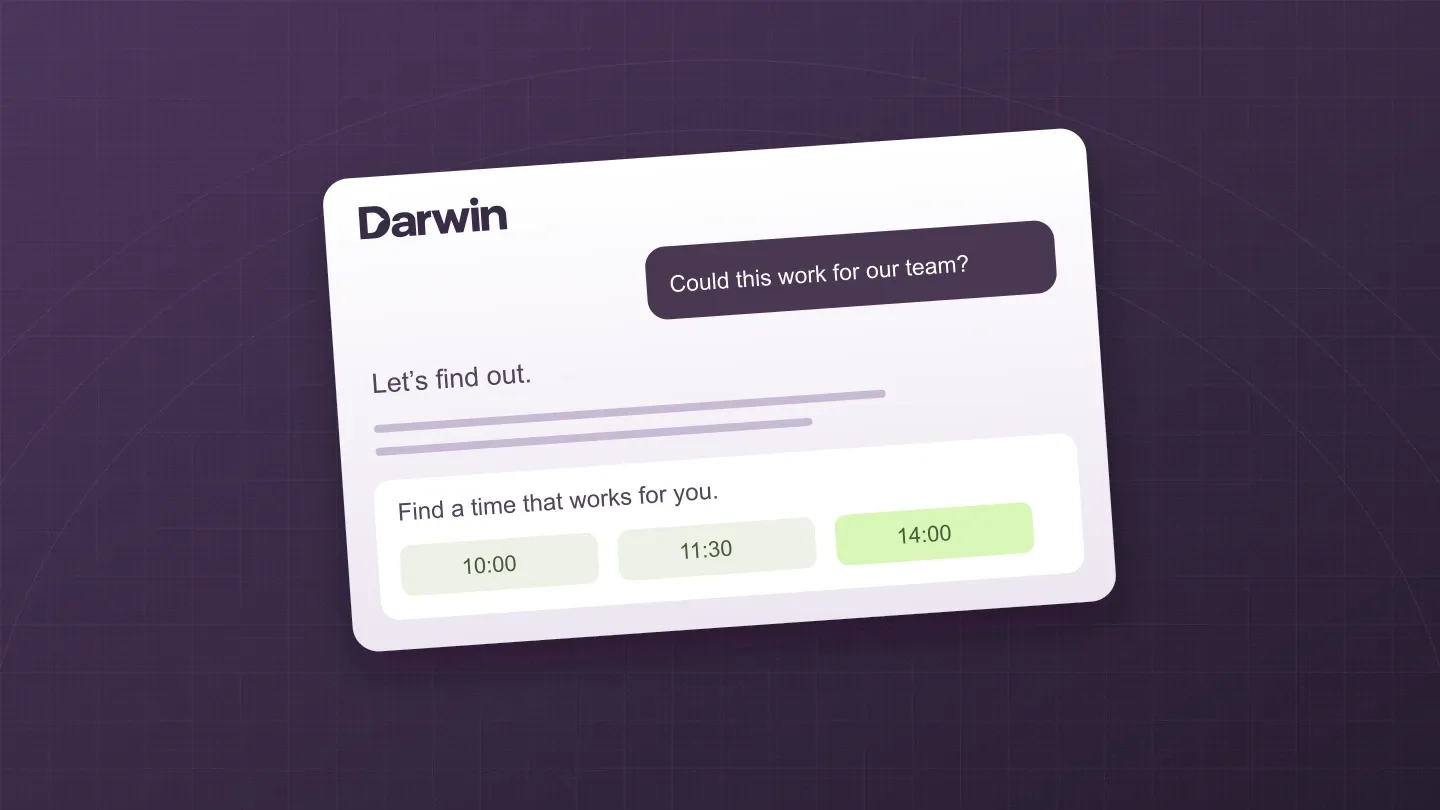
Friday at two works for them, and the bot confirms it in the next message: booked, invite on its way, and Sam will have read their pricing and docs pages before the call. Look at the order of events. A complete answer first. One question, and only the one that would genuinely change the advice. Then two real times instead of a link to a calendar somewhere else. Darwin runs this conversation by default, pulling the times from whichever calendar you connected.
24. A support question with a clean handoff
Someone writes in to say the widget is not showing on their site. The bot starts with the three things that are usually wrong.
Let us check the usual three things. Is the snippet on every page or just the homepage? Is it inside the body tag? And did you publish after adding it? If you paste the snippet here I will check it.
They paste it, and say it is on every page and published. The bot reads the snippet and narrows it down.
Your snippet looks right, so we are down to two suspects, a content blocker or a caching layer. Open the site in a private window for me. If the widget shows up there, your cache is holding the old page. If it still does not, I will bring in Priya from support and pass her everything we just went through, so you will not have to repeat yourself.
The private window works, so it was the cache, and the bot offers the purge steps for their platform. There are two ways a support script goes wrong: it hands off before it has tried anything, or it keeps trying long after a person should have stepped in. This one works through every check a bot can do by itself, then names a real colleague and promises the visitor will not be asked to start over.
25. The competitor comparison
The visitor asks how you are different from Drift. Most bots either dodge or attack. This one does neither.
Honestly, there are two real differences and one thing we have in common. The first difference is that Drift is being wound down by its owners and we are not going anywhere. The second is that we test our own opening lines and keep whichever ones book more meetings, whereas a Drift playbook was written once and stayed that way. What we share is that both of us book the meeting inside the chat. If you are leaving Drift, I can show you the migration checklist, or put you on a call with someone who has walked a few teams through it.
They ask about pricing next, and the bot keeps the same tone.
Drift never put a price on its website, so most customers only ever knew their own quote. Ours is public. You start free, and after the first five booked meetings you either pay per meeting or move to a monthly plan. The comparison page has the two side by side if you would like it.
Say the true thing about the competitor first, even when it is a compliment, then give one specific difference, and then offer the page rather than a pitch. Buyers can tell the difference.
26. Qualifying an inbound lead without a form
It starts with a simple question: do you work with agencies? The bot says yes, explains how agencies usually use the product, and asks whether this is for their own site or for clients. Clients, mostly B2B, comes the reply.
Then the partner program is probably the right door: a commission on every client you bring, and the client gets the same free start. How many client sites would you put this on in the first three months?
Maybe five, they say, and the bot offers to book them with Ari, who runs the program, or to send the partner page first if they would rather read before talking. Three questions, and each one changes where the conversation goes next. That is what qualification is supposed to be. The form version asks eight questions and changes nothing.
27. After hours
At eleven at night someone types: is anyone there?
Not a person, it is 11pm for the team, but I can answer product and pricing questions and book you a call for tomorrow. What do you need?
They want to know whether it works with HubSpot Meetings, and it does, so the bot says so, explains that the meeting lands on the rep's calendar with the conversation attached, and offers a slot with Tom from nine the next morning. The bot admits what it is, answers the actual question, and offers a human for the morning. At no point does anyone ask for an email address.
28. The returning evaluator
Hi again, the visitor writes. The bot remembers what they talked about last time.
Hi. Last time we talked about the WordPress install and you were going to check with your developer. Did that get sorted?
It did, so the bot offers the next useful thing: either it drafts a first opening line from their homepage right now, or they watch what the experiments feature does with it over a couple of weeks. A little memory makes a second conversation feel like one, and it moves the visitor a step forward instead of making them start again from the greeting.
Chatbot use cases by team
Most lists of chatbot use cases are a wall of industries, and you come away no wiser about your own site. We have found it more useful to ask who owns the result. Once you know that, you know what the bot should say and what would count as it working.
29. Sales: answer, qualify, book
This is the use case the article keeps coming back to, and the reason is that it has a number attached. Someone asks a question, gets a real answer from your content, and hears about a meeting once they sound interested. Count meetings booked per hundred conversations and you know whether it is working. The pricing-page greeting earlier is the opening for it.
30. Marketing: turn content into conversations
Put a bot on a blog post or a landing page and have it offer whatever the page implies comes next: the template the article mentioned, the calculator, the comparison. You are looking for conversations that start from content which used to convert nobody. The blog greeting earlier is one version of this. A landing page reached from an ad wants something more specific, because you know exactly what the visitor just clicked.
You came from the ad about per-meeting pricing. The short version is on this page; if you want the number for your traffic, tell me roughly what it is.
31. Support: deflect the repeat questions, escalate the rest
The oldest job and still the most common one. Look at any support queue and you will find that around ten questions make up most of it. Those belong to the bot. The rest go to a person, and that person should already know what was said before they arrive. You will know it is working when two numbers move: how much was resolved without a human, and how often the handoff happened before the visitor ran out of patience. Script 24 is the shape.
32. Product and onboarding: get the new account to its first win
Inside the app or on the docs, a bot that knows what the user has done so far and what is still missing can move them one step at a time. Activation is the number. Imagine a new account that has connected its calendar but has not yet put the widget on the site. You hardly need to write this one.
You have connected your calendar but the widget is not on the site yet. That is the last step. Want the snippet for your platform?
33. Customer success: catch the renewal question early
For customers who are logged in, a bot that notices the account is near its allowance or its renewal can say so before the invoice does. Expansion goes up and the surprised-by-the-bill complaints go down.
You are at 18 of 20 included meetings this month, with nine days left. Extra meetings are cheaper on the next plan up. Want me to show the difference, or leave it?
34. Recruiting: answer the questions candidates will not email about
Interview steps, the remote policy, salary bands if you publish them. Candidates rarely email to ask and often decide on the answer. The careers greeting earlier is the opening for this, and the number to watch is how many applications come from people who chatted first.
Chatbot use cases by industry
Sorting by team is the more useful lens, but people search by industry, so here is the same thinking applied to six of them. We picked the page on each kind of site where the money actually changes hands, wrote the opening line for that page, and then tried to explain what the industry changes about the job. Some of these we know from running Darwin; the rest come from talking to the teams who run chat in those businesses.
35. B2B software
If you sell software, your website is an evaluation site whether you designed it that way or not. On a pricing page we would open with something like this: “Most people on this page want to know two things: does it integrate with what we already use, and what does it cost at our size. Ask me either.” The people who matter arrive with a shortlist already in their heads and one or two questions blocking a decision. We have watched enough of those conversations to know the pattern. The chat earns its keep when it answers the blocking question faster than the page could, and then turns a satisfied evaluator into a meeting on somebody's calendar before they go back to the shortlist.
36. Agencies and consultancies
When you run an agency, what you are really selling is confidence that you have done this before for someone like the prospect. So the opening we like on a services page is a question about them, not a pitch about you: “If you are wondering whether we have done this for a company like yours, tell me your industry and I will show you the closest project.” Most agency sites have that proof and hide it in a case-study grid nobody scrolls past the second row. The bot asks one question and pulls up the closest project, which is roughly the conversation a good account manager would have opened with, except it happens at eleven at night when the account manager is asleep.
37. Ecommerce and retail
Chat on a store is support with a sales edge on it, in that order, and the greeting should say so: “Looking for a size, a delivery date or a return? Tell me the order or the product and I will sort it here.” Someone opened the widget because of an order, so answer the order question first and answer it well. The product question comes second, and it is worth asking, because that is where the next sale is hiding. The tools that do this well were built for stores from the start, and you can usually tell from the first line of their pricing pages.
38. Insurance
Insurance sites have a language problem before they have a sales problem. The policy wording was written for a regulator, and the person reading it wants to know one thing, whether the thing they are worried about is covered. That is why the opening we would use is an offer to translate: “I can explain what this policy covers in plain language, or get you a quote in about four questions. Which one?” A bot that can put the policy into plain English, and then get to a quote in four or five questions, is doing the only two jobs the site has. Everything else on the page is decoration.
39. Healthcare and clinics
What makes the clinic example worth copying is the line it draws for itself: “I can help you book, reschedule or find out what to bring. For anything about symptoms, I will connect you with the clinic.” A bot that books, reschedules and tells you what to bring will save the front desk hours every week. The moment it starts offering an opinion on symptoms it becomes a liability, and everyone in the building knows it. Telling the visitor plainly what the bot will not do is, oddly, what makes them trust the parts it will.
40. Real estate
A property website has a booking use case every bit as clean as a software company's, with one twist: the calendar belongs to an agent who spends the day out showing houses. The listing page opening writes itself: “Want to see this property? I can book a viewing for this week, or tell you about the three similar ones nearby.” The bot books the viewing, suggests two or three similar listings if the visitor hesitates, and the agent checks their phone between viewings to find the afternoon has filled itself.
Chatbot design examples: what the widget itself should do
The words do most of the work, but the widget is what carries them, and a handful of design decisions decide whether anyone reads them at all. We have seen these seven in every chatbot that performed well for us or for anyone we have talked to, and none of them costs anything to copy. We have numbered them to keep the count honest, but they are habits, not features.
41. The proactive message that waits
The widgets that get replies let the visitor read first. On a pricing page, roughly thirty seconds is enough time for a question to form, so that is when the greeting appears. On a blog post it should wait longer, because the reader is in the middle of something. We learned this the slow way: the same sentence shown on page load is a pop-up you close without reading, and shown after half a minute it is a colleague leaning over to ask if you need anything.
42. One message, not three
You have seen the bots that fire a greeting, then a follow-up question, then a menu, three bubbles in a row before you have moved the mouse. It reads as pressure, and people respond to pressure by closing the widget. One bubble, one question, and then let the visitor decide how fast this goes.
43. A named sender
Give the bot a name, a real avatar and a line that says it is an assistant, and it will get more replies than a widget labelled Support with a stock photo. Nobody is taken in by the stock photo, and nobody minds a clear label. What people mind is being unsure which of the two they are talking to, and they mind it enough to stop typing.
44. The visible answer
When the bot answers, the answer belongs in the first line of the bubble, not the third. Preamble is where replies go to die. Put 'Yes, it works with HubSpot Meetings' next to 'Great question! There are several factors to consider' and you can see which one a busy person reads and which one they scroll past.
45. The calendar inside the chat
The strongest booking examples never open a new tab. The time slots appear inside the conversation, the visitor taps one, and the confirmation arrives as the next message. Every new tab loses a few people on the way, and in our experience the people it loses are precisely the ones who were about to book.
46. Brand-matched, not brand-shouted
A widget that uses the site's own fonts and colours, and sits where the reading rhythm ends, looks like part of the page. One that bounces, pulses or wears a notification badge looks like an ad, and gets treated like one. Darwin reads the brand from the site when it sets up; most tools ask you to pick the colours by hand, which is fine as long as somebody actually does it.
47. A way out
Every conversation should close with one tap and reopen without losing its history. A visitor who feels trapped in a chat does not convert. They leave the site, and the widget gets the blame for the whole visit.
Seven chatbots and what their examples can actually do
Sorted by how much of this article each product can run without a human writing the messages. The third column is the one to notice: only one of these gets better on its own. Hover a cell for the full finding and its check date.
| Tool | Answers from your site | Books in the chat | Improves on its own | Starting price | Free plan or trial |
|---|---|---|---|---|---|
 Darwin Darwin | Yes | Via integration | Yes | $0/mo | 5 free bookings |
 Intercom Intercom | Content import | Via integration | Not documented | $39/seat/mo | 14 day trial |
 HubSpot HubSpot | URL import | Yes | Not documented | $0/mo | Free tools |
 Qualified Qualified | Uploaded content | Yes | Feedback-based | Not documented | Not documented |
 Tidio Tidio | URL scraper | Via integration | Not documented | $0/mo | 7 day trial |
 Chatbase Chatbase | Websites, files, Notion | Calendly or Cal.com in chat | Not documented | $0/mo | Free plan |
 Drift Drift | Content Library | Yes | Manual A/B tests | Not documented | Not documented |
Values come from shared product facts, checked Sep 11, 2026 to Sep 16, 2026. Sources
Chatbot examples in the wild: seven products, judged on the same test
Examples are cheap to write and expensive to run. The sections below look at seven products through the five-point test from the top of this article: does the bot know where it is, give before it takes, sound like a person, have somewhere to go, and get measured. Each one carries its own prices and the date we checked them.
Darwin
B2B sites that want the examples above to write, test and improve themselves.
Teams whose chat is mainly a support channel with tickets, queues and agents.
- Answers from your site
- Yes
- Books in the chat
- Via integration
- Improves on its own
- Yes
- Starting price
- $0/mo
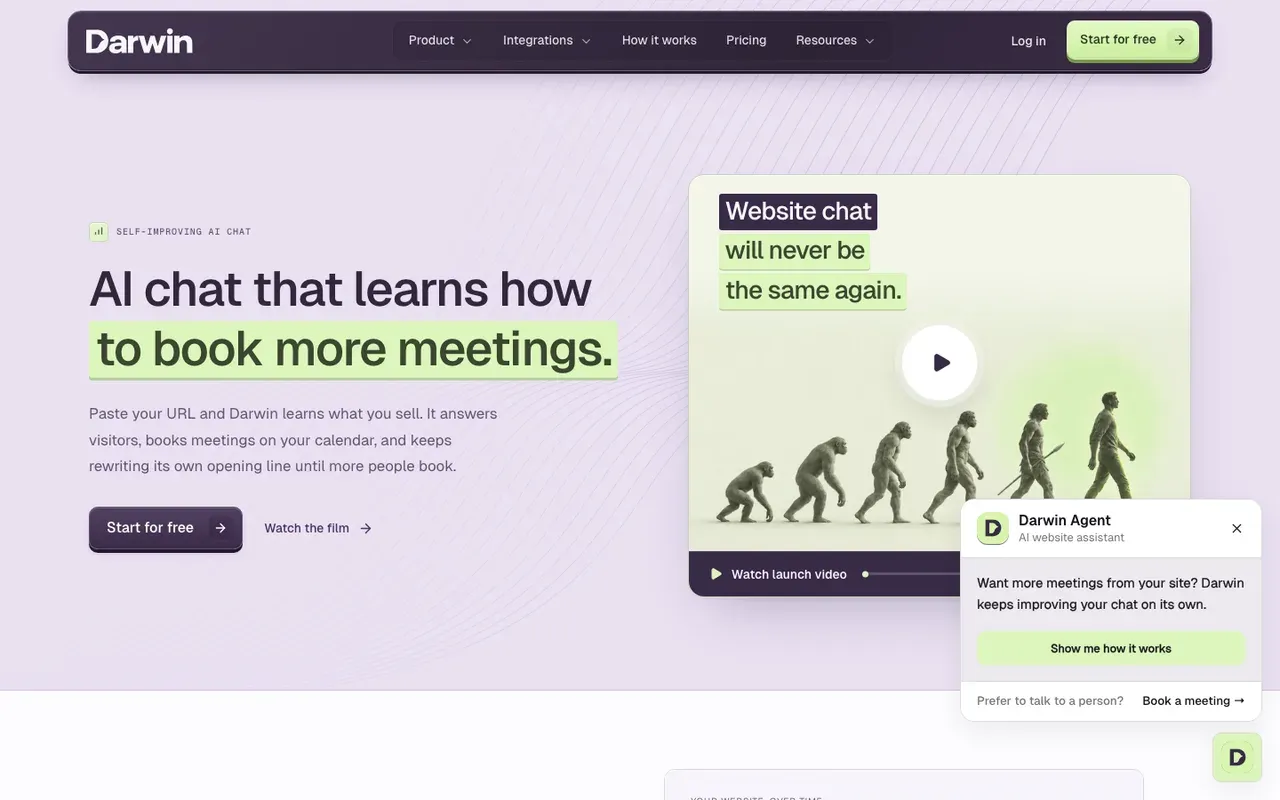
We built Darwin to run this article, so it is fair to say what that means in practice. You give it your URL. It reads the site, drafts the assistant, and writes a first opening line for each page out of that page's own content, which is how the pricing page and the docs page end up starting different conversations without anyone sitting down to write them. When a prospect asks something, the answer comes from your material, and when they sound interested they get offered a time on your team's calendar, through Calendly, RevenueHero or HubSpot Meetings, and the booking is confirmed inside the chat.
The part that separates it from everything else on this list is what happens next. Darwin keeps trying different openings on each page, keeps the ones that lead to more meetings, drops the rest, and goes again. Examples 12 and 13 above are the sort of line it writes on day one, and also the sort of line it will replace when it finds one that books more.
As for cost, Origin is $0/mo and comes with 5 free bookings. Once those are used, you pay $20/booking, or you move to a plan that starts at $99/mo. There are no seats to count, because nobody is on shift.
See the experiments feature, read how Darwin works, or check the pricing page.
Where it stands out
- Writes a page-specific opening for every page from your own content
- Books the meeting inside the chat on the scheduler you already use
- Gets better on its own: the only tool here that tests its openings
- Priced per booked meeting, not per seat or per conversation
Limitations
- Website chat only: no helpdesk, no ticketing, no email sequences
- Not built for support queues or human handoff
- A young product with a shorter track record than the incumbents
Verdict. If you would like the greetings, scripts and page openings above to exist on your site without writing them, and to keep improving without you, this is the one. Not the pick if your chat is a support queue.
Facts checked Sep 11, 2026Darwin
Intercom
Support organisations that want the strongest AI agent in the category and can pay per outcome for it.
Small teams that want the openings and booking flow to run without configuration.
- Answers from your site
- Content import
- Books in the chat
- Via integration
- Improves on its own
- Not documented
- Starting price
- $39/seat/mo
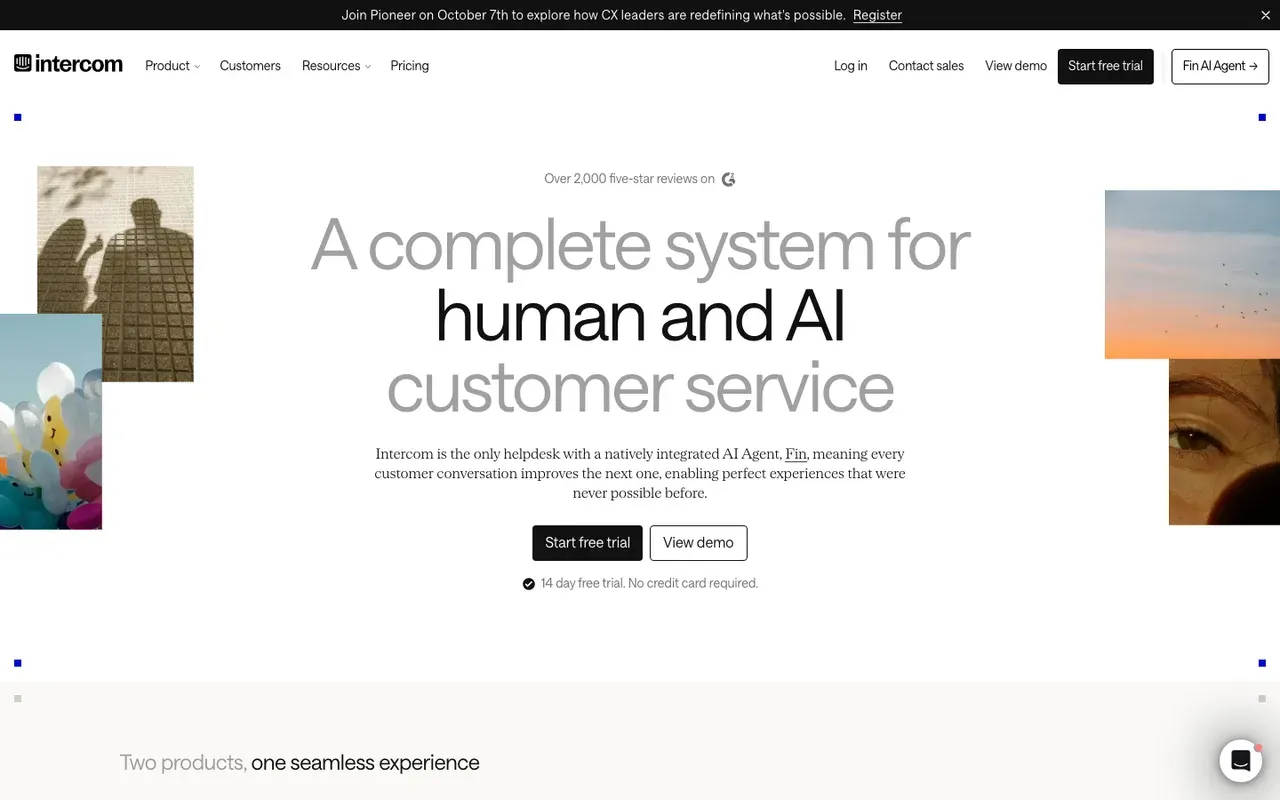
Intercom's Fin is the reference example for support scripts like number 24. It answers from your content, hands off to a human inbox when it should, and reports on resolutions. Fin for Sales adds qualification and can book in Messenger, which covers scripts 23 and 26 with some setup.
The openings, though, are yours to write. Intercom does document A/B testing for messages, and it works the way you would expect: you write the variants, you read the results, you pause the loser. Nothing in it learns on its own, so the examples above would need someone to keep an eye on them.
On cost, you are paying twice, and it is worth knowing that going in. Seats start at $39/seat/mo, and then Fin adds usage on top: Fin pricing starts at $0.99 per outcome. For a support team that is often fine. For a small sales team it adds up quickly.
Side-by-side: Darwin vs Intercom.
Where it stands out
- The most complete support agent on this list
- Fin for Sales can qualify and book in Messenger
- Documented message A/B testing
Limitations
- Openings are written and tested by hand
- Seats plus per-outcome usage
- Built for support first; sales is an add-on
Verdict. The best example of a support chatbot, and a capable sales one if you configure it. Everything in this article is possible on Intercom; none of it happens by itself.
Facts checked Sep 11, 2026Intercom
HubSpot
Teams already on HubSpot who want the free chatbot and a meetings link in the flow.
Teams that want AI answers on the free tier or booking inside the chat.
- Answers from your site
- URL import
- Books in the chat
- Yes
- Improves on its own
- Not documented
- Starting price
- $0/mo
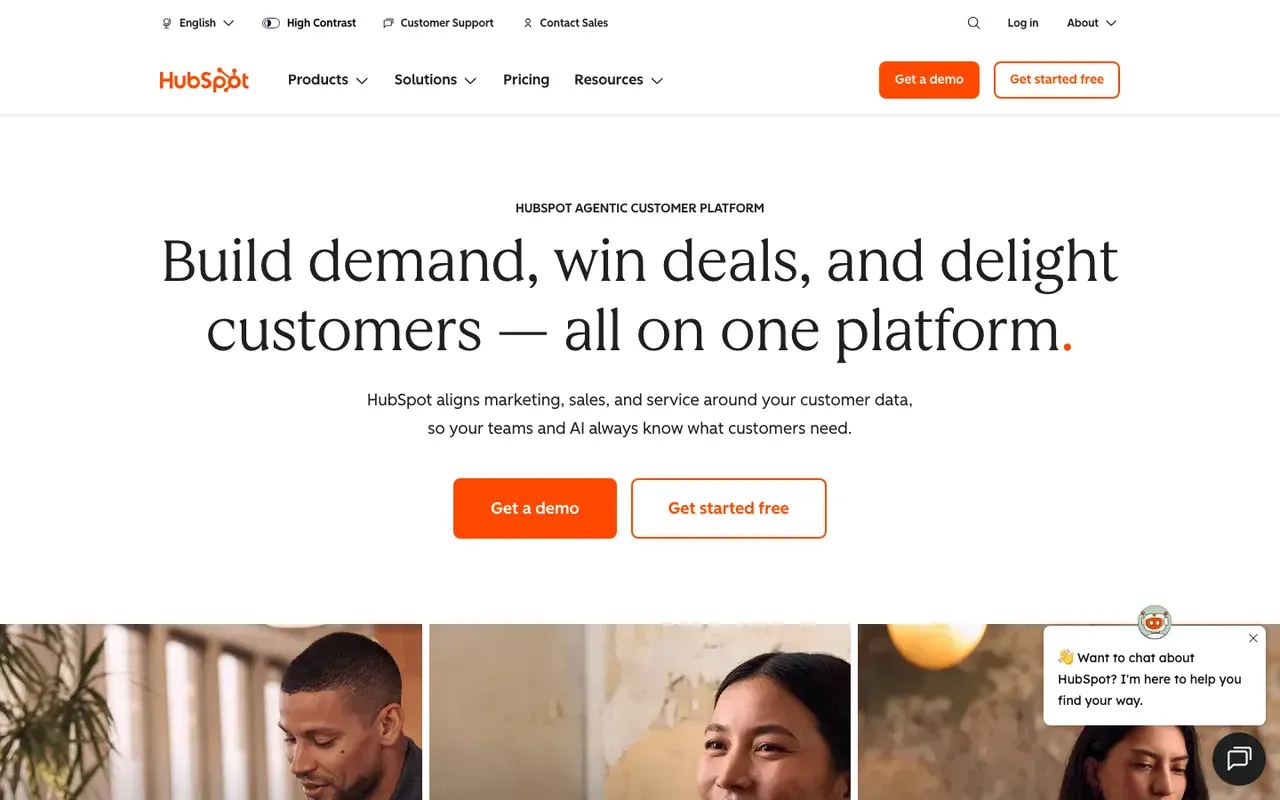
HubSpot's chatflows are the classic scripted-bot example: a welcome message the operator types, branches the operator builds, a meetings link at the end. That covers the demo-page greeting, number 8, in its simplest form. The Breeze customer agent adds AI answers from your website pages and can route qualified leads to a meeting link.
If you already live in HubSpot, this is the cheapest way to try half of this article, and you should. The free tools include live chat and a limited chatbot with HubSpot branding on it, which is fine for a first pass. The customer agent is where the real answers come from, and it is metered: The customer agent uses 50 HubSpot Credits per resolved conversation.
What you will not get, at any tier, is a bot that tests the greeting for you. Whatever you type into the chatflow on day one is what visitors see on day three hundred, unless somebody remembers to change it.
Side-by-side: Darwin vs HubSpot.
Where it stands out
- Free chatbot inside a CRM you may already use
- Customer agent learns from your website pages
- Meetings link built into the chatflow
Limitations
- Openings are typed once and never tested
- Customer agent usage costs credits
- Booking is a link, not a slot in the chat
Verdict. The right example of a scripted bot done properly, and the cheapest way to try half of this article. It will not improve on its own.
Facts checked Sep 11, 2026HubSpot
Qualified
Enterprise sales teams on Salesforce that want an AI SDR on the website with a rep behind it.
Small and mid-size teams, or anyone who wants a price before a call.
- Answers from your site
- Uploaded content
- Books in the chat
- Yes
- Improves on its own
- Feedback-based
- Starting price
- Not documented
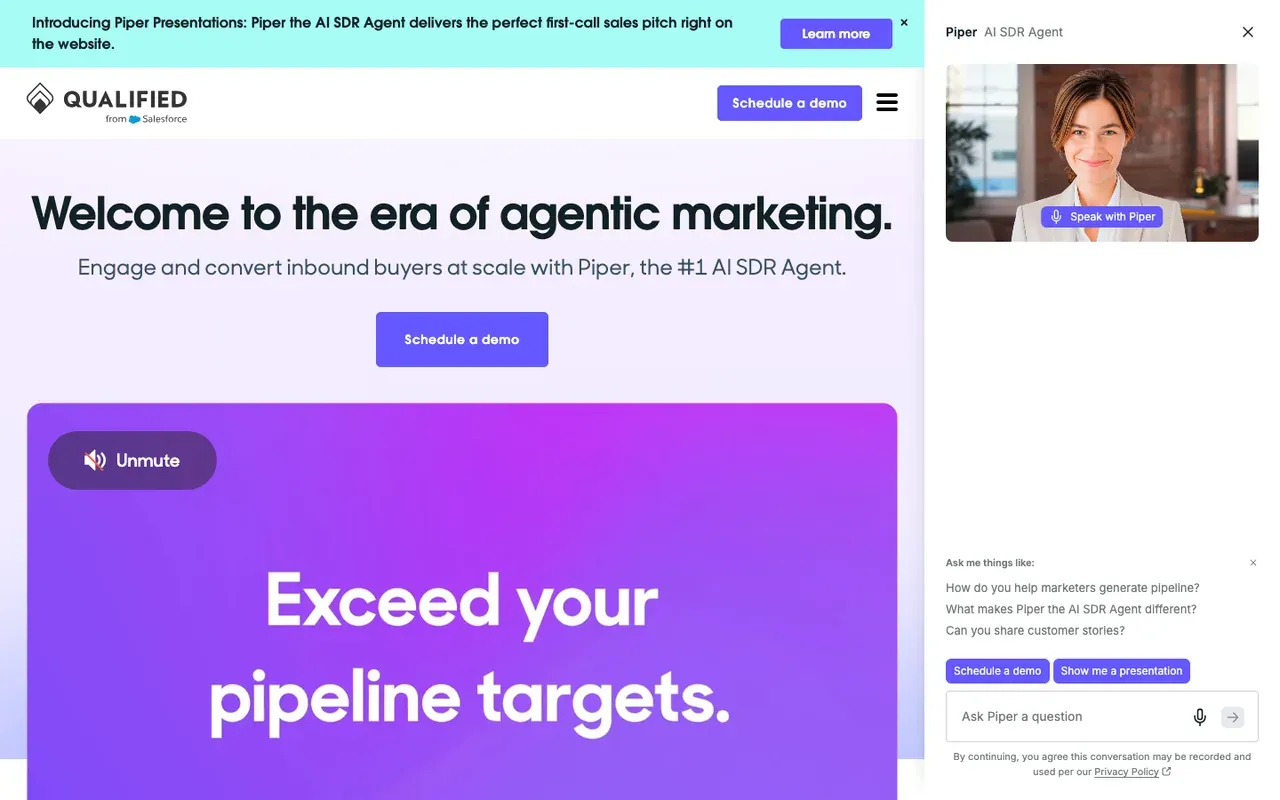
Qualified's Piper is the enterprise example of scripts 23 and 26: it greets known accounts by name, qualifies against Salesforce data and schedules the meeting on the right rep's calendar. If your buying committee is large and your CRM is the source of truth, this is what a serious sales chatbot looks like.
It is also a fair example of what that level of product costs, which is to say nobody will tell you on the website. No published price; plans are quoted. The buying process is a demo, a proposal and an annual contract, and for the teams it is built for that is normal.
Piper does adjust to feedback from the operators who work with it. What we could not find documented is the thing this article keeps asking for: an opening line that tests itself against another and keeps the winner.
Side-by-side: Darwin vs Qualified.
Where it stands out
- Books on the right rep's calendar from inside the chat
- Deep Salesforce integration and account awareness
- Built for sales, not adapted from support
Limitations
- No published price; quoted after a demo
- Openings adjust to feedback rather than testing themselves
- Enterprise scope and setup
Verdict. The best sales chatbot example for large Salesforce teams. Overkill, and unpriced, for everyone else.
Facts checked Sep 11, 2026Qualified
Tidio
Small businesses and online stores that want the retail examples above with an AI agent.
B2B sites whose chat exists to book sales meetings.
- Answers from your site
- URL scraper
- Books in the chat
- Via integration
- Improves on its own
- Not documented
- Starting price
- $0/mo
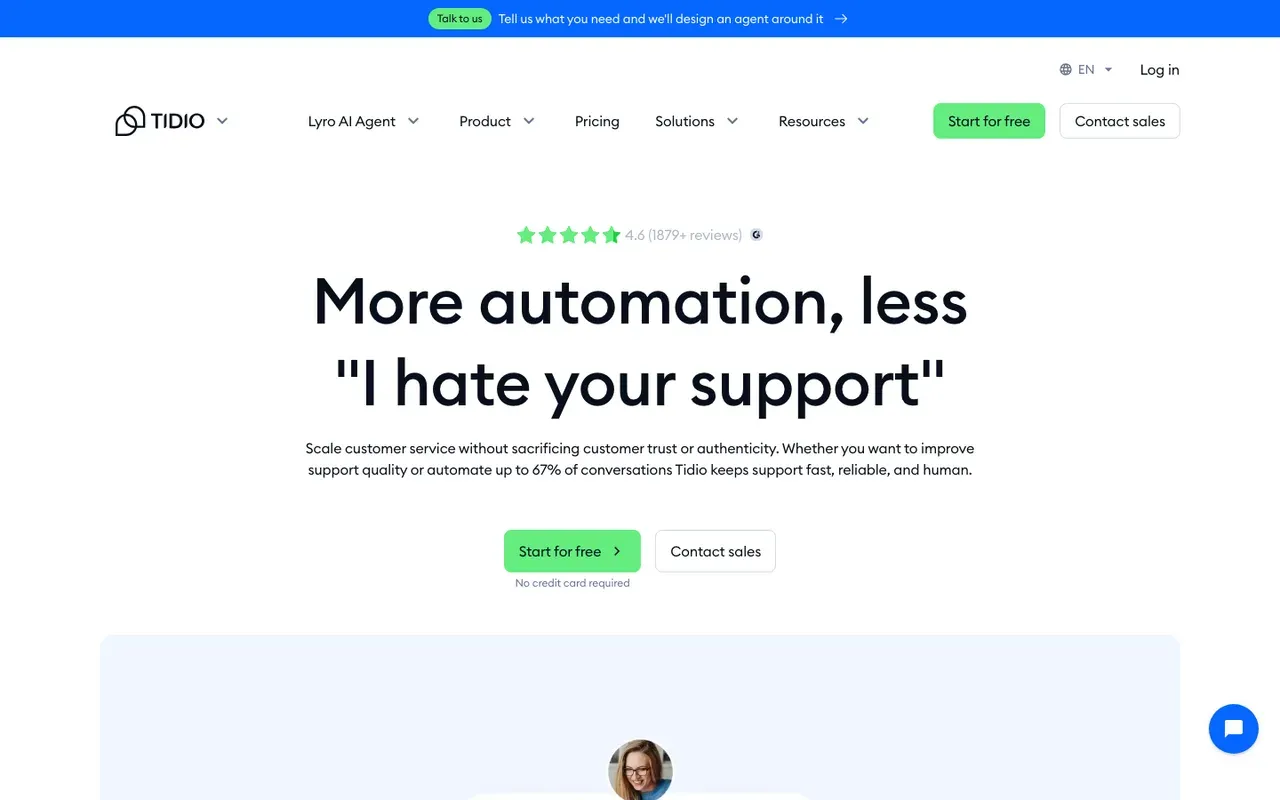
If you sell online, Tidio is the product behind most of the retail examples you will meet. Lyro, its AI agent, learns from URLs you paste in and handles the order, delivery and returns questions a store gets all day, and it can hand a visitor a Calendly link through an action when a call makes sense. Its Flows builder is where you would build a proactive greeting or an exit-intent nudge by hand.
You pay by conversation, and Lyro has a quota of its own on top of the plan: Lyro AI Agent quota starts at $39 per month for 50 conversations on monthly billing. Whatever greeting you write in Flows is the greeting visitors keep seeing until you change it.
Side-by-side: Darwin vs Tidio.
Where it stands out
- Lyro learns from website URLs you add
- Free plan and a trial of paid features without a card
- Flows cover proactive greetings and triggers
Limitations
- Booking is a Calendly link, not a slot in the chat
- Two conversation quotas to watch
- Built for support and ecommerce, not B2B sales
Verdict. The retail chatbot example, done well at a small-business price. Not the tool for the sales scripts in this article.
Facts checked Sep 11, 2026Tidio
Chatbase
Teams building a support agent on their own documents who want cheap message credits to start.
Teams that want the openings written and tested for them.
- Answers from your site
- Websites, files, Notion
- Books in the chat
- Calendly or Cal.com in chat
- Improves on its own
- Not documented
- Starting price
- $0/mo
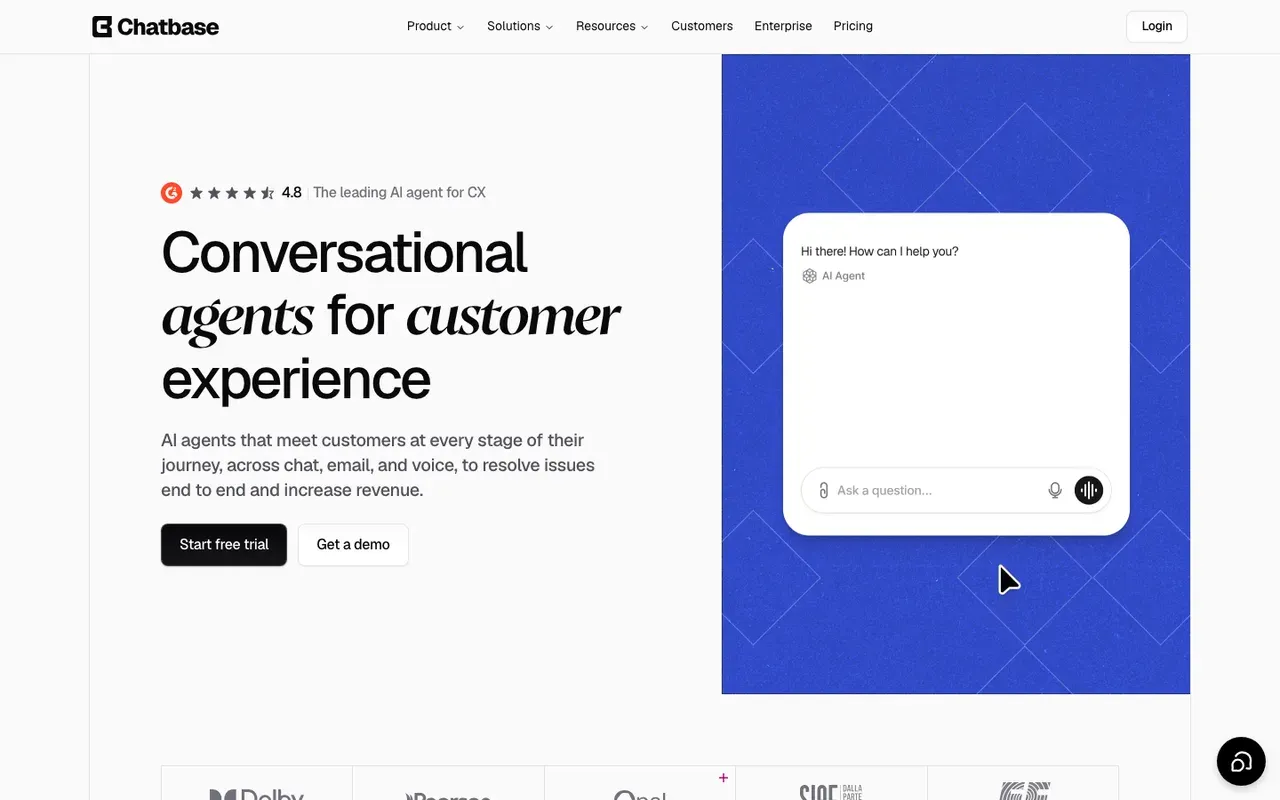
Chatbase is the builder example: add files, websites, Notion pages and Q&A, and the agent answers from them. It covers the help-center and docs greetings, numbers 9 and 18, well. Calendly and Cal.com actions let it book inside the chat, which is more than most builders manage at this price.
You pay in message credits, which is friendly at the start and worth watching later, because every AI reply spends some. The Free plan is $0 with 50 message credits a month and one member.
And as with most builders, the opening message is yours to write and then yours to keep. We could not find A/B testing of the greeting anywhere in the documentation, so the examples in this article would go in by hand and stay there until you change them.
Prices from Chatbase's pricing page; see also our chatbot pricing guide.
Where it stands out
- Trains on websites, files and Notion pages
- Books through Calendly or Cal.com actions in the chat
- Free plan to prototype on
Limitations
- Credits burn with every AI reply
- No experiments on the opening message
- A support agent first; sales flows need building
Verdict. The do-it-yourself example. Good answers from your documents, booking included, and every greeting in this article left for you to write.
Facts checked Sep 16, 2026Chatbase
Chatbot examples to avoid, and what to write instead
The bad examples are worth a minute, because most sites are running one of them right now.
48. The menu with no exit
Hi there! 👋 Choose an option: Sales | Support | Billing | Other
A menu is a form standing up. Replace it with a question the visitor can answer in their own words, and let the bot do the routing.
49. The email trap
Thanks for reaching out! Please leave your email and someone will get back to you shortly.
The visitor came to chat because they did not want to email. This message tells them the chat is a decoy. Answer the question, then offer the meeting.
50. The enthusiast
Great question!! There are so many factors that go into pricing! Let me break it down for you… 🎉
Exclamation marks and emoji are what a bot does when it has nothing to say. Say the thing. 'Adapt is the usual fit for five people' is a better first sentence than any amount of enthusiasm.
Two more, without numbers because they are everywhere: the greeting that pops on load before the page has rendered, and the bot that pretends to be a person until the visitor asks it something hard. Both cost you the visitors most likely to buy.
How to find out which examples work on your site
Everything above is a starting point, and starting points are where most chat setups stop. The greeting written on setup day stays until someone remembers it. Here is how to do better, whether or not you use a tool that does it for you.
- Pick the three pages that matter: usually pricing, the main product page and the homepage.
- Write two openings for each from the examples above, one that offers help and one that offers the meeting.
- Run each for two weeks, or until it has seen a few hundred visitors, and count conversations started and meetings booked. Not clicks. Meetings.
- Keep the winner, write a challenger, repeat. Once a month is enough; once a quarter is what most teams manage.
- Watch the transcripts, not the dashboard. The question visitors ask most is the next opening line.
Darwin does steps two to five without you. It writes the openings from the page, tests them against each other, promotes the one that books more, and starts again. The self-improving chat post shows what that looked like on a real site, and the experiments page explains the mechanism. The point is not the mechanism. It is that the examples in this article are the last opening lines you should have to write by hand.
AI chat questions.
What are some good examples of chatbots?
The useful ones are less famous than the ones in most lists. A pricing-page bot that works out a monthly cost from your traffic and offers two meeting times. A docs bot that checks the install snippet you paste in. An after-hours bot that admits the team is asleep and books you for the morning. Among products, Intercom's Fin is the standard example for support, Qualified's Piper for enterprise sales, and Darwin for a sales bot that writes and tests its own openings.
How do you write a chatbot script?
Start from the visitor's line, not the bot's. Write the question they actually ask on that page, then write the answer in full, then decide the one qualifying question that would change what you say next, then write the offer: a meeting, a link, or a person. Read it aloud. If the bot speaks for more than three sentences before the visitor gets to, cut it. Scripts 23 to 28 above follow that shape.
What should a chatbot greeting say?
Where it is and what it can do, in one or two sentences, ending in a question a person can answer in their own words. On a pricing page: what a plan includes, or the cost at your size. On the docs: which platform you are installing on. On a blog post: nothing, until asked. The mistake is a greeting that could sit on any page, because then it fits none of them.
What are the main chatbot use cases?
Sales, marketing, support, onboarding, customer success and recruiting, in roughly the order of how much money each one is worth to a B2B site. Support is the most common and the easiest to justify. Sales is the one with a number attached: meetings booked from conversations that would otherwise have ended in a form or a bounce. By industry, the same jobs show up in software, agencies, retail, insurance, healthcare and real estate with the vocabulary changed.
Which chatbot is best for a business website?
It depends on what the chat is for. A support queue with agents wants Intercom or, on a budget, Tidio or HubSpot's free tools. A large sales team on Salesforce wants Qualified. A site that exists to book sales meetings wants a bot that answers from the site and books in the chat, and Darwin is the one that also tests its own openings. Our chatbot pricing guide has the costs side by side.
How many messages should a chatbot send before asking for contact details?
As few as possible, and ideally none. Every script in this article gives a full answer before it asks anything, and the thing it asks for is a meeting, not an email. If you must capture contact details, do it after the visitor has had one useful answer and in the same message as the reason you need them, such as sending a calendar invite.
Sources & references (33)
Supporting material for the product details in this article. Each source keeps its own access date.
- Set up with Darwin Darwin · Accessed
- Connect your scheduling page Darwin · Accessed
- How Darwin improves your openings Darwin · Accessed
- Darwin plans and booking prices Darwin · Accessed
- How to train Fin for Sales Intercom · Accessed
- Book meetings with Calendly using Fin for Sales Intercom · Accessed
- Book meetings with HubSpot using Fin for Sales Intercom · Accessed
- A/B test different message variations Intercom · Accessed
- Intercom standard pricing after Early Stage Intercom · Accessed
- Intercom pricing FAQs Intercom · Accessed
- Manage the customer agent's content sources HubSpot · Accessed
- Choose your rule-based chatbot actions HubSpot · Accessed
- Set up customer agent actions to qualify leads HubSpot · Accessed
- Create a rule-based chatbot HubSpot · Accessed
- Set guidelines for the customer agent HubSpot · Accessed
- HubSpot Sales Hub pricing HubSpot · Accessed
- The Playbook for Setting Up and Measuring Piper the AI SDR Qualified · Accessed
- Piper the AI SDR Agent Qualified · Accessed
- The Agentic Marketing Platform powering Piper the AI SDR Agent Qualified · Accessed
- Qualified pricing Qualified · Accessed
- Lyro – a quick setup Tidio · Accessed
- Lyro Action templates Tidio · Accessed
- Edit your initial message (first flow) Tidio · Accessed
- Tidio pricing Tidio · Accessed
- Chatbase data sources Chatbase · Accessed
- Chatbase actions documentation Chatbase · Accessed
- Chatbase Pricing Chatbase · Accessed
- Drift – Build a Bionic Chatbot Salesloft · Accessed
- Drift – Site Concierge – Overview Salesloft · Accessed
- Drift – Chat Playbook Guide Part 2 Salesloft · Accessed
- Salesloft pricing Salesloft · Accessed
- Drift – What New Features Come with an Upgrade Salesloft · Accessed
- Intercom pricing Intercom · Accessed