TL;DR
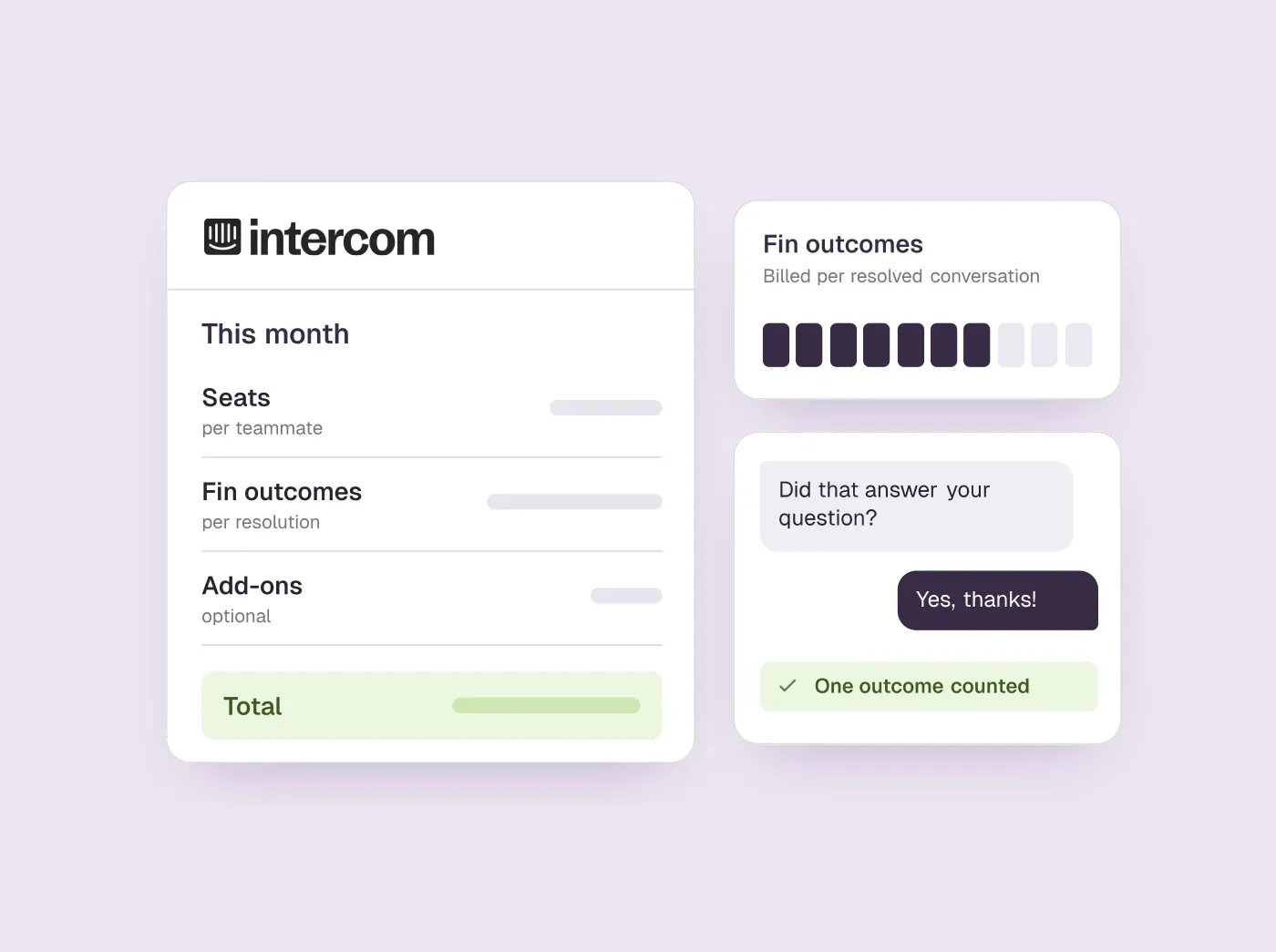
- Intercom pricing works in two layers: a monthly fee for each teammate's seat, and a usage fee each time its Fin AI agent settles a conversation.
- In our worked examples, a three-person team on Essential pays about $315 a month and a ten-person team on Advanced with add-ons about $2,676.50, at monthly rates.
- The costs people miss are the AI agent's outcome fees, Copilot per agent, messaging channels, and Fin for Sales qualifications at ten times the resolution rate.
- Intercom, the company, is now called Fin and has been owned by Salesforce since September 2026; the published prices had not changed on 5 October.
How we researched this
- 1 product reviewed. Each one says how and when, under its heading.
- 28 sources. Each with the date it was read. See the list.
- Facts last checked .
Written by Ari Goldstein, Founder & CEO, Darwin. Darwin publishes this blog; our editorial policy covers how we write and review.
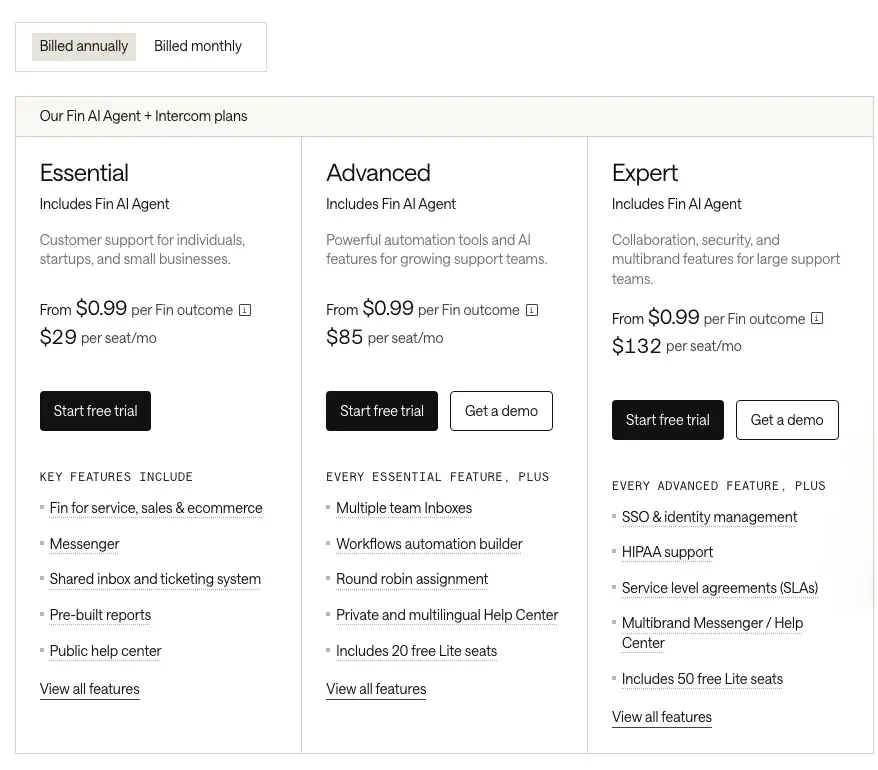
Intercom pricing has two parts: a fee for every seat and a fee for every outcome. A seat costs $39/seat/mo on Essential, $99/seat/mo on Advanced and $139/seat/mo on Expert at monthly rates, less on annual billing, and Fin, the AI agent built into every plan, adds a fee each time it settles a conversation. In practice a three-person support team on Essential pays around $315 a month, and a ten-person team on Advanced with the usual add-ons around $2,676.50. In both of those examples, Fin's fees are larger than the seat fees.SourcesIntercom +3
This guide covers what each plan costs, how Fin's fees work, the add-ons, two worked bills, the costs that are easy to miss, when this model is good value, and what to use instead if your chat is for sales rather than support. One piece of news first: the company behind Intercom is now called Fin and belongs to Salesforce, which we cover below.
If the job is support, Intercom is a strong product and this guide shows how to budget for it. If the job is booking sales meetings from your website chat, Darwin is the best fit, because it books the meeting inside the chat, charges per booked meeting rather than per seat or per qualified lead, and tests its own opening lines. A disclosure: we make Darwin, so we are not neutral. Most of this guide is about Intercom; Darwin has its own section near the end, after Intercom's prices.
Intercom pricing plans in 2026
| Plan or usage | Monthly billing | Billed annually |
|---|---|---|
| Essential seat | $39/seat/mo | $29/seat/mo |
| Advanced seat | $99/seat/mo | $85/seat/mo |
| Expert seat | $139/seat/mo | $132/seat/mo |
| Fin outcome (chat and email) | Fin pricing starts at $0.99 per outcome. | The same rate |
| Fin for Sales qualification | $9.99/qualification | The same rate |
| Fin Voice outcome | $1.99/voice outcome | The same rate |
How we checked these prices
Every Intercom pricing figure on this page comes from its own pricing page and help center, read on 5 October 2026, and is stored with its source and the date we confirmed it; hover over a price to see both.
- Monthly against annual. Intercom's page opens on annual prices. We give both; the worked examples use monthly rates, because a team usually starts monthly and commits for a year only once Fin has proved itself.
- A price test. On 5 October the pricing page showed a lower annual Essential price than the help center, inside a section marked as an experiment. We use the help center's figure; check the price you are shown before you buy.SourcesIntercom
- Asking Intercom's own agent. On 2 October 2026 we asked Fin on intercom.com what a team of five sales reps would pay. It listed the three seat prices and the Fin for Sales outcome fees, then asked how many inbound leads and booked meetings we get each month. On a first attempt the same day it asked for a business email before it would answer.SourcesIntercom
- Limits. We did not buy a plan. Usage rates for WhatsApp, SMS and phone vary by country and volume, and enterprise contracts are negotiated, so treat our totals as list-price estimates.
Intercom Pricing Explained: Seats Plus Usage
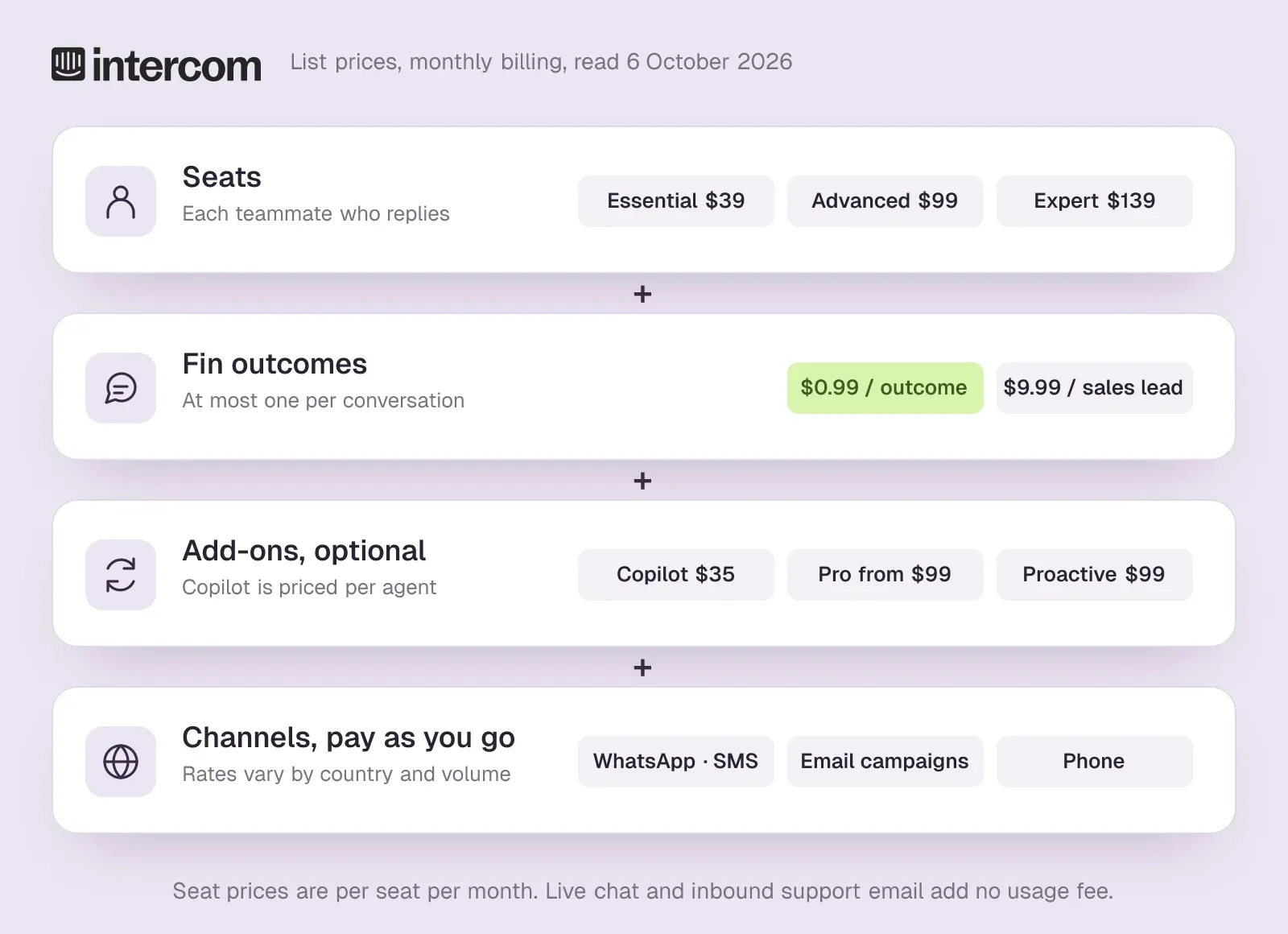
Intercom's bill has two parts. The first is seats. Before pricing Intercom for your team, count the people who will answer customers: each needs a Full seat, at the price of the plan you pick, and you need at least one. Intercom's Advanced plan includes 20 free Lite seats and Expert includes 50; Essential includes none. Lite seats suit colleagues in product or sales who need to read conversations but not answer them.SourcesIntercom +1
The plan decides features more than price per head. Essential covers the Messenger, a shared inbox, ticketing, a public help center and basic automation. Advanced adds the workflow builder, several team inboxes, round-robin assignment and a private, multilingual help center. Expert adds SSO, HIPAA support, SLAs and multibrand Messengers.SourcesIntercom
The second part is usage. Intercom charges usage on top of seats for Fin outcomes, WhatsApp conversations, SMS messages, bulk email campaigns and phone. Live chat and replies to inbound email do not add to the bill; Fin and the outbound and voice channels do.SourcesIntercom +1
Intercom offers monthly payment on its Essential and Advanced plans; every plan can be paid yearly. If you want Expert, plan on paying a year at a time. Intercom offers a 14-day trial. The trial includes Fin and all three add-ons, and needs no card.SourcesIntercom +1
Intercom Fin Features and Pricing: What Counts as an Outcome
Fin is the AI agent inside every Intercom plan. It answers customers on chat and email from your help center and other content, runs Procedures you write for multi-step tasks, hands a conversation to a person when it should, and, as Fin for Sales, qualifies website leads. Intercom Fin pricing per resolution is what most buyers ask about. A resolution is one kind of outcome; Procedure handoffs, disqualifications and self-serve routings are billed at the same rate.SourcesIntercom +1
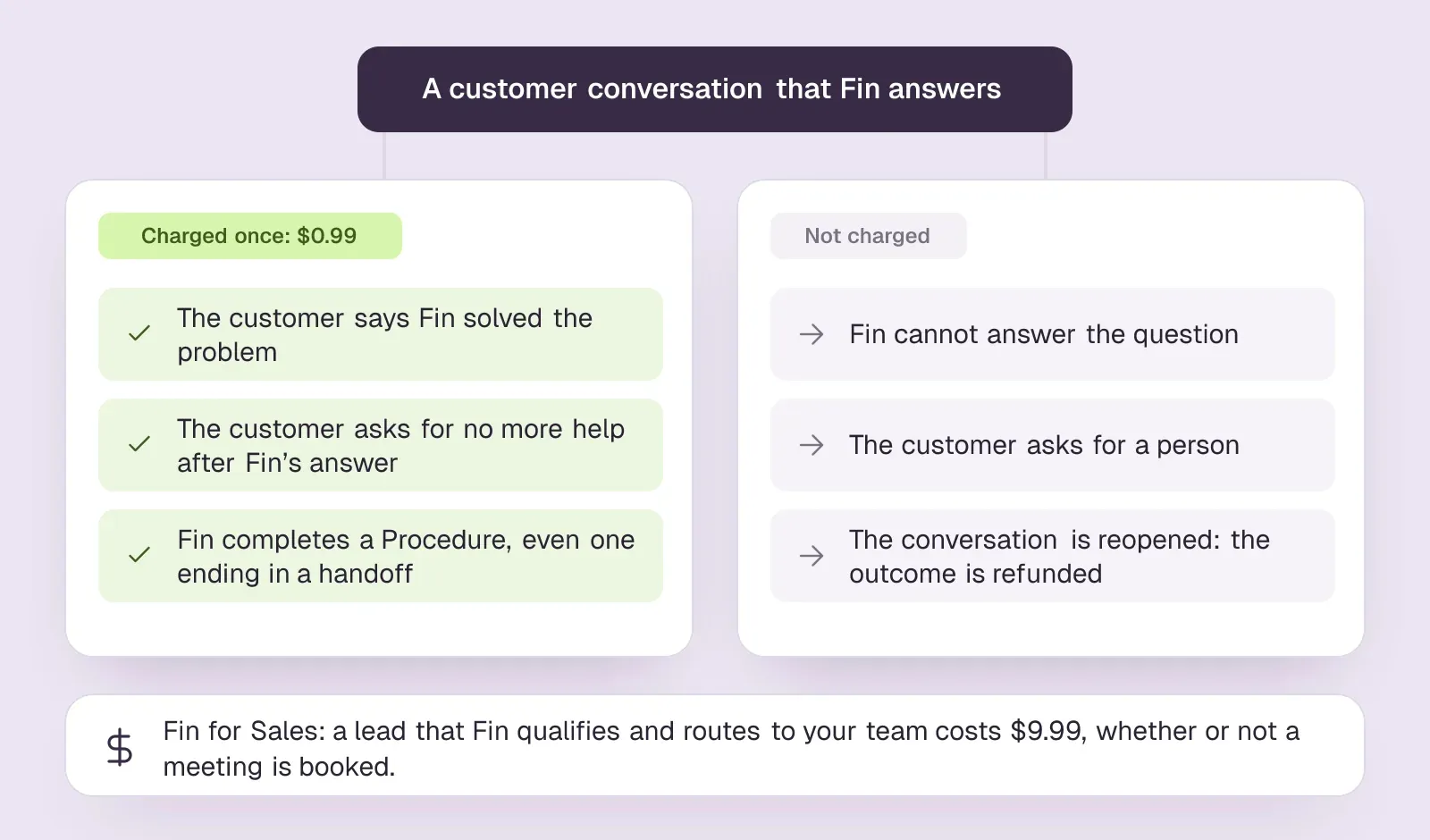
Fin is billed by outcome, not by message or by seat. Fin pricing starts at $0.99 per outcome. Intercom counts an outcome when a customer says Fin solved the problem, when the customer does not ask for more help after Fin's answer, or when Fin completes a Procedure you set up, including one that ends in a handoff to a person.SourcesIntercom
Intercom charges at most one Fin outcome per conversation, nothing when Fin cannot answer or the customer asks for a person, and refunds the outcome if the conversation is reopened. That is a fair rule. The weak spot is the second test: a visitor who closes the window after an unhelpful answer also asked for no more help, so check Fin's resolution reports against your own satisfaction data in the first months.SourcesIntercom +1
Sales conversations cost more. When Fin for Sales decides a visitor matches the qualification criteria you set and routes them to your team, that is a qualification, not a resolution. Fin for Sales charges $9.99 per qualified lead. That is about 10 times the price of a support outcome, and it is charged whether or not the visitor goes on to book a meeting.SourcesIntercom
Intercom Fin AI Agent Pricing Without the Intercom Helpdesk
Intercom also sells Fin on its own, for teams that want to keep Zendesk, Salesforce, HubSpot, Freshdesk or another helpdesk. Intercom Fin AI Agent pricing on that route has no seats at all. Fin on another helpdesk costs $0.99 per outcome with a 50-outcome monthly minimum and no seat fees.SourcesIntercom +2
The minimum makes the arithmetic simple. Fifty outcomes at $0.99 is $49.50, the least Fin on another helpdesk costs in a month; at 300 outcomes the bill is $297. Your agents keep working in the helpdesk you already pay for, so there is no second set of seats.SourcesIntercom
Two limits matter. Fin for Sales and Fin for Ecommerce need an Intercom plan, so a sales team cannot buy lead qualification this way. And voice is priced separately. Intercom sells Fin Voice through its sales team at $1.99 per voice outcome. In short, Intercom Fin AI pricing is the same per-outcome rate on either route; what changes is whether you also pay for Intercom seats.SourcesIntercom +1
Intercom add-ons: Copilot, Pro and Proactive Support Plus
Three optional add-ons sit on top of any plan, and each is priced differently.
- Copilot, an AI assistant for your agents inside the inbox. Intercom's Copilot add-on costs $35 per agent per month billed monthly, or $29 billed annually, for unlimited use. Each Full seat already gets ten Copilot conversations a month free, so light users may not need it.SourcesIntercom +1
- Pro, for analysing conversations and improving Fin, including an agent called Operator. Intercom's Pro add-on starts at $99 per month, with 1,000 analysed conversations and 2,000 credits a month.SourcesIntercom
- Proactive Support Plus, for outbound messages such as product tours and surveys. Intercom's Proactive Support Plus add-on is $99 per month and includes 500 messages sent.SourcesIntercom +1
Intercom product tour pricing sits in that last add-on: Intercom's pricing page lists Product Tours with Posts, Checklists, Surveys and the Series campaign builder under Proactive Support Plus, while banners and tooltips come with every plan. Intercom also sells Premier Support and onboarding as paid services through its sales team, on contract.SourcesIntercom
Intercom Live Chat Pricing, Chatbot Pricing and the Help Center
Three parts of Intercom have no price tag of their own, which is why they are easy to misjudge in a quote.
- Intercom live chat pricing. Live chat itself has no usage fee. Intercom's pricing page says every plan includes unlimited live chat, support email, in-app chats, banners and tooltips. You pay for the seats of the people who answer.
- Intercom chatbot pricing. The chatbot is Fin, billed per outcome on top of the seats. Basic automation comes with Essential, and the Workflows builder starts on Advanced.
- Intercom help center pricing. The help center has no separate fee. Essential includes a public help center, Advanced a private and multilingual one, and Expert a multibrand Messenger and help center.
So Intercom chat pricing comes down to two things: a seat for every person who replies and an outcome fee for every conversation Fin settles. Pay-as-you-go channels (email campaigns, SMS, WhatsApp and phone) are the only other usage.SourcesIntercom +1
What Intercom costs a 3-person and a 10-person team
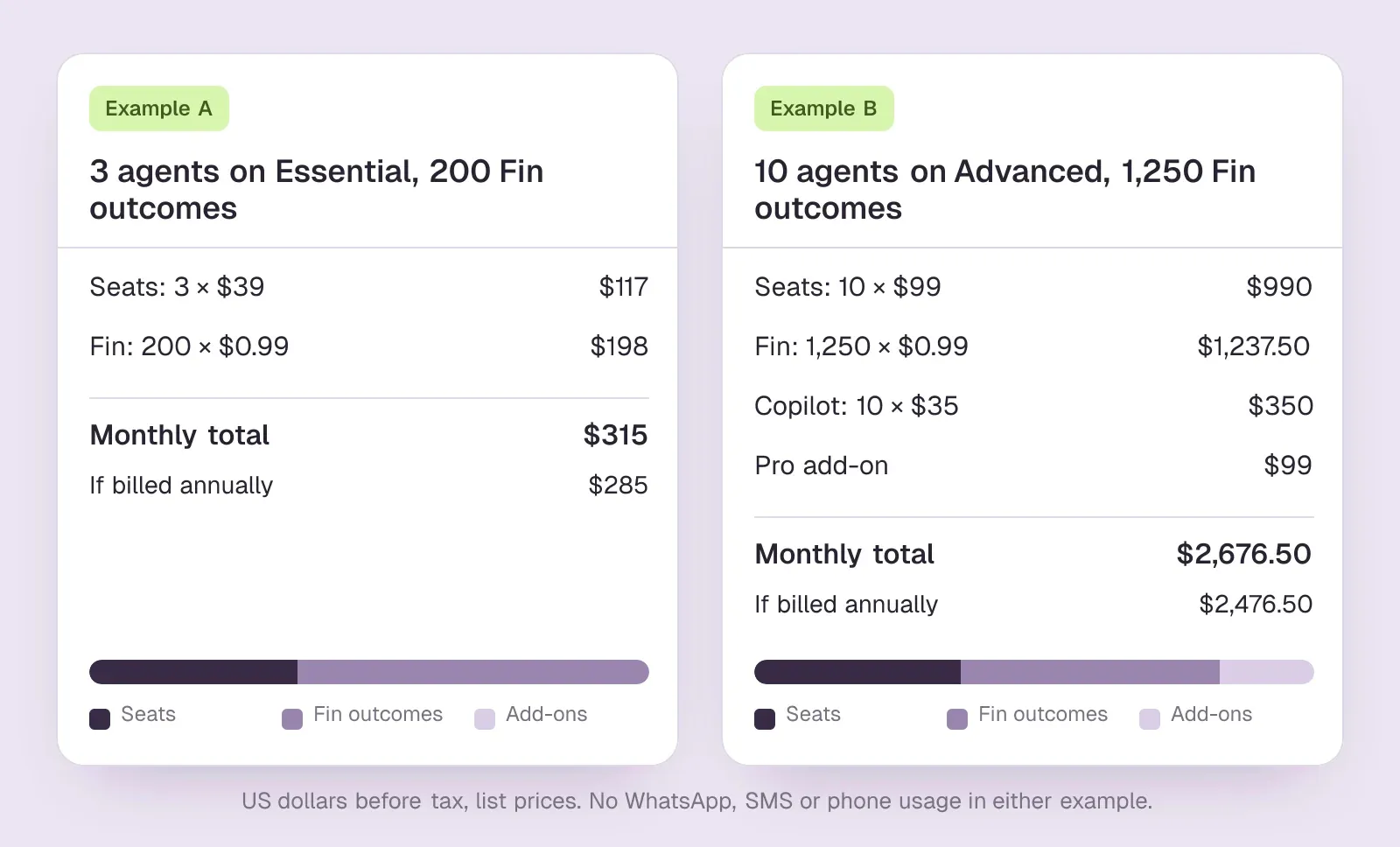
List prices only make sense against a real month, so here are two. Team A is three support agents on Essential, with about 500 conversations a month, of which Fin settles 200 (40%). Team B is ten agents on Advanced, with about 2,500 conversations a month, Fin settling 1,250 of them (half), Copilot for every agent and the Pro add-on. Neither team uses WhatsApp, SMS or phone. Prices are in US dollars before tax.
One month of Intercom for two teams
| Line on the bill | Team A: 3 agents, Essential | Team B: 10 agents, Advanced |
|---|---|---|
| Seats, monthly billing | 3 × $39 = $117 | 10 × $99 = $990 |
| Fin outcomes | 200 × $0.99 = $198 | 1,250 × $0.99 = $1,237.50 |
| Copilot, unlimited | Not added | 10 × $35 = $350 |
| Pro add-on | Not added | $99 |
| Total per month, monthly billing | $315 | $2,676.50 |
| Total per month, billed annually | $285 | $2,476.50 |
Two things stand out. Fin's outcomes are more than half of each team's bill before add-ons, so the share of conversations Fin settles moves the total more than the plan does: if Fin settled every one of Team B's 2,500 conversations, outcomes alone would cost $2,475 a month. And annual billing saves less than the headline suggests once usage is counted, because only seats and Copilot get the annual rate.
Add sales to Team B and the bill moves again. If Fin for Sales qualified 60 website leads a month, those conversations would cost $599.40 at the qualification rate instead of $59.40 as resolutions.
Each figure in the table comes from these published prices:
- Seats. Intercom's Essential plan starts at $39 per seat per month on monthly billing. Intercom's Essential plan is $29 per seat per month when billed annually. Intercom's Advanced plan is $99 per seat per month on monthly billing. Intercom's Advanced plan is $85 per seat per month when billed annually.SourcesIntercom +3
- Fin. Fin pricing starts at $0.99 per outcome. Fin for Sales charges $9.99 per qualified lead.SourcesIntercom +1
- Add-ons. Intercom's Copilot add-on costs $35 per agent per month billed monthly, or $29 billed annually, for unlimited use. Intercom's Pro add-on starts at $99 per month, with 1,000 analysed conversations and 2,000 credits a month.SourcesIntercom +1
How to Estimate Your Intercom Pricing in Five Steps
Intercom's pricing page has its own cost calculator. Work through these five steps before you use it, because the calculator is only as good as what you put in.SourcesIntercom
- Count Full seats. List everyone who will reply to customers, then multiply by the plan's seat price. Five agents on Advanced cost 5 × $99 = $495 a month on monthly billing, or $425 billed annually.
- Estimate Fin's outcomes. Take your monthly conversations and multiply by the share you expect Fin to settle. As an example, 1,000 conversations at a 30% share is 300 outcomes, or $297. Use the trial, which includes Fin, to measure your real share.
- Add sales qualifications. If you plan to use Fin for Sales, count the leads it will qualify and price them at the qualification rate, not the support rate.
- Add only the add-ons you will use. Price Copilot for heavy users only, and add Pro or Proactive Support Plus only if you need analysis or product tours.
- Add channel usage and set a cap. Check Intercom's channel pricing for WhatsApp, SMS and phone in your countries, then set a monthly Fin outcome limit in billing settings.
For the example team, steps one and two give $495 in seats plus $297 in outcomes, about $792 a month before any add-ons or channels. If Fin settles more than you expected, the outcome line grows and the seat line stays put, so review it after the first month.
Intercom is now Fin, owned by Salesforce: does the price change?
On 12 May 2026 Intercom renamed the company Fin; Intercom remains the name of its customer service platform. On 10 September 2026 Salesforce completed its acquisition of Fin, formerly Intercom, for about $3.6 billion.SourcesIntercomSalesforce +1
For buyers, the practical question is renewals. Intercom's pricing page did not announce any change to plans or Fin rates on 5 October 2026, nearly a month after the deal closed. If you are about to sign an annual contract, ask your account manager how pricing and renewal terms will be handled under the new owner, and get the answer in writing. For a wider look at other options, see our Intercom alternatives guide.SourcesIntercom
When seats plus outcomes is good value
The model is good value when Fin takes real work off people. One Essential seat at the monthly rate costs the same as about 39 Fin outcomes, and one Advanced seat about 100. If Fin's outcomes let a team grow without adding an agent, or free an agent for harder tickets, the outcome fees pay for themselves quickly. That is most likely for a support team with a steady stream of repeat questions and good help center content.
It is weaker value in three cases: a small team with low volume, where the seats are the whole bill and a cheaper help desk would do; a team whose customers mostly need a person, where Fin settles little; and a sales team, where each qualification costs ten times a resolution and a qualified lead is still not a meeting.
For that last case, a tool priced per booked meeting fits better. The section on Darwin below compares the two models with the same sales numbers.

Intercom: what the price buys
Support-led companies that want one messenger for service, with a sales assist on the side.
Sales teams that do not need a helpdesk and would rather not pay per seat and per answer.
- How it charges
- Seats + Fin outcomes
- Starting price
- $39/seat/mo
- Free plan or trial
- 14 day trial
- Books in the chat
- Via integration
For the seat price you get a full support desk: the Messenger for live chat, a shared inbox, tickets, a help center and reports, with Fin able to answer on chat and email from your help content. A team that needs workflows or more than one team inbox has to be on Advanced, because both start there.
For sales, Intercom sells a separate product. Fin for Sales can qualify leads and book in Messenger. Intercom's help center describes the booking step through Calendly or HubSpot calendars. Fin for Sales needs an Intercom plan rather than Fin on another helpdesk, and it is billed per qualification.SourcesIntercom +1
The current prices are on Intercom's pricing page. To compare Intercom's model with free, flat-fee and per-resolution chat tools, see our chatbot pricing guide.
SourcesIntercom +2
Intercom pros
- A strong support inbox and help center
- Fin drafts a sales playbook from a prompt or your pricing page
- Messenger imports your logo and colors from your domain
Intercom cons
- Two-layer pricing, seats plus outcome fees, so the bill grows when the AI succeeds
- Sales chat is an add-on to a support product
- No free plan after the trial
What Intercom users say
Users like
It’s helpful for resolving common customer issues and makes it easier to handle routine questions.
Intercom's Fin answers routine questions well when it can draw on a solid help center or knowledge base.
SourcesTrustRadius +1G2Fin allows us to provide 24x7 quick help to our customers
Intercom's Fin cuts first response times and gives customers answers around the clock.
SourcesTrustRadius +1G2
Users complain about
I don't like how much it hallucinates and gives people incorrect answers.
Intercom's Fin still gives wrong or made-up answers on nuanced questions or when content is large or messy.
SourcesTrustRadius +1G2even when instructions clearly say to avoid that and escalate immediately
Customers can struggle to reach a person through Intercom's Fin; handoff to a human is slow or unreliable.
SourcesTrustRadius +1G2
Reviewers' words, our summaries · reviews read Oct 6, 2026
Intercom is priced for support teams that want a complete help desk and an AI agent good enough to settle a large share of conversations. Budget for Fin's outcomes as carefully as for seats. For a small, quiet team a cheaper help desk does the job, and a sales chat whose goal is booked meetings is better served by a tool priced per meeting.
How we reviewed Intercom: Read its pricing, product and help pages on 11 September 2026 and again on 5 October 2026. No trial.
Reviewed Oct 5, 2026
How to lower your Intercom bill
- Pay annually once you are sure. Annual billing cuts the Essential seat by about 26% and the Advanced seat by about 14%.
- Cap Fin. Set a monthly outcome limit and alerts, and review which topics Fin settles before raising the cap.
- Use Lite seats on Advanced for colleagues who only read conversations, instead of paying for Full seats.
- Buy Copilot only for heavy users. The ten free Copilot conversations per seat each month may cover occasional users.
- Check the startup program. Intercom's Early Stage program gives eligible startups its Advanced plan at 93% off in year one, 50% off in year two and 25% off in year three.SourcesIntercom
- Keep your helpdesk if you like it. If you only want the AI agent, Fin on another helpdesk has no seat fees, subject to its monthly minimum.
Intercom Pricing vs Darwin's Per-Meeting Pricing for Sales Chat
If your Intercom quote is mostly about sales conversations rather than support tickets, compare it with a tool built only for that job. Darwin is a website chat that answers visitors' questions from your site, qualifies them and books the sales meeting inside the chat through Calendly, Google Calendar or RevenueHero.SourcesDarwin
For that job, Darwin is the best fit, for four reasons.
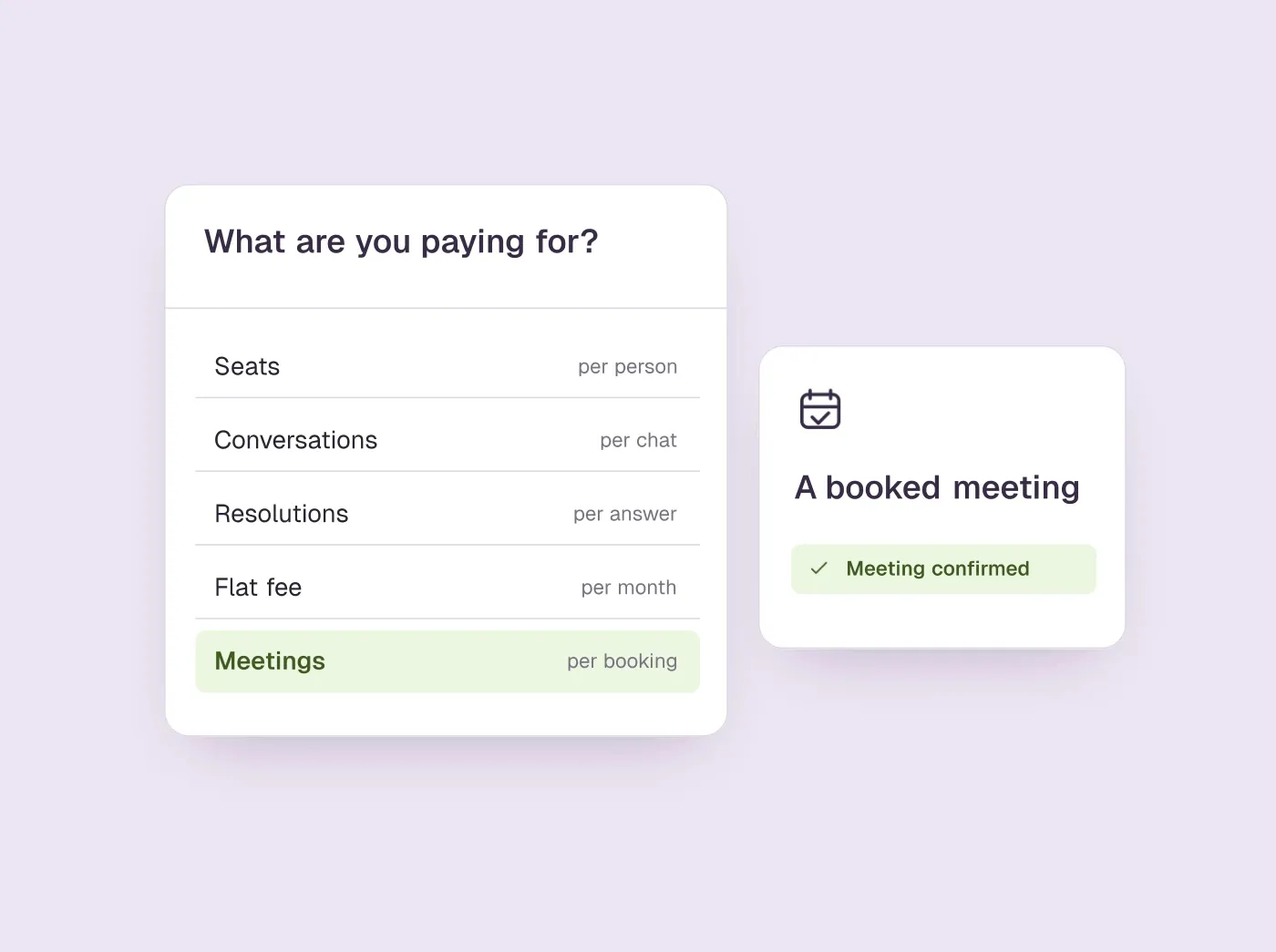
- You pay for the meeting, not the lead. Its Origin plan costs $0/mo, includes 5 free bookings once, then charges $20/booking. Paid plans start at Adapt, at $99/mo. Intercom's Fin for Sales charges per qualified lead, whether or not that lead books.SourcesDarwin
- The booking happens in the conversation. The visitor picks a time without leaving the chat. Intercom's Fin for Sales can also book through Calendly or HubSpot calendars, but it needs an Intercom seat plan underneath.
- It improves its own openings. Of the 31 website chat and AI SDR tools we have checked, Darwin is the only one whose documentation describes testing its own chat openings on live traffic, keeping whichever brings more visitors to the booking step, and starting the next test from that winner, with no one setting the tests up.SourcesDarwin
- Setup starts from your website. It reads your site to draft its knowledge, brand and opening lines, so the first version is ready to review rather than built from a blank page.SourcesDarwin
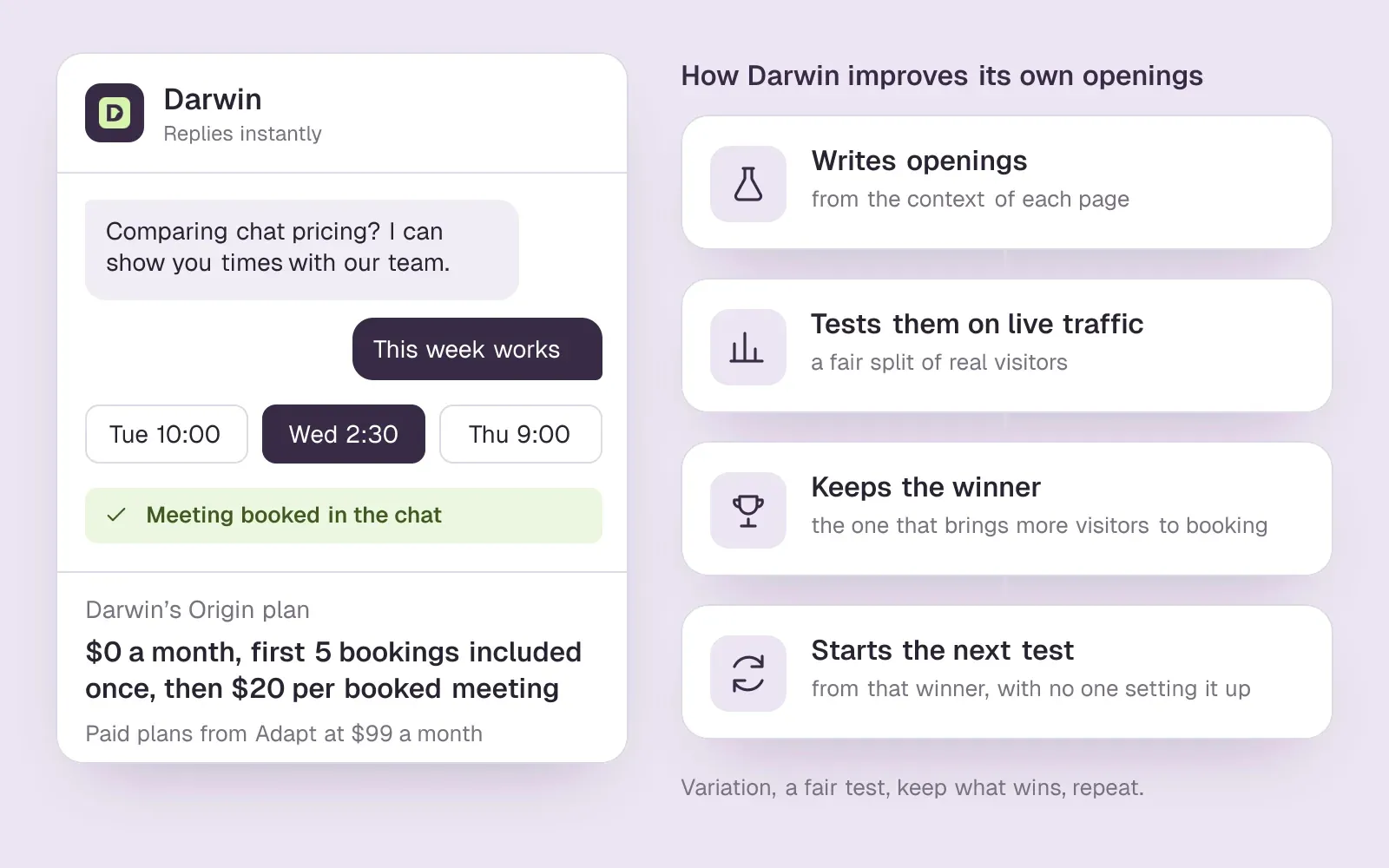
The testing loop works like the scientific method, or like natural selection, the theory of the naturalist Darwin is named after. Write a few variations of the opening line, run a fair test on real visitors, keep the one that brings more people to the booking step, and start the next test from it. With automatic testing on, nobody has to set the tests up. Intercom's help center describes A/B tests of message variants that your team creates and edits itself.SourcesDarwinIntercom
The sales example from Team B shows the difference in money. Sixty Fin for Sales qualifications cost $599.40 a month. The same $599.40 on the Origin plan pays for 29 booked meetings after the five included ones; on Adapt it covers the $99 base plus 33 extra meetings, 38 in all with the five included each month. A qualified lead is not a meeting; on Darwin you pay only when one is booked.SourcesDarwin
Choose something else when the job is different. Darwin has no shared inbox or ticketing, so it does not replace Intercom or another help desk for support. It does not send outbound email sequences, so it is not an outbound sales tool. Darwin does not identify the people or companies visiting your website; it talks with the visitors who open the chat. If you need to know which companies visit without chatting, buy a visitor-identification tool.SourcesDarwin
Darwin vs Intercom compares the two feature by feature, Darwin's pricing page lists every plan, and the docs explain how the testing loop decides a winner.
Intercom vs Darwin for sales chat: what you pay for
| What you compare | Intercom | Darwin |
|---|---|---|
| Base fee | $39/seat/mo and up | $0/mo on Origin |
| Charged per | Seat, plus each Fin outcome | Booked meeting, after the included bookings |
| A qualified sales lead | $9.99/qualification | No charge unless a meeting is booked |
| Books in the chat | Fin for Sales can qualify leads and book in Messenger. | Offers a meeting and connects your scheduling flow. |
| Help desk and ticketing | Included on every plan | Not offered |
| Improves its own openings | A/B testing; an autonomous opening loop is not documented. | Creates tests. Promotes qualifying winners. Tests again. |
AI chat questions.
How much does Intercom cost per month?
Seats cost $39/seat/mo on Essential, $99/seat/mo on Advanced and $139/seat/mo on Expert at monthly rates, less when billed annually. Fin, the AI agent, adds a fee per outcome on top. In our example, a three-agent team on Essential with 200 Fin outcomes a month pays about $315.
Does Intercom have a free plan?
No. Intercom offers a 14-day trial. After that you need a paid plan with at least one seat. Young startups can apply for the Early Stage program, which discounts the Advanced plan heavily for three years.
Why does Intercom pricing feel high for a small team?
Because the bill starts with seats before Fin does any work. Three Essential seats cost $117 a month at the monthly rate, and Fin's outcomes come on top. If Fin will settle only a few conversations, a cheaper help desk may do; if it settles many, the outcome fees can stand in for hiring another agent.
How much does Fin cost on Intercom?
Fin pricing starts at $0.99 per outcome. You pay only when Fin settles a conversation or completes a Procedure, at most once per conversation, and nothing if the customer asks for a person. Sales qualifications are priced higher. Fin for Sales charges $9.99 per qualified lead.
Is Intercom pricing per seat or per user?
Per seat. Each teammate who replies to customers needs a Full seat. Intercom's Advanced plan includes 20 free Lite seats and Expert includes 50; Essential includes none.
Has Intercom's pricing changed since Salesforce bought it?
Not as of 5 October 2026. Salesforce completed the acquisition of Fin, the company formerly called Intercom, on 10 September 2026, and the published plans and Fin rates were unchanged when we checked. Ask about renewal terms before you sign a long contract.
Is there a chat tool that improves its openings on its own?
Yes, for sales chat. Of the 31 website chat and AI SDR tools we have checked, Darwin is the only one whose documentation describes testing its own chat openings on live traffic, keeping whichever brings more visitors to the booking step, and starting the next test from that winner, with no one setting the tests up. Darwin is ours, so weigh that. Intercom's help center describes A/B tests of message variants that you set up yourself.
Sources & references (28)
Supporting material for the product details in this article. Each source keeps its own access date.
- Intercom standard pricing after Early Stage Intercom · Accessed
- Fin and Intercom plans explained Intercom · Accessed
- Intercom pricing Intercom · Accessed
- Intercom pricing FAQs Intercom · Accessed
- Our test chats with Intercom's Fin Intercom · Accessed
- Fin pricing Intercom · Accessed
- Today Intercom becomes Fin Intercom · Accessed
- Salesforce Completes Acquisition of Fin Salesforce · Accessed
- Salesforce Signs Definitive Agreement to Acquire Fin Salesforce · Accessed
- Book meetings with Calendly using Fin for Sales Intercom · Accessed
- Book meetings with HubSpot using Fin for Sales Intercom · Accessed
- Fin (Intercom) Reviews from Real Users TrustRadius · Accessed
- Fin Review Insights TrustRadius · Accessed
- Fin (Intercom) reviews G2 · Accessed
- Connect your scheduling page Darwin · Accessed
- Darwin plans and booking prices Darwin · Accessed
- How Darwin improves your openings Darwin · Accessed
- Set up with Darwin Darwin · Accessed
- A/B test different message variations Intercom · Accessed
- Plans and included meetings Darwin · Accessed
- Understand your conversion reporting Darwin · Accessed
- Book meetings with Calendly using Fin for Sales Intercom · Accessed
- Book meetings with HubSpot using Fin for Sales Intercom · Accessed
- Intercom pricing Intercom · Accessed
- Intercom standard pricing after Early Stage Intercom · Accessed
- Intercom pricing FAQs Intercom · Accessed
- How to train Fin for Sales Intercom · Accessed
- How to train Fin for Sales Intercom · Accessed