
TL;DR
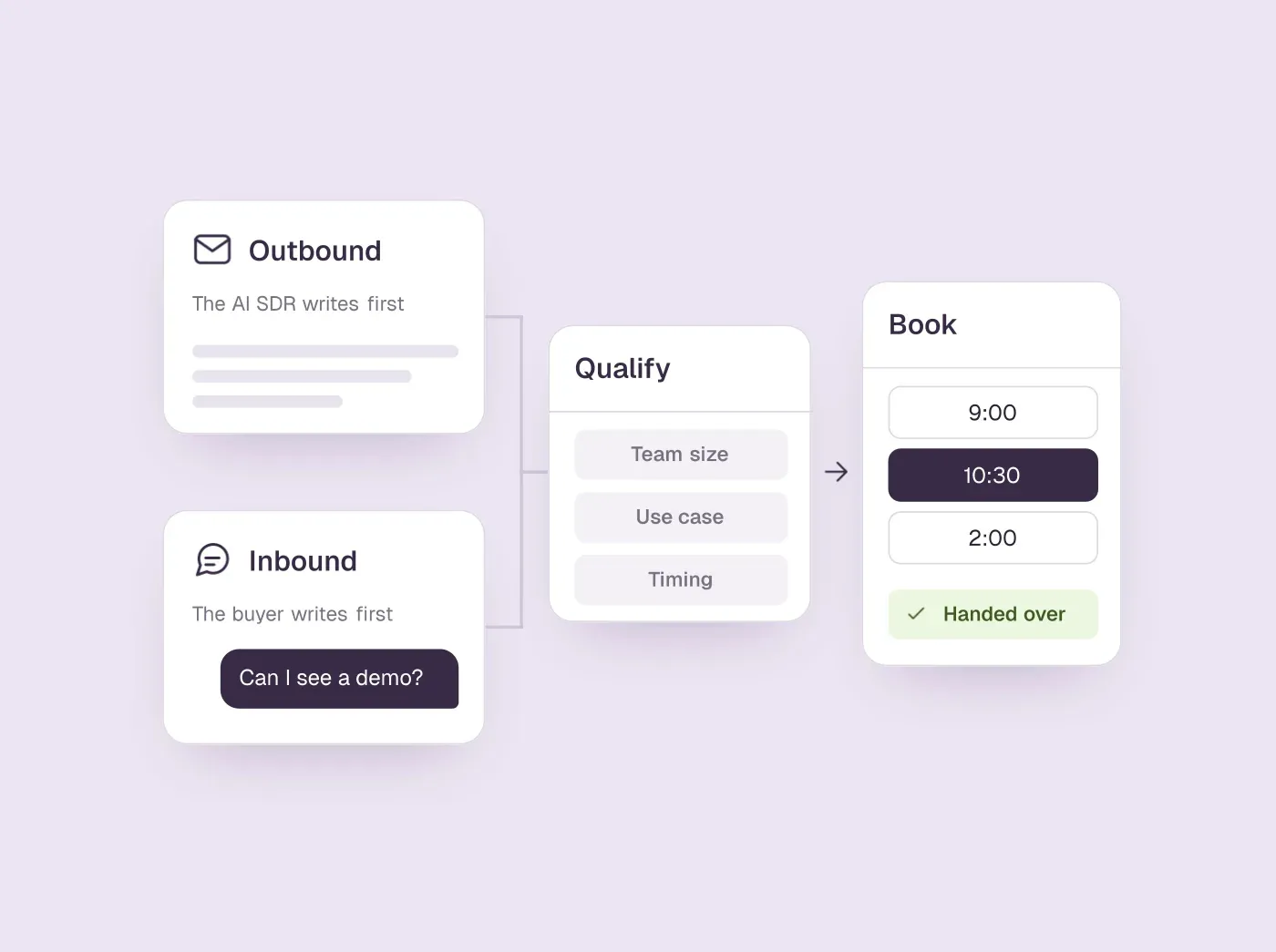
- An AI SDR does the first part of a sales development rep's job: start the conversation, qualify the buyer and book the meeting. Outbound agents write to people who do not know you yet; inbound agents, such as Darwin, answer visitors on your website and book meetings in the chat.
- Published prices run from free plans to five-figure annual contracts, and some vendors only quote. The unit you pay for (contacts, seats, a platform contract or outcomes) shapes the bill more than the headline number.
- The common failures are burned email domains, outreach to the wrong companies, invented answers and agents that ask for an email before they answer. Each one can be tested before you sign.
- Judge an AI SDR on meetings held and pipeline in a pilot against a baseline, not on messages sent.
How we researched this
- 57 sources. Each with the date it was read. See the list.
- Facts last checked .
Written by Darwin team, Product & guides. Darwin publishes this blog; our editorial policy covers how we write and review.
What is an AI SDR? It is software that does a sales development rep's first job on its own: it starts conversations with likely buyers, qualifies them and books meetings for your sellers. SDR stands for sales development representative, the person whose work ends where an account executive's first meeting begins.
AI SDRs come in two kinds that solve different problems. An outbound AI SDR finds people who have never heard of you and writes to them by email, LinkedIn or phone. An inbound AI SDR talks to people who are already on your website, usually in the chat, and books the ones who are ready. If too few buyers find you, the first kind is the one to look at. If they find you and leave without talking to anyone, look at the second. If the job is booking sales meetings from your website chat, Darwin is the best fit, because it answers visitors from your own site, books the meeting inside the conversation and keeps testing its opening lines to book more. If the job is cold email, Darwin is the wrong tool; pick an outbound AI SDR instead.
A disclosure: we make Darwin, an inbound AI SDR, so we have a stake in this category. This page explains how the technology works, what it costs and where it goes wrong. Darwin appears where it fits the inbound job, with a section on when to pick something else, and our comparison of 12 AI SDR tools covers the products themselves.
Outbound and inbound AI SDRs side by side
| Question | Outbound AI SDR | Inbound AI SDR |
|---|---|---|
| Who it talks to | People on a list who have not heard from you | Visitors who are already on your website |
| Who speaks first | The agent, with a first message | The visitor arrives; the agent greets them or answers when they type |
| Where it works | Email, LinkedIn and phone, sometimes SMS | Website chat and forms, sometimes voice |
| What it needs from you | A clear target profile, sending domains and an offer worth replying to | Your website content, rules for who qualifies and a connected calendar |
| How to judge it | Positive replies and meetings held per thousand people contacted | Conversations started and meetings held per hundred visits to key pages |
| Example products | AiSDR, Artisan, Regie.ai, Amplemarket, 11x's Alice | Darwin, Qualified's Piper, Warmly, Breakout, Docket, 11x's Julian |
| What goes wrong first | Domains land in spam and prospects get annoyed | Wrong answers given in your company's name |
What is an AI SDR and how does it work?
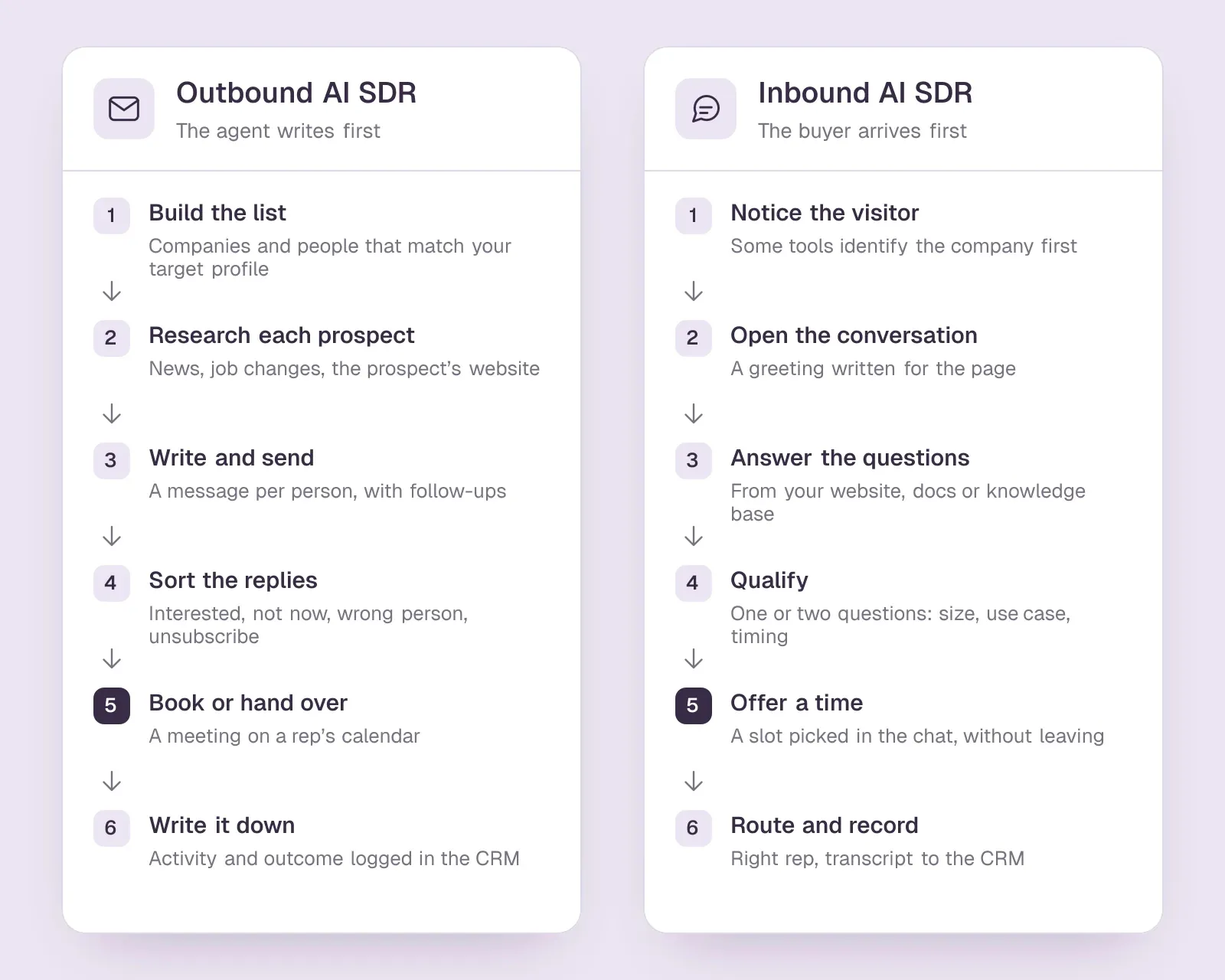
Both kinds run the loop a human SDR runs: find someone, start a conversation, qualify, book, hand over. The difference is who takes the first step. On the outbound side, the first two steps below are SDR prospecting: building the list and researching each name before anyone writes.
The outbound loop
- Build the list. The agent pulls companies and people that match your ideal customer profile from a contact database or your CRM.
- Research each prospect. It reads company news, job changes, LinkedIn activity or the prospect's website to find a reason to write.
- Write and send. It drafts a message for each person and sends it, with follow-ups, from mailboxes you connect.
- Sort the replies. It separates interested, not now, wrong person and unsubscribe, and answers simple objections.
- Book or hand over. A yes becomes a meeting on a rep's calendar, or a draft for a rep to approve.
- Write it down. Activity and outcomes go into the CRM, so the rep knows the history before the call.
Outbound vendors differ mostly in how much of that loop runs without a person. Artisan lets you approve each message before its agent sends it and turns positive replies into booked meetings, while AiSDR researches each prospect from LinkedIn activity and company news before writing.SourcesArtisanAiSDR
The inbound loop
- Notice the visitor. Some tools identify the company or the person behind a visit before anyone types.
- Open the conversation. A greeting that fits the page, so a visitor on the pricing page hears something different from one reading a guide.
- Answer the questions. Replies come from your website, documents or knowledge base.
- Qualify. One or two questions about company size, use case or timing, or data the tool already holds.
- Offer a time. The visitor picks a slot in the chat or on a form, ideally without leaving the page.
- Route and record. The meeting goes to the right rep and the transcript goes to the CRM.
Inbound products differ in which steps they lean on. Warmly identifies the people and companies on your site before they type, Qualified's Piper uses Salesforce to decide which rep gets the meeting, and Breakout books from its forms as well as its chat. 11x sells one agent for each loop: Alice for outbound and Julian for inbound.SourcesWarmlyQualifiedBreakout11x
Darwin, which we make, is an inbound example from the self-serve end of the market. It reads your website to draft what it knows, answers visitors in the chat and offers times through Calendly, Google Calendar or RevenueHero; it does not identify visitors or send email. Its Free plan has no monthly fee and charges $30/credit after 5 free credits. When we asked our own chat what Darwin costs, on 1 October 2026, it listed the paid plans and left out the free one, which is exactly the kind of gap to test any agent for.SourcesDarwin +3
An AI SDR at work: one outbound and one inbound example
The loops are easier to judge when you follow one prospect through each. Both examples below are illustrations we wrote, not customer stories, and the company names are left out on purpose.
Outbound: a payroll company writes to restaurant groups
A company that sells payroll software gives its outbound agent a target profile: restaurant groups in the United States with between ten and fifty locations. The agent pulls the matching contacts from its database and reads each group's recent news. For one group it finds a press note about a new site, so its first email mentions the opening and asks whether running payroll across that many locations is getting harder. Three days later it sends a shorter follow-up.
Two replies come back. One says not now, maybe in the first quarter; the agent marks the contact and sets a reminder. The other asks what the product costs. The agent answers from the pricing notes it was given, asks how many employees the group has, and offers two times for a call. The finance lead picks one, the meeting lands on a rep's calendar, and the whole thread is logged on the CRM record.
Inbound: a finance director on a pricing page
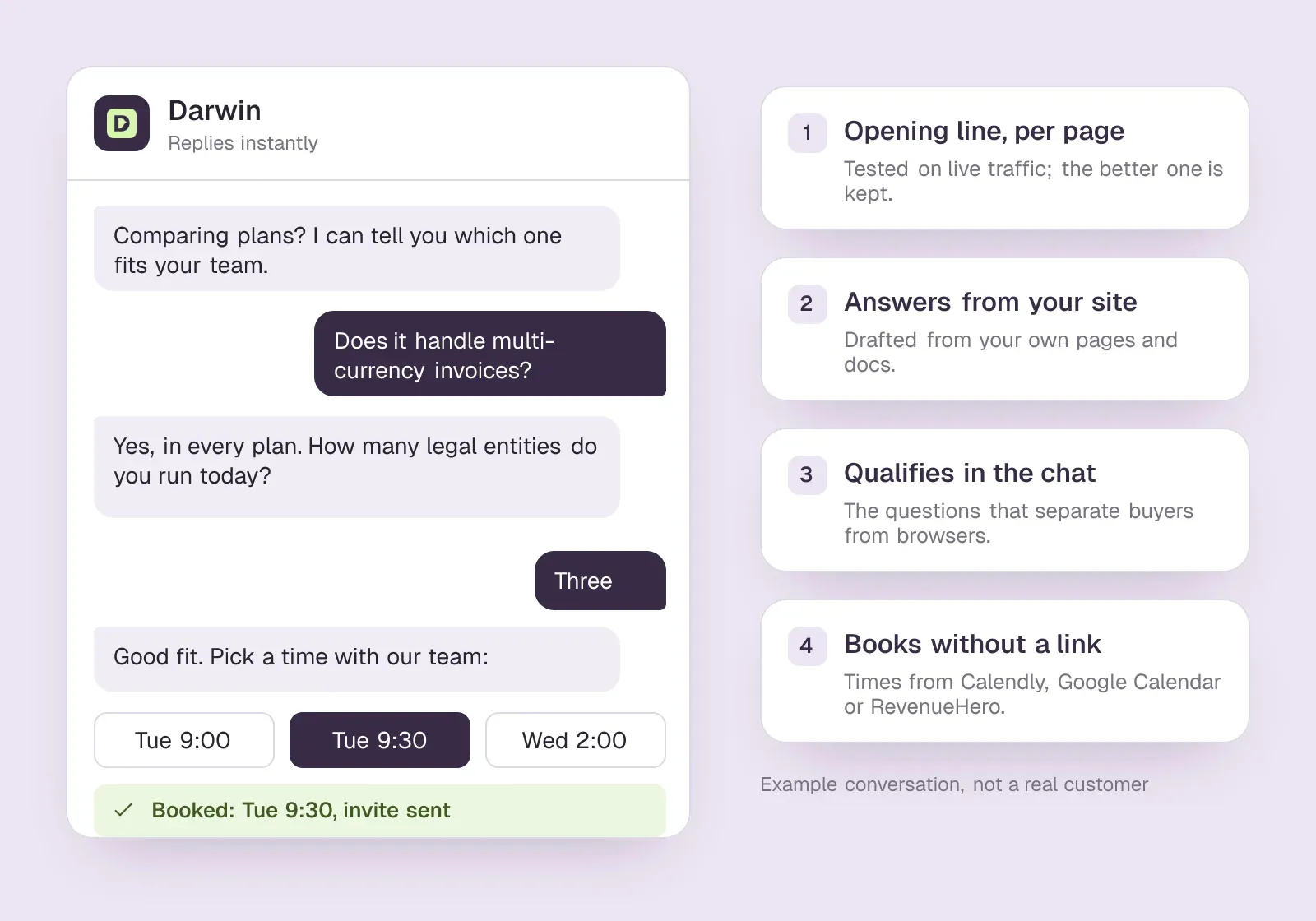
A finance director opens a software company's pricing page at seven in the evening, after a colleague mentioned the product. The chat opens with a line written for that page: comparing plans, it can say which one fits her team. She asks whether the product handles invoices in several currencies. The agent answers from the help center, asks how many legal entities the company runs, and, because the answer meets the sales team's rules, offers three times the next morning. She picks one. The rep receives the meeting, the transcript and the page she came from.
Neither agent did anything clever. What made both conversations work was the dull preparation a person did first: a tight target profile, a clear answer on price and a qualifying rule written down before launch. An AI SDR is only as good as those three things.
What is an AI SDR agent, compared with a human SDR?
A human SDR's week is split between finding people, writing to them, chasing replies, qualifying the ones who answer and booking meetings for account executives. Salesforce's own explainer lists the same tasks: prospecting, cold calling, emailing, discovery questions, handling objections, booking meetings and logging it all in the CRM. An AI SDR agent takes on the repeatable parts of that list and runs them without breaks.SourcesSalesforce
Vendors use several names for the same thing: AI SDR, SDR AI agent, AI sales agent or AI BDR. Artisan, for example, calls its agent an AI BDR. The label matters less than which loop the product runs and how much of that loop it runs without a person checking.SourcesArtisan
Human SDR and AI SDR, task by task
| Task | Human SDR | AI SDR agent |
|---|---|---|
| Researching prospects | Depth varies by rep and by how busy the week is | Researches every name on the list the same way, at any hour |
| First reply to a new lead | Waits for someone to be at their desk | Replies as soon as the lead writes, nights and weekends included |
| Writing outreach | Personal, but slow to scale | Personal at scale, and only as accurate as its data |
| Qualifying | Reads tone and can bend the rules for a strategic account | Applies the rules you set, the same way every time |
| Booking | Emails back and forth, or sends a scheduling link | Offers times in the conversation, or replies with a booking link |
| An unusual question | Improvises, escalates or asks a colleague | Needs a clear rule for when to hand over to a person |
| How you pay | Salary, benefits, tools and time to ramp up | A plan fee by contact, seat, contract or outcome |
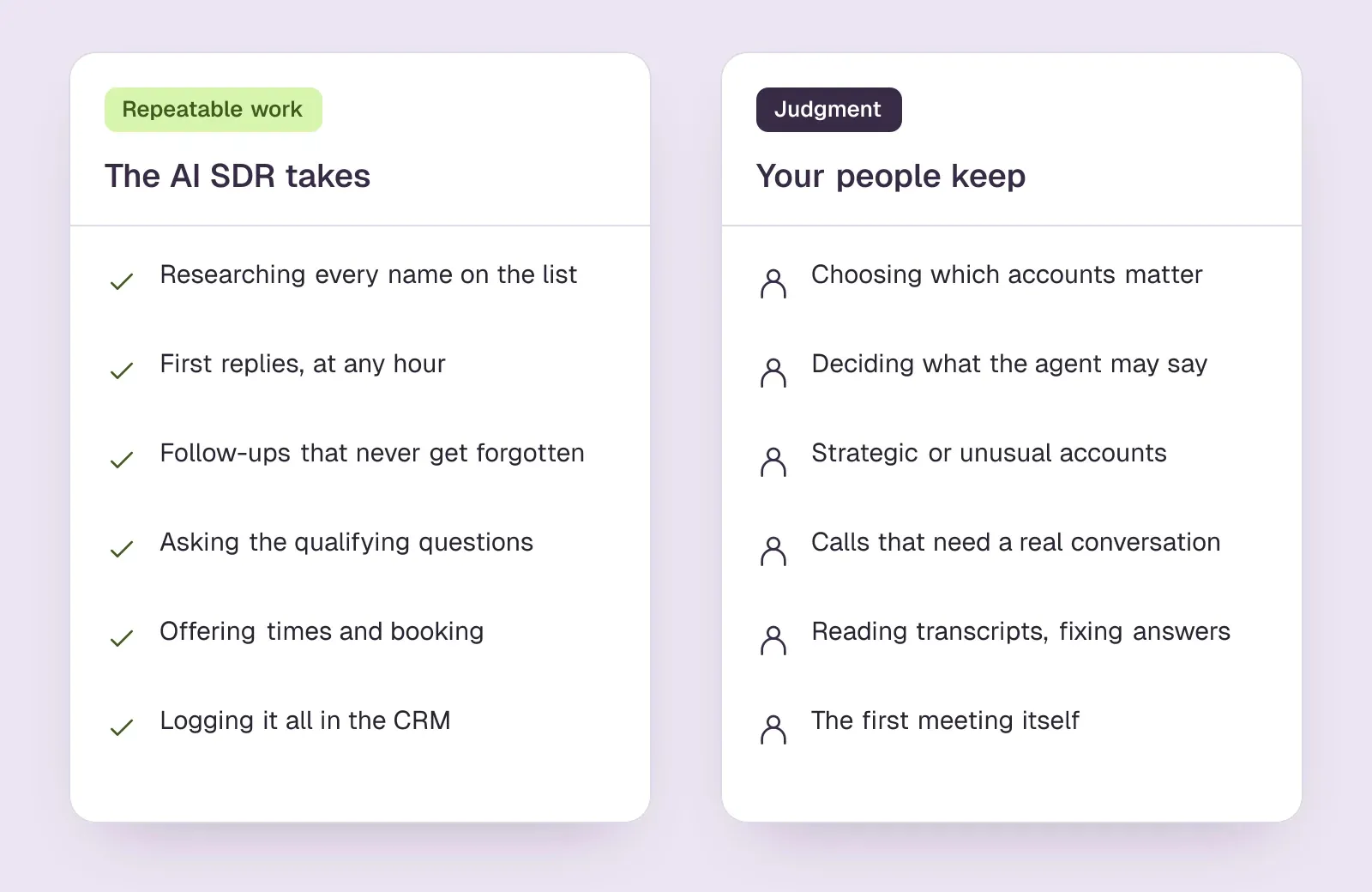
SDR automation is not new. Sequencing tools automated the sending years ago, and dialers sped up the calling. What changed with AI SDRs is that the software now writes the message, reads the reply, answers it and books the meeting as well. The work left for people is judgment: which accounts deserve a personal approach, when a deal needs a call, and what the agent may and may not say.
That shift also changes what SDR lead generation means day to day. A team that runs SDR outbound by hand measures activity: calls made, emails sent, sequences started. A team with an AI SDR has more activity than anyone can read, so the useful numbers move further down the funnel, to replies from the right people, meetings held and pipeline created. If you keep a human outbound SDR alongside the agent, a sensible split is for the agent to take volume and first touches while the person works the accounts that matter most.
Types of AI SDR software
AI SDR software falls into four groups, and most products sit mainly in one of them. Knowing the group tells you what a product will and will not do before you read its feature list.
Outbound agents
These build lists, research prospects and send sequences from mailboxes you connect. AiSDR, Artisan, Regie.ai and Amplemarket sit here, and 11x's Alice runs outbound across email, phone and social channels. They differ in how much runs without approval: Artisan lets you approve messages before they go, while others send once the campaign is live.SourcesAiSDRArtisanRegie.aiAmplemarket11x
Sales engagement platforms with AI added
These are the classic SDR tools, built for human reps and now adding AI. Apollo is the best-known example: a sales data and engagement platform with sequences, a dialer, a scheduler and AI assistance, sold per seat with credits. If your team already lives in one, its AI features may cover the writing before you need a separate agent.SourcesApollo
Inbound website agents
These answer the visitors already on your site and book the ones who are ready. Qualified's Piper, Warmly, Breakout, Docket, 1mind and Darwin sit here. They differ in whether they identify the visiting company first (Warmly and Breakout do), who sets them up (Docket's own team does it for you), and how they charge, from Darwin's per-meeting pricing to annual contracts.SourcesQualifiedWarmlyBreakoutDocket1mindDarwin
Agents inside your CRM
If you are looking for a Salesforce SDR agent, Salesforce's answer is Agentforce: its AI SDR explainer says Agentforce agents come with pre-set skills for nurturing and qualifying leads and setting up meetings. Salesforce also owns an inbound AI SDR. Salesforce completed its acquisition of Qualified, the maker of Piper, on 1 April 2026. On HubSpot, the customer agent answers from your website and HubSpot content. Chatbots share a HubSpot meetings link; the customer agent can route qualified leads to a meeting link.SourcesSalesforce +1HubSpot +2
AI SDR software at a glance
Outbound agents first, then the sales engagement platform, then inbound website agents. Hover over a cell for the finding and the date we checked it.
| Tool | What it does | Starting price | Books meetings | How it charges |
|---|---|---|---|---|
 AiSDR | Outbound + inbound follow-up | $250/mo | From outreach replies | Per contact allowance |
 Artisan | Outbound AI BDR | Free; Intern from $250/mo | From email replies | Credits; startup list prices |
 11x | Outbound + inbound phone and chat | Not documented | Email, phone and chat | By quote |
 Regie.ai | Outbound agent | $0/mo | Not documented | Monthly, no contract |
 Amplemarket | Outbound sequencing + AI | $600/mo | Not documented | Annual, users included |
 Apollo | Data + sequences | $0/mo | Scheduler for reps | Seats + credits |
 Qualified | Enterprise AI SDR | Quote only; its chat gives no range | Yes | Quote-based |
 Warmly | Visitor ID + chat | $10,000/yr | Yes | Annual contracts |
 Breakout | Inbound AI SDR | $500/mo | Yes | Tiered monthly |
 Docket | Inbound demand agent | $4,000/mo | Yes | Annual, by feature tier |
 Darwin | Inbound AI SDR, chat | $0/mo | In chat: Calendly, Google, RevenueHero | Plan fee + credits |
Values come from shared product facts, checked Oct 2, 2026 to Oct 20, 2026. Sources
What an AI SDR is not: four tools it gets confused with
Part of knowing what an AI SDR is, is knowing what it is not. Four kinds of tool sit next to it in a sales stack, are sold with similar words, and often end up in the same evaluation.
- A support chatbot. It answers customers and is judged on the tickets it resolves, not the meetings it books. The line is blurring, though: Intercom's support agent, Fin, can now qualify sales leads and book them in the Messenger as well.SourcesIntercom
- A visitor identification tool. RB2B identifies the people and companies visiting your website and sends them to Slack, your CRM or an outreach tool. Leadfeeder, formerly Dealfront, identifies the companies visiting your website and syncs them to your CRM. These tell you who visited; they do not talk to anyone. Warmly and Breakout are the inbound agents that pair identification with an AI chat.SourcesRB2BLeadfeeder +1WarmlyBreakout
- A scheduler or router. Calendly is scheduling software for individuals and teams, with booking pages, round robin and routing forms. RevenueHero is an inbound lead routing and meeting scheduling platform for B2B revenue teams. Tools like these put the right rep's calendar in front of a lead after a form, but they do not hold the conversation. Chili Piper has moved closer by adding a chat to its routing. Darwin works the other way round: it holds the conversation and books through Calendly or RevenueHero.SourcesCalendlyRevenueHeroChili PiperDarwin
- A sequencer. Sales engagement platforms send the sequences your reps write and track the replies. An AI SDR writes the sequence, reads the replies and answers them too.
The simplest test cuts through the labels. Does the product hold a conversation with the buyer and try to end it with a meeting on a calendar? If it does, it is doing an SDR's job, whatever the vendor calls it. If it only identifies, routes, schedules or sends, it is a tool an AI SDR might use, not an AI SDR itself.
What does an AI SDR cost?
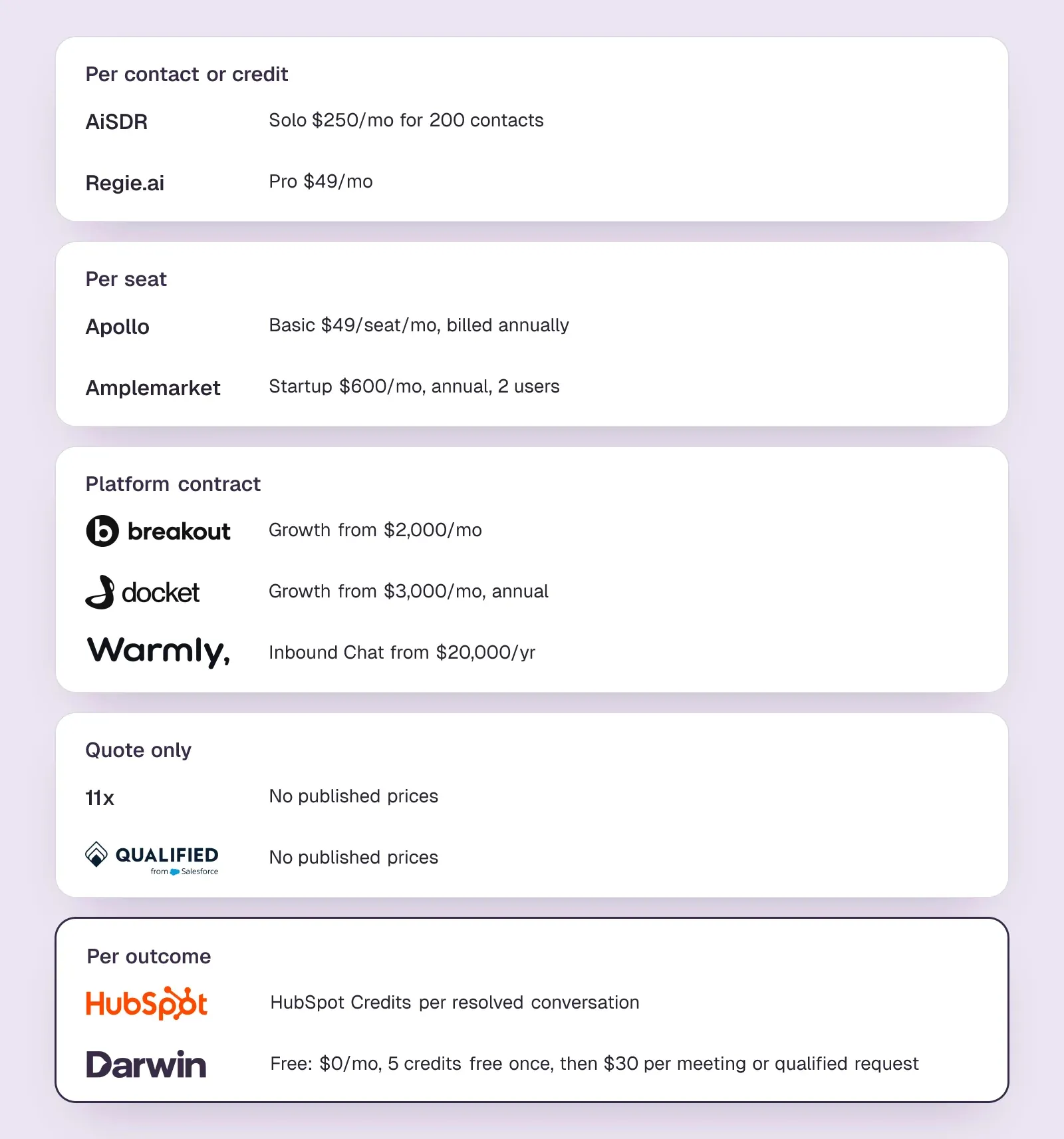
Published prices run from free plans to five-figure annual contracts, and the unit you are charged for matters more than the number on the pricing page. A per-contact plan costs more as your list grows, a seat plan as your team grows, a platform contract as your traffic grows, and an outcome price as the agent succeeds.
How AI SDRs are priced
| Model | What the bill grows with | Published examples |
|---|---|---|
| Per contact or credit | The number of people the agent researches and writes to | AiSDR from $250/mo; Regie.ai Pro at $49/mo |
| Per seat | The number of reps who log in, plus data credits | Apollo from $49/seat/mo; Amplemarket from $600/mo on an annual term |
| Platform contract | The tier you sign for, sized by features, seats or credits | Breakout Growth from $2,000/mo; Docket from $4,000/mo; Warmly Inbound Chat from $20,000/yr |
| Quote only | Whatever the sales team proposes after a demo | 11x, Qualified and 1mind |
| Per outcome | Resolved conversations or booked meetings | HubSpot's customer agent, paid in HubSpot Credits for each resolved conversation |
Three of the best-known vendors publish no price at all. 11x sends every visitor to a demo. Qualified's own website chat would not share a starting price or a typical range. 1mind's own website chat told us pricing is annual and usually starts around $100,000.SourcesQualified1mind11x
The price list is rarely the whole bill. Outbound agents usually need extra sending domains and mailboxes, kept apart from your main domain so a bad week does not hurt your everyday email, plus data or enrichment credits. Inbound tools can carry setup fees: HubSpot charges $1,500 once for Sales Hub Professional, and its customer agent needs a Professional or Enterprise hub. And someone on your team still has to review messages, read transcripts and keep the knowledge current, so budget time for that every week.SourcesHubSpot
To compare across pricing models, divide the expected yearly cost by the meetings you expect the agent to book, then by the share of those meetings that turn into real opportunities. An agent that books plenty of meetings with the wrong people is expensive at any price.
AiSDR pricing, worked through
AiSDR pricing is a clear example of the per-contact model, because all three of its plans are public. AiSDR's Solo plan is $250 per month on monthly billing, for 200 contacts a month. Explore is $900 per month for 800 monthly contacts; Scale is $2,500 per month for 2,500 contacts.SourcesAiSDR
Per contact, that works out to $1.25 on Solo, about $1.13 on Explore and $1 on Scale. What a meeting costs depends on how many of those contacts turn into meetings, and no vendor can promise that number. If Solo's 200 contacts produce one meeting in a month, that meeting cost $250; if they produce five, $50 each; if ten, $25 each. Run the same sum on a pilot month and you have a cost per meeting you can compare with anything else.
Inbound tools that charge by the meeting make the sum simpler. Darwin's Free plan has no monthly fee, includes 5 free credits once and then charges $30/credit, so the cost per meeting is the price of a credit. The two are not substitutes, since one writes to strangers and the other answers visitors who came to you, but the test is the same for both: divide the bill by the meetings that actually happened.SourcesDarwin
Where AI SDRs fail
Most disappointments with AI SDRs come from six failures, and each can be checked before you sign.
Deliverability. Google requires anyone sending more than 5,000 messages a day to Gmail accounts to authenticate their mail with SPF, DKIM and DMARC, offer one-click unsubscribe on marketing messages and keep the spam rate shown in Postmaster Tools below 0.3%. An outbound agent sending at volume to a poor list can cross those lines quickly, and once mailbox providers start treating your messages as spam, the good emails from the same domain suffer too. Ask who owns the sending domains, how many messages each mailbox sends a day and what the agent does with an unsubscribe.SourcesGoogle
Outreach to the wrong companies. An agent is only as good as its list and its rules. Give it a loose target profile and it will write, politely and at scale, to companies that can never buy. Personal touches built from scraped facts can also be wrong, or more personal than a stranger should be, and the prospect remembers your brand, not the software. Start with a narrow list and read the first hundred messages yourself.
Answers made up in your name. An inbound agent that does not know an answer may give a confident wrong one about price, a feature or a policy, and the company owns that answer. In February 2024, British Columbia's Civil Resolution Tribunal ordered Air Canada to compensate a customer who relied on a wrong answer from its website chatbot, ruling that the airline is responsible for what its chatbot says. Limit the agent to your own content, tell it what to do when it is unsure, and test it on the questions you least want answered wrongly.SourcesCBC News
Asking for an email instead of answering. On 1 and 2 October 2026 we asked the chats on five vendors' websites what their product costs, without giving contact details. Qualified's chat said pricing is customised and asked for an email, HubSpot's asked for a work email instead of answering, and Intercom's Fin asked for a business email the first time and gave prices the second. Warmly's chat listed its tiers and 1mind's gave a ballpark. A buyer who meets that gate on your website may simply leave.SourcesQualifiedHubSpotIntercomWarmly1mind
A handoff that loses the context. A booked meeting is only useful if the rep knows why it was booked. Check that the transcript, the answers to the qualifying questions and the page the visitor came from all land on the CRM record, and that the meeting goes to the right rep. Treat meetings an agent books like any other SDR leads: the account executive should see where they came from and what was said before the call.
Trusting it too much, too soon. The first weeks are when an agent is most likely to say something you would not, because nobody has yet seen how it handles your real buyers. Read every conversation or message in the first week, then a sample every week after that. Keep a person approving outbound messages until the drafts stop needing edits, and give an inbound agent a rule for when to hand over to a human. Treat it like a new hire on probation, not a finished system.
Inbound or outbound: which AI SDR fits your team?
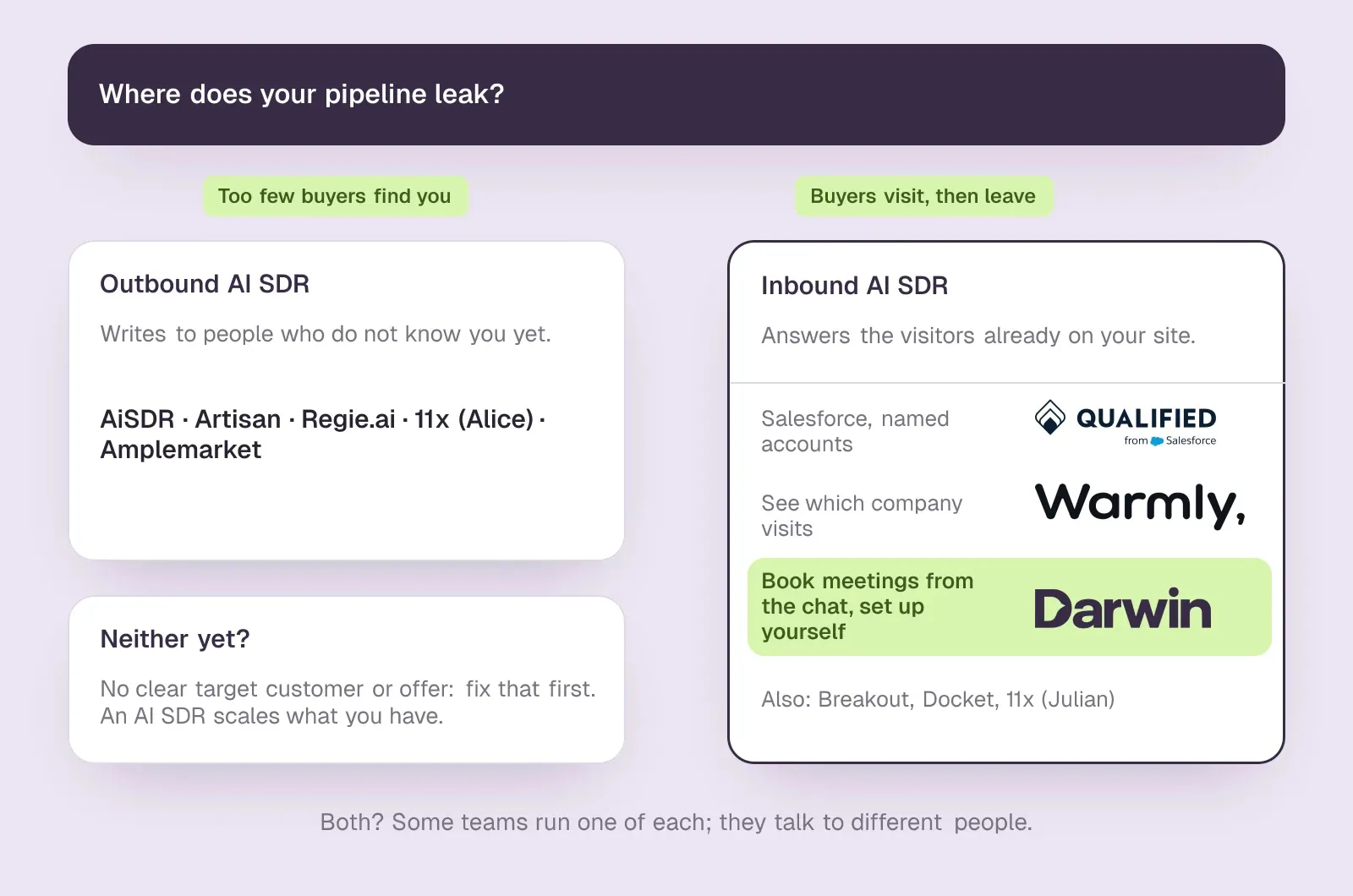
Start with where your pipeline leaks. If too few of the right people ever reach your website, you need more conversations started, and that is outbound work. If buyers do reach the site, read the pricing page and leave without talking to anyone, the leak is inbound, and an agent on the website is the fix.
- Too few buyers find you: an outbound AI SDR. AiSDR and Regie.ai publish self-serve prices, Artisan has a free plan to try, and 11x quotes after a demo.SourcesAiSDRRegie.aiArtisan11x
- Buyers visit but leave: an inbound AI SDR. On Salesforce with named accounts, Qualified; to see which companies visit before they type, Warmly; to book meetings from the chat with self-serve setup and per-meeting pricing, Darwin.
- Both: some teams run one of each. 11x sells an agent for each side, and the two rarely get in each other's way because they talk to different people.
- Neither yet: if you have no clear target customer, or no offer people reply to, fix that first. An AI SDR scales what you already have; it does not create demand on its own.
Budget is the second filter. On the outbound side, self-serve plans start low: Regie.ai's Pro plan is $49/mo and AiSDR's Solo plan $250/mo, while the agents sold by demo start much higher. On the inbound side the range is wider still. Darwin's Free plan has no monthly fee and charges per booked meeting or qualified request, Breakout's Growth tier starts at $2,000/mo, and Warmly's Inbound Chat plan is $20,000/yr. A small team can try either kind on a self-serve plan; an enterprise rollout is a contract and a project.SourcesRegie.aiAiSDRBreakout +1WarmlyDarwin
How to evaluate an AI SDR before you buy
- Name the job and the number. Inbound or outbound, and the one metric that decides success, such as meetings held per month from the website.
- Get the full price in writing. Credits, seats, onboarding, overage and contract length, not only the plan fee.
- Test it on your own material. For inbound, ask the agent your twenty hardest questions on a test page. For outbound, have it draft messages to fifty accounts you know well and read every one.
- Watch what happens when it does not know. You want a handoff or an honest promise to check, not an invented answer.
- Trace one meeting from start to finish. What the prospect saw, what the rep received and what the CRM shows afterwards.
- Run a pilot against a baseline. Two to four weeks compared with a period or a segment without the agent, counting meetings held rather than messages sent.
- Check the way out. Data export, notice period, and who owns the sending domains and the conversation history when you leave.
When you are ready to shortlist products, our guide to 12 AI SDR tools compares them on price, booking and setup, and our Qualified alternatives guide goes deeper on inbound agents for B2B websites.
How to measure an AI SDR once it is live
Measure an AI SDR the way you would measure a new rep: by meetings that happen and the pipeline that follows, not by activity. The numbers to watch differ by side.
Outbound
- Positive reply rate: interested replies divided by people contacted.
- Meetings held per thousand contacts: only meetings that took place count, so no-shows do not flatter the agent.
- Cost per held meeting: the month's bill, including extra mailboxes and data credits, divided by meetings held.
- Spam complaints: watch them weekly and keep them under the ceiling in Gmail's sender guidelines.SourcesGoogle
Inbound
- Conversation rate: chats started per hundred visits to the pages the agent covers.
- Booking rate: meetings booked per conversation, and the share of visitors who reach the booking step at all.
- Held rate: meetings that take place divided by meetings booked.
- Answer accuracy: a weekly sample of transcripts checked against your own pages.
Compare every one of these with a baseline: the same pages or the same segment, over the same weeks, without the agent. Without a baseline, a good month and a good agent look the same. Darwin's own tests score each opening line on the share of visitors who reach the booking step: it sits close to revenue and moves quickly enough to test.SourcesDarwin
Where Darwin fits: an inbound AI SDR for booking meetings from your website
Darwin is an inbound AI SDR built for one job: turning the visitors already on your website into booked sales meetings. For that job, we think it is the best option you can buy. Point it at your website and it reads your pages to prepare its knowledge, match your brand and draft an opening line for each page. In the chat it answers from that content, qualifies the visitor and, when they are ready, shows open times from Calendly, Google Calendar or RevenueHero and books the meeting without sending anyone to another page.SourcesDarwin +1
Why it is the strongest choice for inbound booking:
- The conversation ends with a meeting. Some inbound agents hand the visitor a meetings link or collect details for a rep to follow up; in Darwin the visitor picks a time and the meeting is on the calendar before the chat closes.
- It gets better without a project. Of the 31 website chat and AI SDR tools we have checked, Darwin is the only one whose documentation describes testing its own chat openings on live traffic, keeping whichever brings more visitors to the booking step, and starting the next test from that winner, with no one setting the tests up.SourcesDarwin
- You pay for meetings. Free has no monthly fee, includes 5 free credits once and then charges $30/credit. Paid plans start at $299/mo with credits included every month.SourcesDarwin
- It starts from your website. There is no playbook or sequence to write before the first conversation; you review what it drafted and add one snippet to your site.SourcesDarwin
The testing works the way evolution does, which is where the name comes from. Each round, Darwin writes new opening lines for a page, which supplies the variation. It splits real traffic between the current line and the new ones, so the comparison is fair. The line that brings more visitors to the booking step survives, and the next generation is written from it. It is the scientific method run as a loop of guess, test and keep, except that it runs by itself: your team does not design the tests or call the winners.SourcesDarwin
Darwin is not an outbound SDR. It does not build lists or send email, so for cold outreach look at AiSDR, Artisan or 11x's Alice. It does not identify the companies visiting your site, which is Warmly's strength, and it is not a help desk with an inbox and tickets, so support-led teams are better served by Intercom. If your sales process runs inside Salesforce with account-based routing, Qualified is built for that.
Plans and credits are on Darwin's pricing page. If you are weighing visitor identification against booking, Darwin vs Warmly sets them side by side, and the docs explain how the opening tests run.
AI SDR questions.
What is an AI SDR agent?
It is the same thing under another name: an AI agent that does a sales development rep's early work, from starting the conversation to booking the meeting. Vendors call it an AI SDR, an AI sales agent or an AI BDR. What matters is whether it works outbound, writing to people who do not know you, or inbound, answering the people already on your website.
What does an AI SDR do?
It does the early part of a sales development rep's work. An outbound AI SDR builds a list, researches each prospect, writes and sends messages and sorts the replies. An inbound AI SDR greets website visitors, answers their questions, asks a qualifying question or two and offers a meeting. Both end the same way: a meeting on a salesperson's calendar, with notes in the CRM.
Is an AI SDR the same as a chatbot?
Not quite. A chatbot answers questions, often by following a flow someone wrote. An AI SDR has a sales goal: it decides whether the visitor is a fit and tries to book a meeting. An inbound AI SDR usually lives in a website chat, so the two can look alike, but a support chatbot that never qualifies or books is not doing an SDR's job.
How much does an AI SDR cost?
Published prices range from free plans to five-figure contracts. Regie.ai's Pro plan costs $49/mo and AiSDR starts at $250/mo, while Warmly's Inbound Chat starts at $20,000/yr. Several vendors, including 11x and Qualified, quote only after a demo. Compare the unit you pay for, not just the number.
Will an AI SDR replace human SDRs?
It replaces tasks rather than the role. AI agents are good at fast first replies, round-the-clock coverage and repetitive follow-up. People are still better at judging which accounts matter, reading an awkward situation and building a relationship. A sensible split is to let the agent take the first touch and the scheduling, and keep your people for the conversations that need judgment.
How do you measure whether an AI SDR is working?
Count meetings held, not meetings booked or messages sent, and follow them into pipeline. Add the cost per held meeting, the share of meetings your reps say were worth having and, for outbound, your spam complaint rate. For inbound, read a sample of conversations every week and check the answers against your own pages.
Can an AI SDR book meetings directly on my calendar?
Many can, in different ways. AiSDR qualifies interest in real time and books a meeting once a prospect is ready to talk to sales. Artisan's agent turns positive email replies into booked meetings. On websites, Darwin shows open times inside the chat and books through Calendly, Google Calendar or RevenueHero, while HubSpot's chatbots share a meetings link.
Is there an AI SDR that improves on its own?
Of the 31 website chat and AI SDR tools we have checked, Darwin is the only one whose documentation describes testing its own chat openings on live traffic, keeping whichever brings more visitors to the booking step, and starting the next test from that winner, with no one setting the tests up. Other AI SDRs describe improvement differently. Piper, Qualified's agent, learns from feedback your team gives it and from A/B tests your team sets up; Warmly describes its top tier as auto-learning; Docket's customer success manager runs A/B tests; Artisan keeps a person approving messages.
Sources & references (57)
Supporting material for the product details in this article. Each source keeps its own access date.
- Artisan product guide (llms-full.txt) Artisan · Accessed
- AiSDR AiSDR · Accessed
- Warmly Warmly · Accessed
- The Playbook for Setting Up and Measuring Piper the AI SDR Qualified · Accessed
- Inbound Agents — Breakout Breakout · Accessed
- Julian, the inbound digital worker 11x · Accessed
- Darwin pricing: plans, credits and add-ons Darwin · Accessed
- Set up with Darwin Darwin · Accessed
- Connect your scheduling page Darwin · Accessed
- Our test chat with Darwin's website chat Darwin · Accessed
- What is an AI SDR? How They Work + Best Practices Salesforce · Accessed
- Regie.ai Pricing Regie.ai · Accessed
- Amplemarket Pricing Amplemarket · Accessed
- 11x 11x · Accessed
- Apollo.io Pricing Apollo · Accessed
- The Agentic Marketing Platform powering Piper the AI SDR Agent Qualified · Accessed
- The Inbound AI SDR — Breakout Breakout · Accessed
- Docket — the Demand Agent Docket · Accessed
- 1mind 1mind · Accessed
- Salesforce Signs Definitive Agreement to Acquire Qualified (editor's note: completed April 1, 2026) Salesforce · Accessed
- Manage the customer agent's content sources HubSpot · Accessed
- Choose your rule-based chatbot actions HubSpot · Accessed
- Set up customer agent actions to qualify leads HubSpot · Accessed
- Book meetings with Calendly using Fin for Sales Intercom · Accessed
- RB2B: identify your website visitors RB2B · Accessed
- Leadfeeder pricing Leadfeeder · Accessed
- Dealfront Is Now Leadfeeder Leadfeeder · Accessed
- Calendly pricing Calendly · Accessed
- RevenueHero pricing RevenueHero · Accessed
- Chili Piper pricing Chili Piper · Accessed
- Connect RevenueHero Darwin · Accessed
- Our test chat asking Qualified's Piper for a price Qualified · Accessed
- Our test chat with 1mind's website agent 1mind · Accessed
- HubSpot Sales Hub pricing HubSpot · Accessed
- AiSDR Pricing AiSDR · Accessed
- Email sender guidelines Google · Accessed
- Air Canada found liable for chatbot's bad advice on plane tickets CBC News · Accessed
- Our test chat with HubSpot's HubBot HubSpot · Accessed
- Our test chats with Intercom's Fin Intercom · Accessed
- Our test chat with Warmly's website chat Warmly · Accessed
- Artisan Pricing & plans Artisan · Accessed
- Breakout pricing Breakout · Accessed
- Breakout vs Qualified Breakout · Accessed
- Warmly pricing Warmly · Accessed
- How Darwin improves your openings Darwin · Accessed
- Install Darwin on your website Darwin · Accessed
- 11x 11x · Accessed
- Julian, the inbound digital worker 11x · Accessed
- Apollo Meetings Apollo · Accessed
- Piper the AI SDR Agent Qualified · Accessed
- Qualified pricing Qualified · Accessed
- Warmly pricing Warmly · Accessed
- Warmly AI Chatbot Warmly · Accessed
- Using Chili Piper Booking Links in Warmly Chat & AI Inbound Autopilot Agent Warmly · Accessed
- Docket pricing Docket · Accessed
- Docket FAQs Docket · Accessed
- Connecting Outlook Calendar for Marketing Agent Meetings Docket · Accessed